
Seven minutes into episode 107, I asked Ewelina Kurtys what a computer made of living neurons would change for security. I expected a list. She gave me a hedge and a reason.
“maybe not so many things change, because you will always have the silicon layer outside”
Ewelina Kurtys, at 7:34
Ewelina is a strategic advisor at FinalSpark, a Swiss company that’s trying to build computers out of living neurons, and the founder and chief executive of Ekai, her consulting company in the United Kingdom. Episode 107 of The Security Podcast of Silicon Valley aired on November 3, 2026 (Podbean, Apple Podcasts, Spotify, YouTube). I hosted this one without Sasha.
This page follows the conversation in order and checks it against the record: FinalSpark’s own paper and posts, and the press that has visited the lab. For the quantum side it uses the standards bodies. It has 14 figures, 7 clips from the tape, 2 more interviews, the full transcript, and 6 tools: a quiz, a scorecard for the outer layer of your own product, a calculator for what a model price increase does to your margin, a second calculator for what a 10-year product costs to reach, a timeline and a to-do list. Where the machine transcript was unclear, the transcript puts its best guess in square brackets, and this page doesn’t quote those words.
One note on dates. Nobody says on the tape when we recorded, so wherever Ewelina describes where FinalSpark stands, read it as where things stood when I recorded this.
Computers from living neurons
I introduced Ewelina as the founder and chief executive of Ekai. She steered straight to the other job.
“we are trying to build computers from living neurons”
Ewelina Kurtys, at 1:59
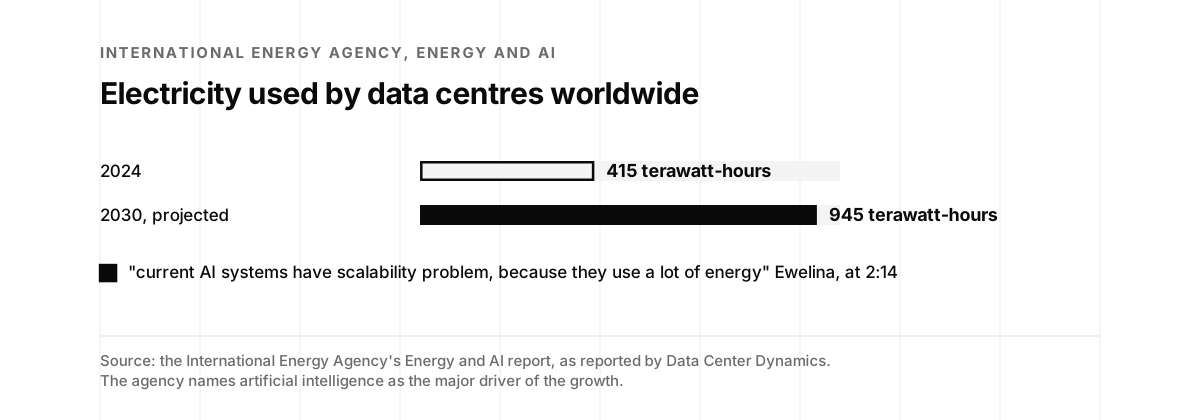
Her case for doing something that hard is about energy, and through energy, about cost. In her words, “current AI systems have scalability problem, because they use a lot of energy”, and if nothing changes, “we might have a huge problem of the cost”.
The record backs the first half. The International Energy Agency’s Energy and AI report puts the electricity used by data centres worldwide at 415 terawatt-hours in 2024 and projects 945 by 2030, with artificial intelligence as the major driver (Data Center Dynamics).
The second half is the part a founder should sit with. Ewelina thinks the price you pay for a model today doesn’t reflect what it costs to run.
“many models are underpriced, because they are during the adoption phase”
Ewelina Kurtys, at 2:33
She expects that to end: “we can expect that these prices might grow in the future”. She isn’t alone. In March 2026, Axios ran a piece headlined “Don’t get used to cheap AI,” reporting that OpenAI was projected to burn $14 billion in 2026 and quoting Writer’s chief executive, May Habib, on what the labs will do once they’re public companies: “they’re going to raise prices because they have to” (Axios).
If your gross margin depends on today’s price per token, that’s a risk you can put a number on. The calculator below takes your monthly model bill and your revenue and shows what a price increase does to the share of revenue you hand to a model provider. We wrote about the other end of the same problem, an agent that runs up a bill by itself, in Too Fancy.
1 million times less
Then she named the target.
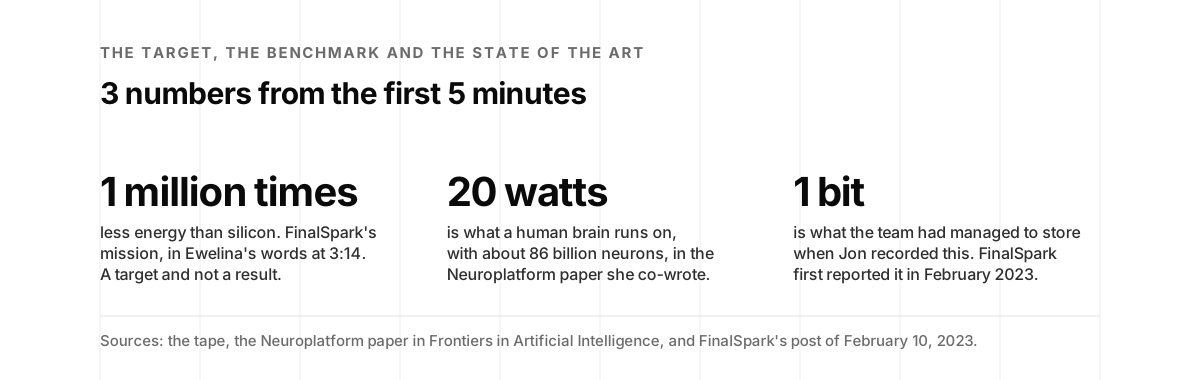
“which will use 1 million time less energy than silicon. That’s the mission.”
Ewelina Kurtys, at 3:13
I’d heard the comparison behind it before, and I said so on the tape: “a human brain generates almost no heat and has just incredible, immense computing power”. The paper that Ewelina co-wrote with FinalSpark’s founders gives it numbers. A human brain runs “86 billion neurons while consuming only 20 W of power” (Frontiers in Artificial Intelligence, May 2, 2024).
Two things keep that number honest. Ewelina called it the mission, which makes it a goal. And the comparison is between neurons and processors. A working system also has to keep the neurons alive. When The Register covered a FinalSpark demonstration in October 2024, the developer behind it, Daniel Burger, said the comparison still leaves out “supporting hardware like incubators and electrical stimulation systems” (The Register).
Skeptics ask the question more bluntly. When the field got its name, a Hacker News reader put it in 10 words.
"Are neurons really more efficient at computing than transistors?"
fvdessen, on Hacker News, March 4, 2024
Nobody can answer that for a full system yet, and Ewelina didn’t claim to. What she said next is the reason I trust the rest of her answers.
1 bit, and 10 years
I asked how far the technology is from a proof of concept. She didn’t oversell it.
“Currently we are at the stage where we managed to store one bit of information”
Ewelina Kurtys, at 4:37
That was the state of things when I recorded this. FinalSpark first reported the milestone on its own blog on February 10, 2023, writing that it could “reliably modify the network responses to store one bit of information” (FinalSpark). The lab has done more since. Its 2024 paper describes more than 1,000 organoids tested and 18 terabytes of recordings. In October 2024 a developer used the platform to steer a simulated butterfly. In July 2025, National Geographic reported that a University of Bristol team had used FinalSpark’s organoids to read Braille characters with 83% accuracy (National Geographic).
None of that is a product, and she said how long she thinks a product will take: “it will take us another 10 years to build a final product”. Her reason is that everything a programmer knows about silicon stops applying.
“So we have to figure out from scratch totally new approach”
Ewelina Kurtys, at 5:01
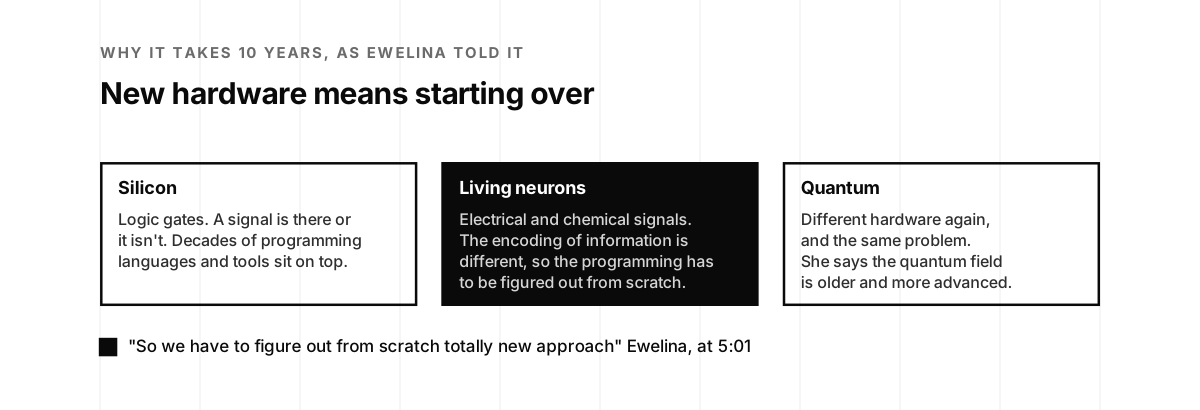
She has put it more sharply elsewhere. At a Neurofounders webinar in May 2026 she said, “Nobody knows how neurons encode information” (Neurofounders). A founder who says that in public, with a 10-year estimate attached, is doing the opposite of a hype cycle.
No contest with quantum
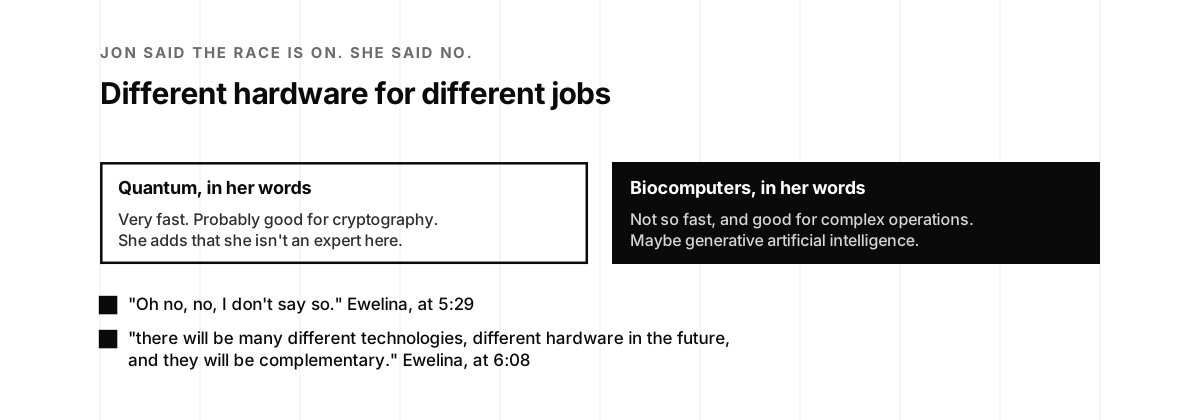
She’d compared the problem to quantum computing, which also has to work out its programming from scratch on new hardware. I jumped on it: “It sounds like the race is on quantum versus biocomputing.”
“Oh no, no, I don’t say so.”
Ewelina Kurtys, at 5:29
She’d only meant that both are new hardware. She expects the 2 to be used for different things. Quantum is very fast, so she thinks it will probably be good for cryptography, and she added a line I wish more guests would use: “I’m not an expert here.” Biocomputers are slower and, in her view, good for complex operations, maybe generative artificial intelligence.
“there will be many different technologies, different hardware in the future, and they will be complementary.”
Ewelina Kurtys, at 6:08
I closed the episode on the same thought, that this is “not competing at all with what’s coming in terms of quantum”. For a security leader, the practical version is that the 2 technologies put different questions on your desk, on different timelines. Quantum’s question has dates on it already.
What quantum does to security
This was my turn to make a claim.
“I think quantum computing is going to have a huge impact on the security community because of its implications for cryptography.”
Jon McLachlan, at 6:29
The algorithms I meant are the asymmetric ones that agree keys and sign things: RSA and Diffie-Hellman, along with the elliptic-curve family. A large enough quantum computer breaks them, and as I put it, “they’re going to go out the window”. Ewelina’s guess that quantum will be “good for cryptography” lands on the same fact from the other side.
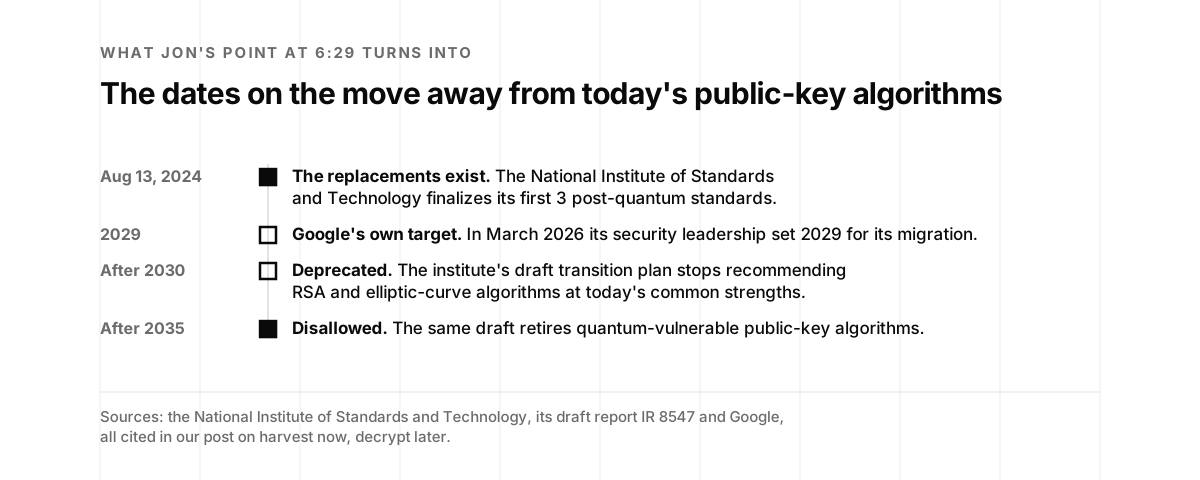
Here’s what the record says, with the sources in our post on harvest now, decrypt later. The replacement algorithms exist: the National Institute of Standards and Technology finalized its first 3 post-quantum standards on August 13, 2024. Google’s security leadership set 2029 as the target for its own migration. The institute’s draft transition plan would deprecate today’s common RSA and elliptic-curve strengths after 2030 and disallow quantum-vulnerable public-key algorithms after 2035.
The date nobody has is the day a quantum computer can do it. You don’t need that date to act, because an attacker can record your encrypted traffic today and decrypt it later. Michele Mosca’s inequality turns that into arithmetic.
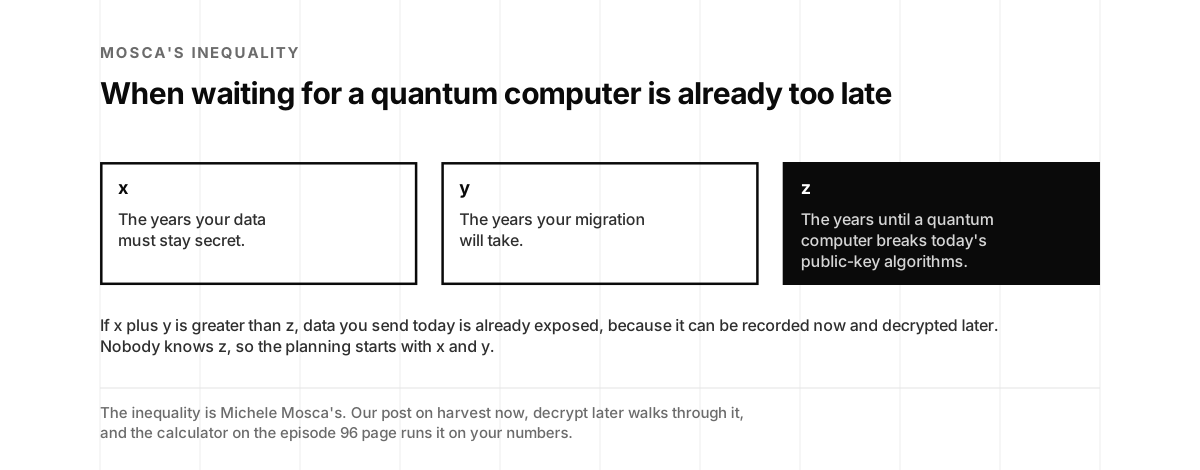
For a founder, this shows up in a sales cycle before it shows up in an attack. A buyer in government, defense, health or finance will ask what your plan is, and “we’re waiting to see” reads badly in a security questionnaire. Kevin Kane went deep on all of it in episode 96. That page has a scorecard for quantum readiness and a calculator that runs Mosca’s inequality on your numbers, so this one doesn’t repeat them. Kevin was also on 3 years earlier, in episode 32.
The outer layer is silicon
Then I asked the question this page opened with: does biocomputing have a more direct impact on security? Her first answer was about time.
“I think this is very long, very long perspective. It’s too early.”
Ewelina Kurtys, at 7:13
Her second was about architecture. In FinalSpark’s lab, “everything is interfaced with the silicon”, so “the outer layer is silicon, or generally electronics”. Whatever the neurons do, the outside world reaches them through ordinary computers.
I think she’s right, and the paper shows what that outer layer is made of. Researchers reach the Neuroplatform through a Python library and notebooks, over remote access, with the recordings kept in a database. Several outside groups share the same lab. An attacker looking at that sees credentials, an interface and a multi-tenant service, the things a security review already knows how to ask about.
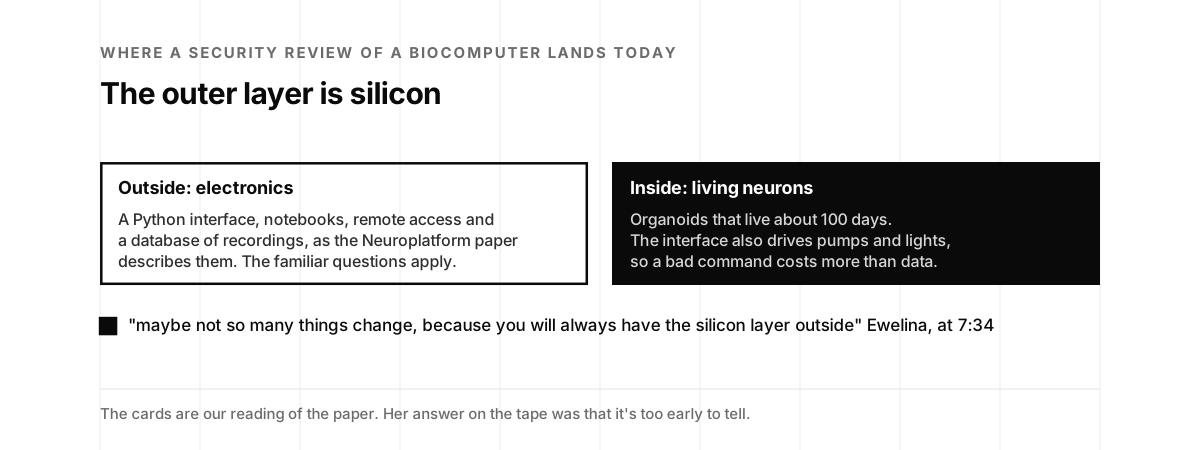
One thing is different, and it’s worth a founder’s attention even if you never touch a neuron. The same interface that reads the recordings also drives pumps and lights in a lab full of living tissue, and the paper says an organoid lasts about 100 days. A bad write to a database costs you data, where a bad command here can cost you the hardware, and the hardware takes months to grow. If your product’s interface can change something in the physical world, the questions about who can write, and what gets logged, weigh more than the questions about who can read. We made the same argument about agents in Are You Actually Going to Give the Agent Write Access?. The scorecard below turns this section into 8 questions about your own product.
Our own post about this episode took her answer to the buyer’s side of the table.
YSecurity's post for episode 107: her security answer, and what an enterprise buyer asks about an artificial intelligence product.
YSecurity · November 3, 2026
The point in that post holds for any new technology you sell. The buyer’s security team asks the familiar questions and the new ones, and for an artificial intelligence product the first new one is whether their data ever trains a model. We collected the rest in The 10 AI Security Questions Your First Enterprise Buyer Will Ask in 2027.
How she got here
Ewelina came to all this from biology. On the tape: “I did a PhD in neuroscience”, then London as a postdoc, which she called a “perfect place to leave academia”.
Her LinkedIn fills in the dates. She was a doctorate researcher at the University Medical Center Groningen from September 2011 to December 2015, working on brain imaging, and a postdoctoral researcher at King’s College London from September 2016 to September 2018 (LinkedIn). King’s still lists her papers, on imaging cancer immunotherapy and, in 2019, on engineering human induced pluripotent stem cells so they can be traced in the body (King’s College London). The cells FinalSpark’s neurons come from are the same kind.
Her first job outside academia was with a medical imaging company, and it’s where the other half of her career started: “this is how I learned about AI”. She began going to conferences, and at one of them, a summit on artificial intelligence in London, she met FinalSpark’s founders.
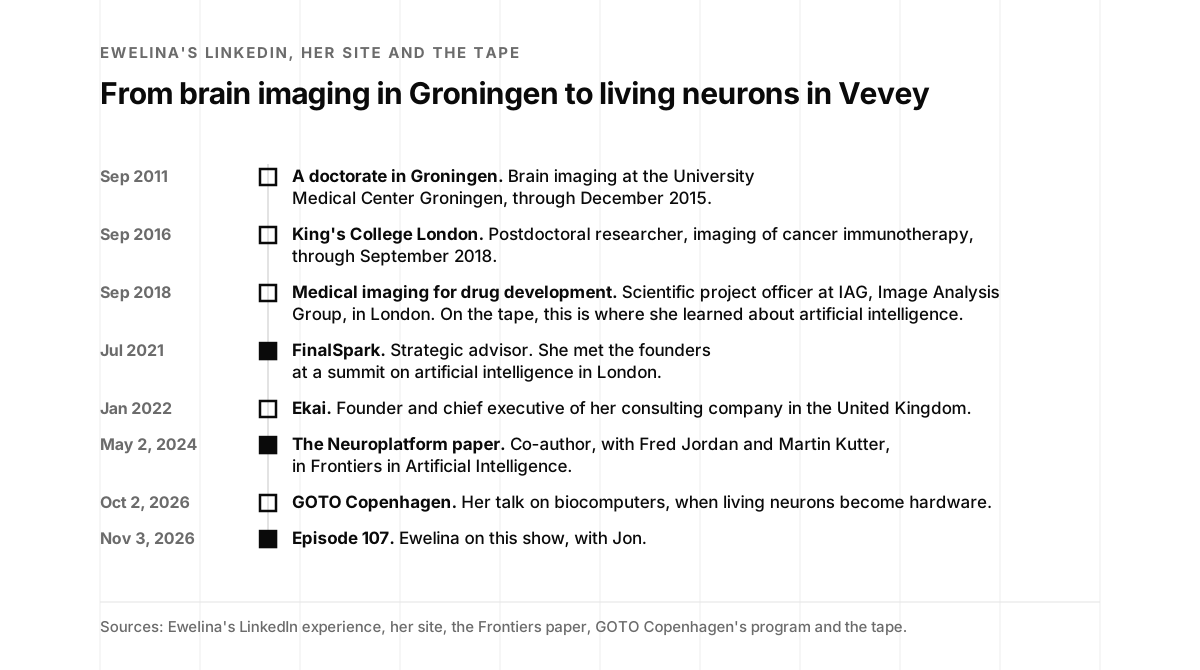
Since then she has built Ekai, her own company, and she’s a named author on the paper that introduced FinalSpark’s platform to the research world. Her site says she has recorded more than 100 online interviews. This one is the first, as far as I know, where the host mostly wanted to know about threat models.
How FinalSpark started
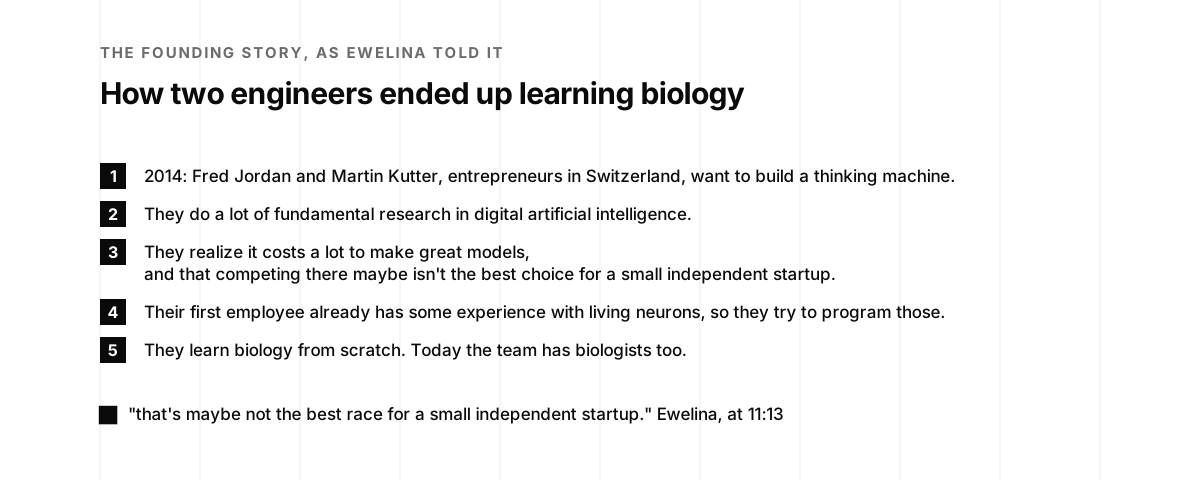
FinalSpark is older than most people guess. Ewelina dated it for me: “FinalSpark was founded in 2014.” The founders, Fred Jordan and Martin Kutter, are entrepreneurs in Switzerland with backgrounds in applied mathematics and engineering, and what they wanted, long before chatbots, was a machine you could have a conversation with. Her words: “they wanted to build thinking machine”.
They started where everyone starts, with digital artificial intelligence. Then they did the math on what it would take to win there.
“that’s maybe not the best race for a small independent startup.”
Ewelina Kurtys, at 11:12
So they looked for something more disruptive. Their first employee had some experience with living neurons, and the founders’ reaction, as she tells it, was “let’s try living neurons, let’s try to program them”. What followed is my favorite line in the episode: “They had to learn biology from the scratch.”
There’s a lesson here for any founder watching the model labs spend. When the main contest in your market costs more than you can raise, a small company’s advantage is being willing to do something the big ones won’t. It took FinalSpark 10 years to get from that decision to a paper and a platform that outside scientists could use.
FinalSpark Launches the First Remote Research Platform Using Human Neurons for Biocomputing
FinalSpark (@finalsparkai) · May 15, 2024
Python, for now
I asked whether they’d named the programming language yet. The answer gave the episode its title.
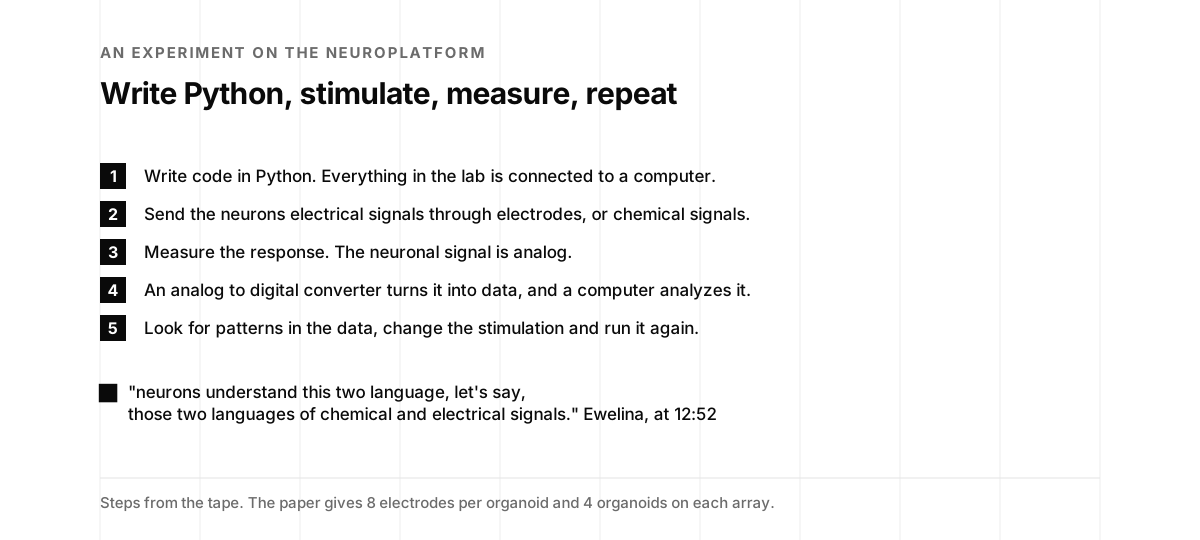
“you write a code in Python, and you can execute experiments on living neurons.”
Ewelina Kurtys, at 12:39
Everything in the lab is connected to a computer. From Python you can send the neurons electrical signals and measure the response. You can send chemical signals too. She has a nice way of putting why both matter.
“neurons understand this two language, let’s say, those two languages of chemical and electrical signals.”
Ewelina Kurtys, at 12:52
I pushed on what the data looks like. Computers are digital, and a neuron isn’t. “Is it analog?” I asked. It is, and it doesn’t stay that way for long: the signals “are transformed through analog to digital converter to the digital data”, and a computer does the analysis. The Neuroplatform paper gives the plumbing: 8 electrodes for each organoid and 4 organoids on each array, with recordings sampled at 30 kilohertz.
The hard part comes after the recording. When I asked how you represent data with biology, she said that for the moment it’s “data science and mathematics”, and “You have to figure out some patterns in the data.” I described it back to her as setting an initial state, letting it run and doing it again and again. She agreed.
Python is where this stands today. She was clear that it won’t be where it ends: “definitely we will need new way of programming”, because neurons “work in a different way than logic gates in silicon”.
If you’d like to hear the founders’ side of the same story, Fred Jordan walks through the lab in this interview from 2024.
Building blocks of a brain
I asked how FinalSpark’s work relates to the companies that put electrodes into people’s heads. Her answer drew a line I found useful. Those companies want to interact with a living human brain, which FinalSpark has no plans to do.
“We actually only use the building blocks of human brain, which are living neurons”
Ewelina Kurtys, at 15:35
In her description, the team builds “a different structure than brain” in the lab, out of the same parts. She allowed that the methods FinalSpark develops for talking to neurons might be useful to the implant companies someday, and she was plain about the limit: “that’s not our objective.”
Where the neurons come from
This was the question I most wanted to ask, and the answer was shorter than I expected.
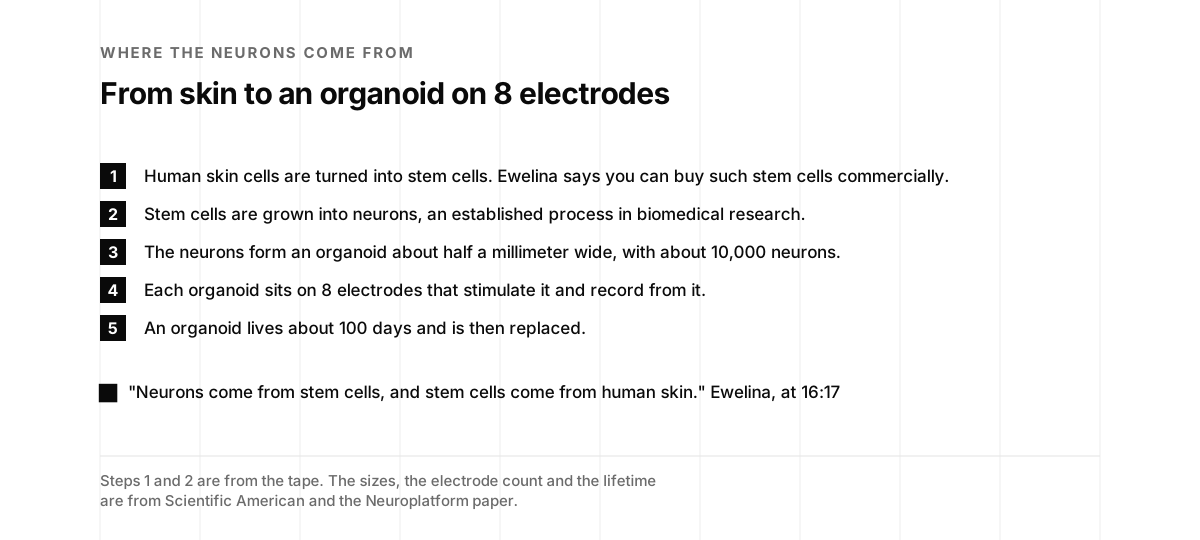
“Neurons come from stem cells, and stem cells come from human skin.”
Ewelina Kurtys, at 16:17
She added the context right away: “You can buy such a stem cells commercially.” It’s an established process in biomedical research, and in her words FinalSpark copies “what biologists are doing”. The process has a name, induced pluripotent stem cells, and the scientist who discovered it, Shinya Yamanaka, shared a Nobel Prize for it in 2012 (Wikipedia).
The press that has visited the lab adds the dimensions. Scientific American describes each organoid as about half a millimeter wide and made of about 10,000 neurons, connected to 8 electrodes, and living about 100 days (Scientific American).
There’s a question in here that a buyer’s questionnaire will get to eventually, in any business that works with human cells: where the cells came from, and under what consent. Cells carry a donor’s genome, and genetic data is the kind that has to stay private for a lifetime. I didn’t ask Ewelina about FinalSpark’s suppliers and she didn’t say, so take this as a note for your own vendor reviews. It’s the same shelf-life thinking as the quantum section, applied to a different kind of secret.
A bio server in 10 years
I asked her to predict, knowing it’s too early to predict. She did it anyway.
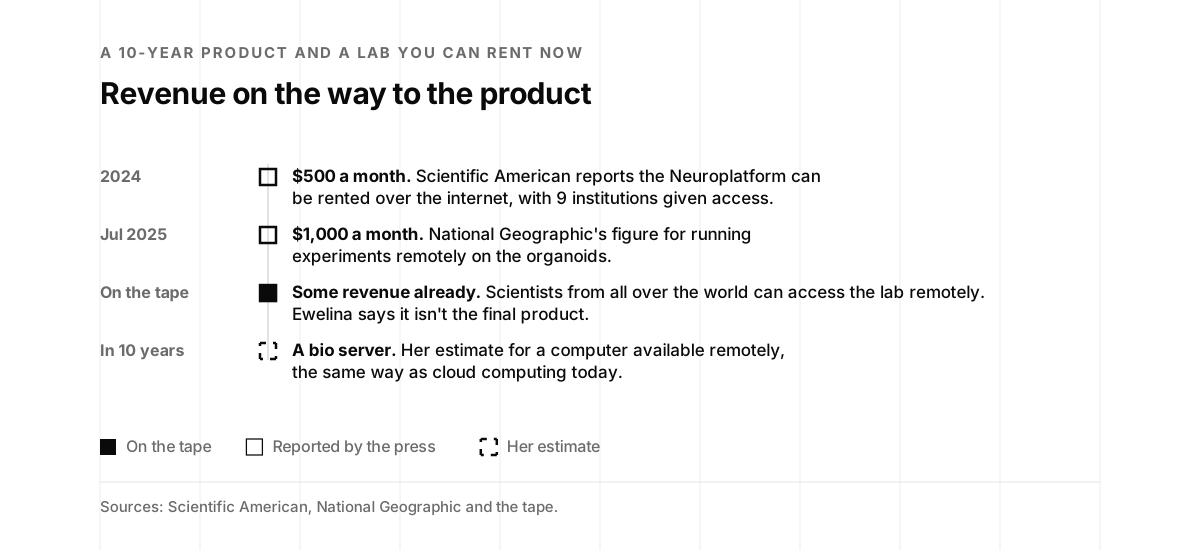
“we aim to build a bio server, a huge computer which will be available remotely, the same way as cloud computing today”
Ewelina Kurtys, at 17:02
She imagines that in about 10 years, and she’s careful about it: “of course it’s a long-term project”. I asked what investors ask. Everything, she said, and then named the hard one.
“usually many investors would like to see the results very quickly. But this is not a quick project.”
Ewelina Kurtys, at 18:22
What makes the wait survivable is that the lab itself is a product. When I recorded this, FinalSpark was already making some revenue from it, because “scientists from all over the world can access our lab, and they can do experiments remotely on living neurons”. I called it “providing experiments as a service”, and she agreed. The press has tracked the price: Scientific American reported $500 a month in 2024, with 9 institutions given access, and National Geographic reported $1,000 a month in July 2025.
Founders building anything slow should notice the shape of that. FinalSpark built a lab to do its own research, then rented the lab to other researchers. The tool you had to build for yourself is often the first thing someone else will pay for. The second calculator shows what that revenue is worth over 10 years. We wrote about why this kind of company can’t be rushed in What Is Deep Tech?, and Roei Ganzarski made a similar case from the hardware side in episode 103.
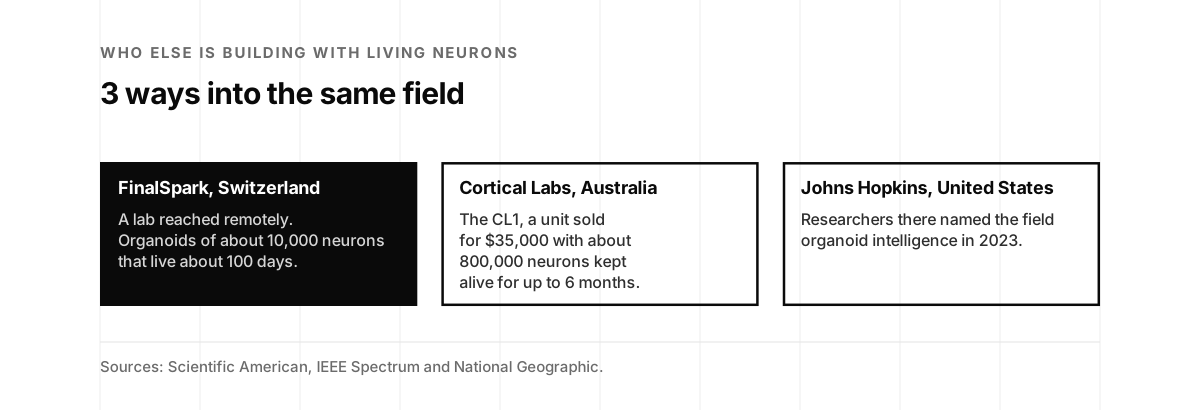
FinalSpark has company in the field. Cortical Labs in Australia sells a unit called the CL1 for $35,000, with about 800,000 neurons kept alive for up to 6 months (IEEE Spectrum). Researchers at Johns Hopkins gave the field its name, organoid intelligence, in 2023.
Ewelina tells the long version of the FinalSpark story in this interview.
Food and water
I asked whether a biocomputer needs a battery, thinking about the electronics. Her answer was about the other half of the machine.
“living cells always need food and water”
Ewelina Kurtys, at 19:46
The neurons have to be kept at the right temperature and fed, and they sit in a special liquid that the lab calls medium. An operations person hears that and thinks about uptime. A processor that needs feeding has a maintenance window built in, and the paper’s figure of about 100 days for an organoid means the hardware gets replaced on a schedule.
I asked what legacy she’d like to leave. She laughed it off, and then answered: “I think we just try to make a world a better place.”
The right problem to solve
A lot of founders listen to this show, so I asked a leading question. Is there a problem in the lab so painful she’d pay another company to solve it? I was hoping for a startup idea to hand to the audience.
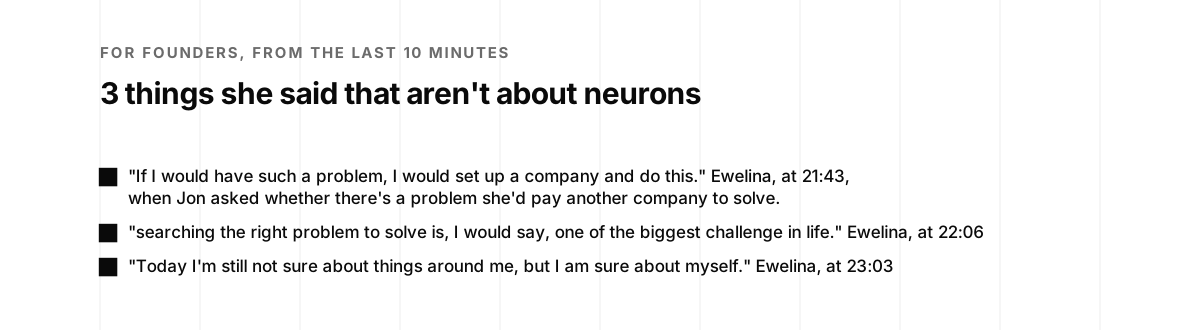
“If I would have such a problem, I would set up a company and do this.”
Ewelina Kurtys, at 21:43
All I could say was “Okay, that’s fair. That is fair.” Then she said the thing underneath it.
“searching the right problem to solve is, I would say, one of the biggest challenge in life.”
Ewelina Kurtys, at 22:06
Her point is that building has become easy. With so many tools, she said, it’s “so easy to do stuff actually now”. Knowing what to build is where the difficulty went. Every founder I talk to who’s shipping with coding agents says some version of this, and we argued it at length in The Art and Zen of Adopting AI.
Sure about myself
I asked what she’d tell her younger self. She’d tell her to be more confident, and the way she said it stayed with me.
“Today I’m still not sure about things around me, but I am sure about myself.”
Ewelina Kurtys, at 23:03
Research works that way, and so does starting a company. The world stays uncertain, and what you can settle is how you’ll act.
I asked why she got her doctorate. She’d always wanted to be a scientist, she said, and to be in interesting conversations, and the degree opened the door. She likes what the title allows: “when you are a scientist you can do a little bit crazy stuff”. And she likes hard problems for their own sake.
“I like to teasing my brain, you know, just to have some, something to, some problem to solve.”
Ewelina Kurtys, at 24:11
The philosophical question
For her last word she sent listeners to finalspark.com, and said the subject can be discussed “from engineering point of view, from scientific point of view, or also philosophical”.
I hadn’t thought about that last one, and I asked the obvious version. If you can turn neurons into a computer, what’s the difference between that and a human?
“Oh, I think there is huge difference, because we just using building blocks of brain, which are neurons.”
Ewelina Kurtys, at 25:31
An organoid is far from how a brain is structured, she said, and then she granted the other side: “But for some people look similar.”
The field takes that seriously. Lena Smirnova, the Johns Hopkins researcher whose group named organoid intelligence, told National Geographic, “we’re proceeding with a lot of care and thoughtfulness.” Brett Kagan of Cortical Labs said at the Neurofounders webinar, “Our first scientific paper is an ethics paper.” I’m glad the people closest to the work are the ones raising it.
All of this compute
I ended on a thought I still haven’t finished.
“I’m not sure what we’re going to do with all of this compute once it gets here.”
Jon McLachlan, at 26:44
Two episodes ago, Jesse Anglen and I talked about the cost of writing software, and the cost of breaking in, heading toward zero (episode 106). If Ewelina’s mission works, the cost of running the software follows. Cheap compute helps whoever has a use for it, and attackers always have a use for it. I read that as a reason to get the boring parts of your security in order while compute is still expensive, and no reason at all to fear the lab in Vevey.
After the tape
The episode aired on November 3, 2026. A month earlier, on October 2, Ewelina spoke at GOTO Copenhagen on biocomputers and what happens when living neurons become hardware (GOTO Copenhagen). GOTO’s podcast also has her in conversation with Charles Humble on the state of the art of biological computing (GOTO).
On November 7, 4 days after the episode aired, FinalSpark announced a webinar with Ewelina and Fred Jordan for November 27, 2026, at 16:30 Central European Time. If this page left you with questions for the people who run the lab, bring them there.
FinalSpark's webinar with Ewelina Kurtys and Fred Jordan, November 27, 2026, at 16:30 Central European Time.
FinalSpark · November 7, 2026
Did you catch it? A 7-question quiz
Quiz · 7 questions
Did you catch it?
Pick an answer to see whether you caught it.
-
How much information had FinalSpark's team managed to store when Jon recorded this?
- 1 kilobyte
- 1 bit
- Nothing yet
b. "we managed to store one bit of information" Transcript, 4:39.
-
What is FinalSpark's mission for energy use?
- 1 million times less than silicon
- Half of what silicon uses
- The same as a laptop
a. "1 million time less energy than silicon. That's the mission." It's a target, and she said so. Transcript, 3:14.
-
What did Ewelina say when Jon called it a race between quantum and biocomputing?
- That biocomputing will win
- That quantum is 10 years behind
- That she doesn't say so
c. "Oh no, no, I don't say so." She expects different hardware to be complementary. Transcript, 5:29.
-
What does the team write its experiments in, for the moment?
- A new language made for neurons
- Python
- Assembly
b. "for the moment we use Python" She expects neurons to need a new way of programming later. Transcript, 12:26.
-
Where do FinalSpark's neurons come from?
- Stem cells that come from human skin
- Donated brain tissue
- Lab animals
a. "Neurons come from stem cells, and stem cells come from human skin." Transcript, 16:17.
-
Why does Ewelina think biocomputing may not change much for security?
- Neurons can't be attacked
- Nobody will connect one to a network
- The outer layer is silicon
c. "you will always have the silicon layer outside" She also said it's too early to tell. Transcript, 7:38.
-
What would she do with a problem she'd pay another company to solve?
- Set up a company and solve it
- Hire a consultant
- Wait for a vendor
a. "I would set up a company and do this." Transcript, 21:45.
Is your outer layer ready for a security review?
Scorecard · 8 questions
Is your outer layer ready for a security review?
Answer for your product as it runs today, whatever the new part inside it is. If 2 answers fit, pick the lower one.
-
Do you have a list of every way into your product from outside?
- No list
- The main ones
- An inventory we keep current
Application interfaces and remote access count, and so does the admin console nobody mentions. The outside world reaches the new part through these. See The outer layer is silicon.
-
Do you know which of those can change something physical or hard to replace?
- We haven't looked
- Roughly
- Listed, with who can use each one
In FinalSpark's lab, the interface that reads the recordings also drives pumps and lights. A bad command there costs months of growing.
-
Are writes held to a higher bar than reads?
- The same credentials do both
- Separate in some places
- Separate roles, and every write is logged
-
If customers share your platform, has anyone tested that one can't reach another's work?
- Not tested
- Tested by us
- Tested by someone outside the team
Several research groups share the Neuroplatform, which makes a lab a multi-tenant service. Our penetration testing covers the walls between tenants.
-
Do you know where your most sensitive inputs came from, and under what consent?
- No
- For most of them
- Documented for each source
For FinalSpark that's cells. For you it may be the data a model was trained on. See Where the neurons come from.
-
Have you worked out what a model price increase does to your margin?
- No
- A rough idea
- Yes, and we know the multiple we'd survive
Run your numbers in the calculator.
-
Do you have a written answer for a buyer who asks about your post-quantum plan?
- No
- We'd say we're waiting
- Written, with dates
The dates are in What quantum does to security. For the cryptography itself, episode 96 has its own scorecard.
-
Does one person own the answers to a buyer's security review?
- Nobody
- Whoever is free that week
- A named owner
The familiar questions come first and the new ones follow. We collected the new ones in The 10 AI Security Questions Your First Enterprise Buyer Will Ask in 2027.
You're where Ewelina says the whole field is: nobody can say yet what changes. Start by listing every way in, and mark the ones that can change something physical.
You know your outer layer. Next, hold writes to a higher bar than reads, and have someone outside the team test the walls between customers.
A buyer's security team will find the familiar answers in place. Keep the list current as the product changes, and write down the new answers before they ask.
What if the model price goes up?
Calculator
What if the model price goes up?
3 numbers: what you pay model providers in a month, your revenue in a month, and how many times today's price you want to test.
At 2.0 times today's price, a $20,000 monthly model bill goes from 13% of revenue to 27%, and costs $240,000 more a year.
Every default here is a placeholder: put in your own numbers. Nobody knows whether prices will rise or by how much. Ewelina's view on the tape is that many models are underpriced during the adoption phase. The calculator shows what you'd be exposed to if she's right.
What does a 10-year product cost to reach?
Calculator
What does a 10-year product cost to reach?
3 numbers: how many years until the product, what the company spends in a year, and what it earns in a year on the way there. The money is in millions of dollars.
Over 10 years, spending 3.0 million dollars a year comes to 30.0 million. Revenue of 0.5 million a year covers 17% of it and leaves 25.0 million to raise.
Every default here is a placeholder: put in your own numbers. None of them are FinalSpark's. The arithmetic is flat on purpose, with no growth and no inflation, because the point is the shape. Every dollar earned on the way is a dollar you don't have to raise, and it's the evidence the next investor asks for.
From a thinking machine to a living one
Timeline
From a thinking machine to a living one
- Stem cells from adult cells
Shinya Yamanaka's lab reports induced pluripotent stem cells, the process behind neurons grown from skin (Wikipedia, on this page).
- A doctorate in Groningen
Ewelina starts research on brain imaging at the University Medical Center Groningen (LinkedIn).
- FinalSpark is founded
Fred Jordan and Martin Kutter set out to build a thinking machine (on this page).
- King's College London
Postdoctoral researcher, imaging of cancer immunotherapy, through September 2018 (LinkedIn).
- Medical imaging for drug development
Scientific project officer at IAG, Image Analysis Group, in London, where she learned about artificial intelligence (on this page).
- Strategic advisor
Ewelina joins FinalSpark as a strategic advisor (LinkedIn).
- Ekai
She founds her consulting company in the United Kingdom (LinkedIn).
- 1 bit
FinalSpark reports that it can reliably store 1 bit of information in a network of neurons (FinalSpark, on this page).
- Episode 32
Kevin Kane of American Binary on cryptography and quantum computing (episode page).
- The Neuroplatform paper
Frontiers in Artificial Intelligence publishes the paper, with Ewelina as a co-author (Frontiers).
- The platform goes public
FinalSpark announces remote access to its lab for researchers (X).
- Post-quantum standards
The National Institute of Standards and Technology finalizes its first 3 (the announcement).
- A butterfly
The Register covers a simulated butterfly steered by FinalSpark's organoids (The Register).
- A biological computer for sale
IEEE Spectrum reports on Cortical Labs' CL1 at $35,000 a unit (IEEE Spectrum).
- Braille at 83%
National Geographic reports a Bristol team reading Braille with FinalSpark's organoids, and access at $1,000 a month (National Geographic).
- Google picks 2029
Google's security leadership sets 2029 for its own post-quantum migration (Google).
- Cheap models, for now
Axios reports on the pressure on model providers to raise prices (Axios, on this page).
- Biocomputing's commercial phase
Neurofounders publishes its webinar with Ewelina and Cortical Labs' Brett Kagan (Neurofounders).
- Episode 96
Kevin Kane on harvest now, decrypt later (episode page).
- GOTO Copenhagen
Ewelina's talk on biocomputers (GOTO Copenhagen).
- Episode 106
Jesse Anglen of Ruh.ai on the cost of breaking in (episode page).
- Episode 107
Ewelina on this show, with Jon.
- FinalSpark's webinar
Ewelina and Fred Jordan take questions (LinkedIn).
- Google's target
The year Google set for its own migration (on this page).
- Disallowed
The draft transition plan retires quantum-vulnerable public-key algorithms (the draft plan).
What to do this week
5 things, in the order of the episode.
- Price a model increase. Put your monthly model bill and your revenue into the calculator, and decide what multiple you’d survive, as in Computers from living neurons.
- List every way into your product. Mark the ones that can change something physical or hard to replace. Then take the scorecard, as in The outer layer is silicon.
- Rank your data by how long it has to stay secret. Run the longest one through the Mosca calculator on the episode 96 page. Our harvest now, decrypt later post has the 4-step migration.
- Count the revenue on the way. If your product is years out, work out what the tool you built for yourself could earn, in the second calculator, as in A bio server in 10 years.
- Write the answer before the buyer asks. Our Product Security work covers the review of your outer layer, and Sales Support puts one of us in the security review with you. We’ll be at MicroConf US in April 2027 talking about turning security commitments into revenue. If you’d like to talk sooner, book 15 minutes with us.