
Episode 28 of The Security Podcast of Silicon Valley came out on May 19, 2023, with Jon McLachlan hosting. The guest was David Carpe, the founder of Carpe Search Partners, which recruits engineering and product leaders for early-stage startups (Podbean, Apple Podcasts, Spotify, LinkedIn). The episode is called “David Carpe - How to Network, and The Myth of The Great Silent Resignation.”
The talk covers two subjects. The first is quiet quitting, which David sees as a label on an old question. The second is networking, which David sees as giving before you ask.
This page follows the conversation in order: a section for each part of it, fifteen figures, fourteen clips from the tape, the full transcript, and five tools: a quiz, a scorecard for how well your security team knows the rest of the company, a calculator for how far your network reaches, a timeline, and a to-do list. Where the decodes of the tape disagree on a word, the transcript puts its best guess in brackets, and the page doesn’t quote or retell those words.
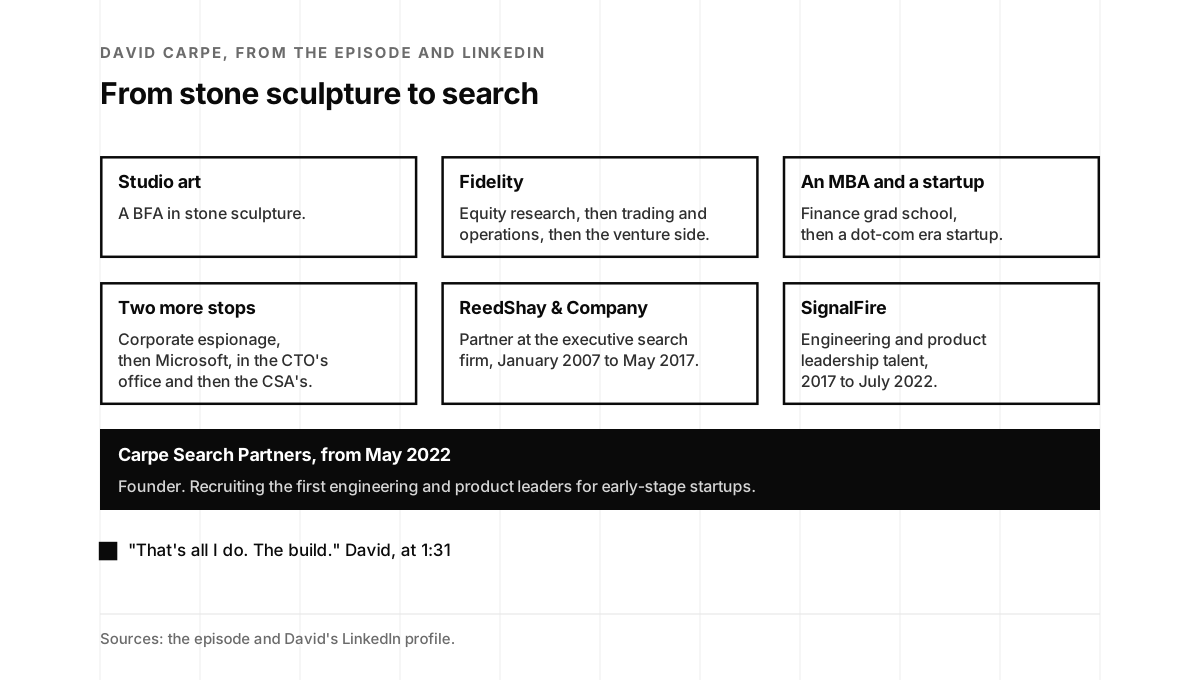
From stone sculpture to search
David gave Jon the short version. A BFA in studio art, in stone sculpture. Equity research at Fidelity, then trading and operations. Grad school and an MBA in finance. A startup that blew up in the dot-com boom. A corporate espionage firm. Then a long stretch with Microsoft, in the old office of the CTO and then the office of the CSA.
David places that Microsoft work in Ray’s time. Ray Ozzie held the positions of chief technical officer and chief software architect at Microsoft between 2005 and 2010 (Wikipedia).
Next came a search firm. David’s LinkedIn lists a partner role at ReedShay & Company, an executive search firm, from January 2007 to May 2017, and says David was the last remaining partner after 2010 or 2011 (LinkedIn). People David knew then brought David to SignalFire, a venture fund, for five and a half years. LinkedIn lists the role there as head of engineering and product leadership talent, from 2017.
The focus for the last 10 to 15 years has been early-stage startups: incubation, studio and pre-seed companies, and some growth-stage ones, next to large clients such as Microsoft, TiVo and PGP.
The work is product and engineering, and nothing else.
“That’s all I do. The build.”
David Carpe, at 1:31
In David’s words, it means helping founders build companies, by finding co-founders, first builders and first heads of product.
A best day: leaving a bad boss
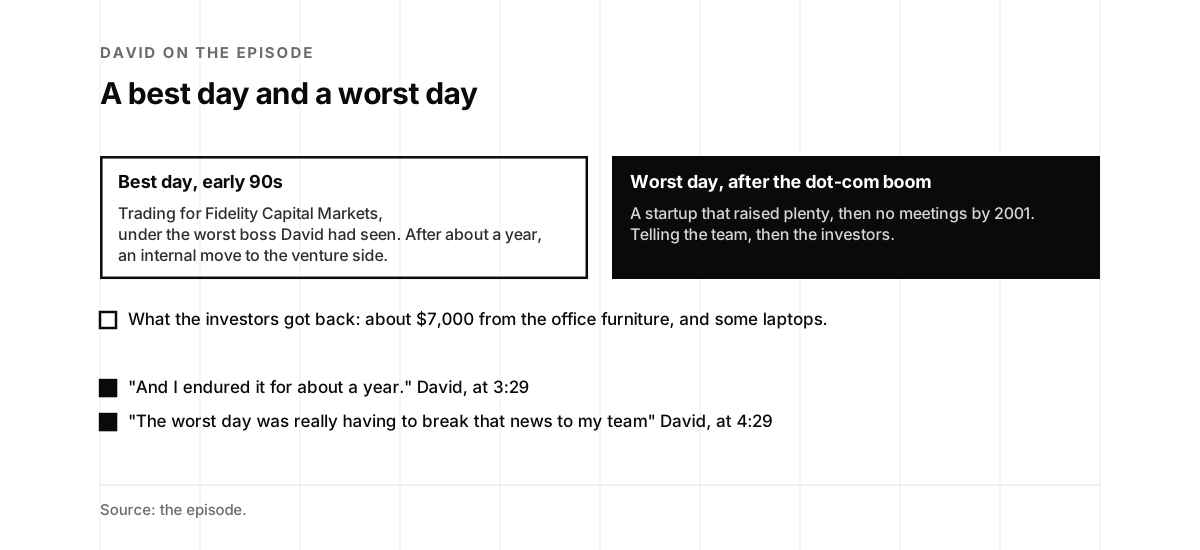
Jon asked for the best day of David’s career. What came to mind was a job in the early 90s on the trading floor at Fidelity Capital Markets, in equities and some fixed income.
The firm hired an operations executive, the worst David has ever seen. This boss made people cry, screamed at them and threatened them all day. David looked for a way out and found one: a job on the venture side of Fidelity Capital Markets. The best day was announcing that internal move and saying goodbye.
“And I endured it for about a year.”
David Carpe, at 3:29
Then David made the break. David’s word for it was freedom, and Jon repeated it.
A worst day: the dot-com shutdown
One of the worst came after the dot-com boom. David had raised a lot of money for a startup from notable investors. There were high hopes and high fives all around.
In 2001, David was out raising again and couldn’t get a meeting with anybody. Investors wouldn’t meet a business described with an acronym, such as B2B, B2C or ASP. The dot-com bubble had peaked on March 10, 2000 (Wikipedia).
After endless rejections, David accepted it: shut the startup down and lay people off.
“The worst day was really having to break that news to my team”
David Carpe, at 4:29
Investors asked how they would be made whole. David sold all the office furniture and gave them about $7,000, plus a couple of laptops.
David sees people living through the same thing today, with startups imploding. As the frenzy fades, what’s sustainable and real turns out to be small, and many companies should never have been built at all.
Quiet quitting is mostly a label
Jon asked about the quiet quitting movement, with people revisiting their values and asking whether their work is what they want to do for the rest of their lives.
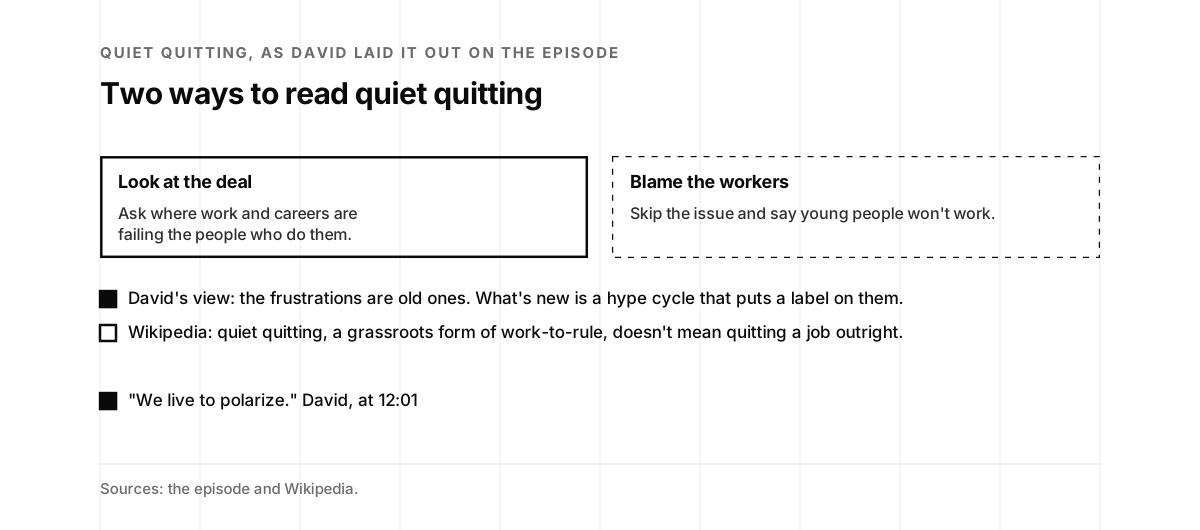
David talks to a lot of people about it and called it a polarizing issue. In David’s view, most of what you read about quiet quitting is, by and large, nonsense.
“It’s a lot of corporate control narrative”
David Carpe, at 6:42
The things that frustrate young people today, David said, have bothered young people for ages. A 26-year-old in the 70s felt as disenfranchised. David laid out two readings. One asks what we’re doing wrong, and how work and careers are failing people. The other ignores the issue and says that young people don’t want to work.
Wikipedia describes quiet quitting as a grassroots form of work-to-rule. Despite the name, it doesn’t mean quitting a job outright. Employees stop going above and beyond the call of duty (Wikipedia). The episode’s title also names the Great Resignation, a mainly American trend in which employees resigned en masse, beginning in early 2021 during the COVID-19 pandemic (Wikipedia).
The contract is broken
David sees young people in tech who did the right things. They went to college, got good grades and landed good jobs, and they still don’t know what comes next. Homes and retirement look out of reach.
“That is reality. Things are exorbitantly expensive.”
David Carpe, at 9:41
So young people look at what’s happening and worry about the future. David put their question this way: you want me to grind, and give you 100 hours a week, for what?
“The contract that society made with me is broken.”
David Carpe, at 10:47
The company that hired them is part of it, David said, and so is the social contract. What people call a negative attitude is young people being realistic.
Labels and the hype cycle
What’s new, David said, is the hype cycle in the news. As soon as we see something, we put a label on it and make it an issue.
“We live to polarize.”
David Carpe, at 12:01
Companies answer that nobody wants to work, when they could talk about the issue. People don’t want to stay till 7 p.m. when they’re no longer sure what they’re working for.
In the 90s, David said, you could have a quiet quitting attitude and still be fine. You could quit, get a job at Coffee Connection, an early predecessor to Starbucks, live with friends, pay rent, pay for a car and go out on weekends.
“All of that’s gone.”
David Carpe, at 13:05
The cost of living is so high, David said, that you work from a studio you might share with one other person, finish your workday, and wait for the next one.
Zoom out first
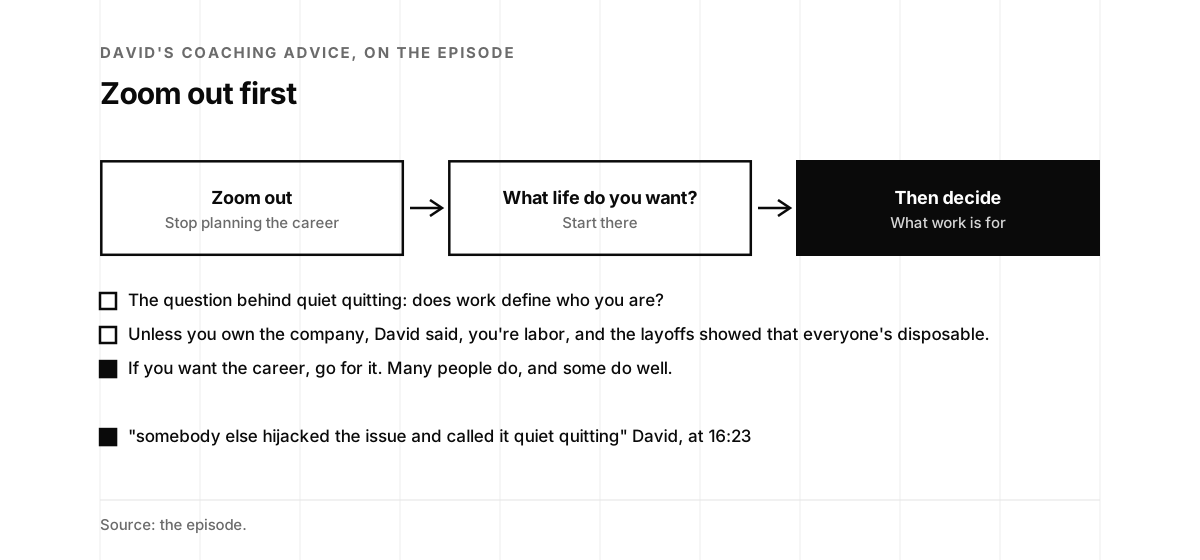
David does career coaching with young people and takes it seriously. The first step is to zoom back out:
“stop thinking about your career and start to think about just the way you want to live your life”
David Carpe, at 14:07
In David’s view, the question behind quiet quitting is whether work and career are the focus and fabric of your identity, who you are and what defines you. People enter and re-enter intense periods of work at any age.
David was blunt about the model. Everyone’s disposable, and the last three years of layoffs showed it.
“If you’re not the owner of that company, you’re an employee, you’re a unit of labor.”
David Carpe, at 15:14
Many people want that life, and you can do well in it. If you reject it, look at the people in the 60s and 70s who went from college to one job for 40 years, and ended up old and burned out, having forgotten what they enjoyed. David pointed to The Graduate, the 1967 film about a recent college graduate (Wikipedia). Trying to avoid that end is what people are doing, David said.
“somebody else hijacked the issue and called it quiet quitting”
David Carpe, at 16:23
Or give yourself to work
Jon agreed and added that it pays to be intentional and deliberate with our choices. Figure out your values, and why you do what you do, and then line up your career with them. What’s right for you might differ from what your peers, friends and family expect. And value and meaning often come from the people in our lives.
David then made the case for the other side too. David has embraced a career and, when younger, ran through brick walls to make things happen. For young people with that drive and ambition, the advice is to do it, if the identity and the accomplishments matter that much.
“You might not do it forever. That’s totally fine.”
David Carpe, at 18:10
David sees another pattern in young founders. They run a million miles an hour and land outsized outcomes, the kind of money that looks like fantasy. Then, in their 30s or early 40s, with infinite choice, they don’t know what they’re into. So they fall back on building startups because they’re good at it. David encourages them to take a break from tech.
Jon offered another way to see it. If you get a great deal of happiness from making things, you’re in a wonderful position to keep doing that, and you’re still building something at the end of the day.
Don’t turn every hobby into income
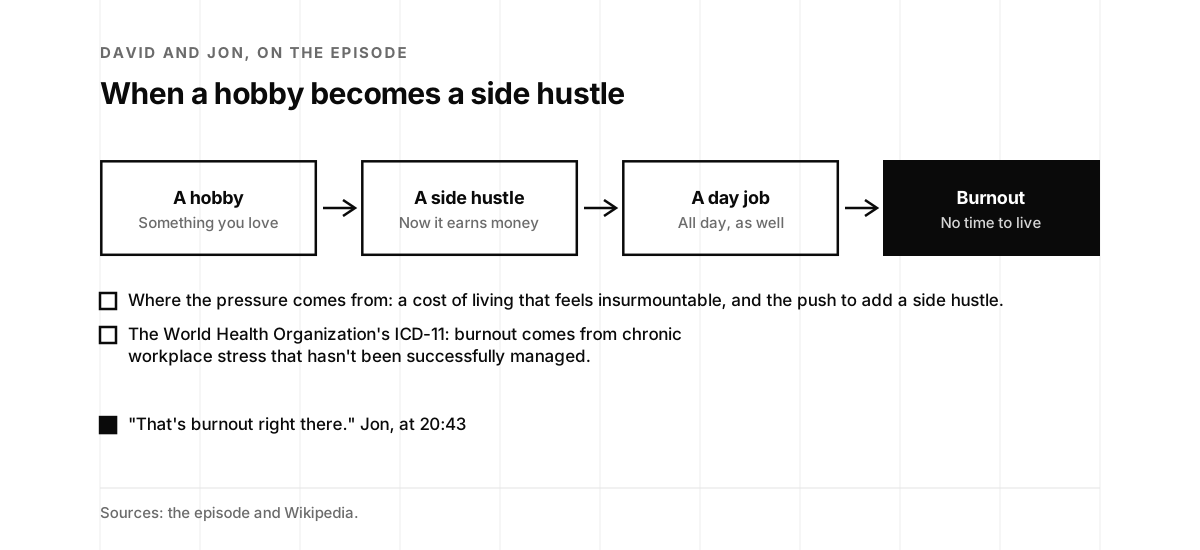
What worries David is the pressure to monetize what people enjoy. Young people face an insurmountable cost of living, and they’re told that everyone needs a side hustle.
“feel compelled to monetize them”
David Carpe, at 20:06
That means turning a hobby into a source of income.
David called that a broken way to live. If you photograph your food all the time because you like it, and then go to work all day, and keep Saturday for laundry, when do you live? Do that long enough and it will break you.
“That’s burnout right there.”
Jon McLachlan, at 20:43
The World Health Organization’s ICD-11 describes burnout as a work-related phenomenon resulting from chronic workplace stress that has not been successfully managed (Wikipedia).
Jon brought up advice from Mark Cuban, heard on a podcast: don’t follow your passion, do what you’re good at. Had he followed his passion, the point went, he’d still be trying to play basketball.
Try the things you’re bad at
David read Mark Cuban’s advice another way: if you’re not good at it, don’t even try. So David asked Jon to picture saying, 10 years from now, that he’s done with security and done with podcasting. David has followed people from the Microsoft years through their careers and has those talks with them.
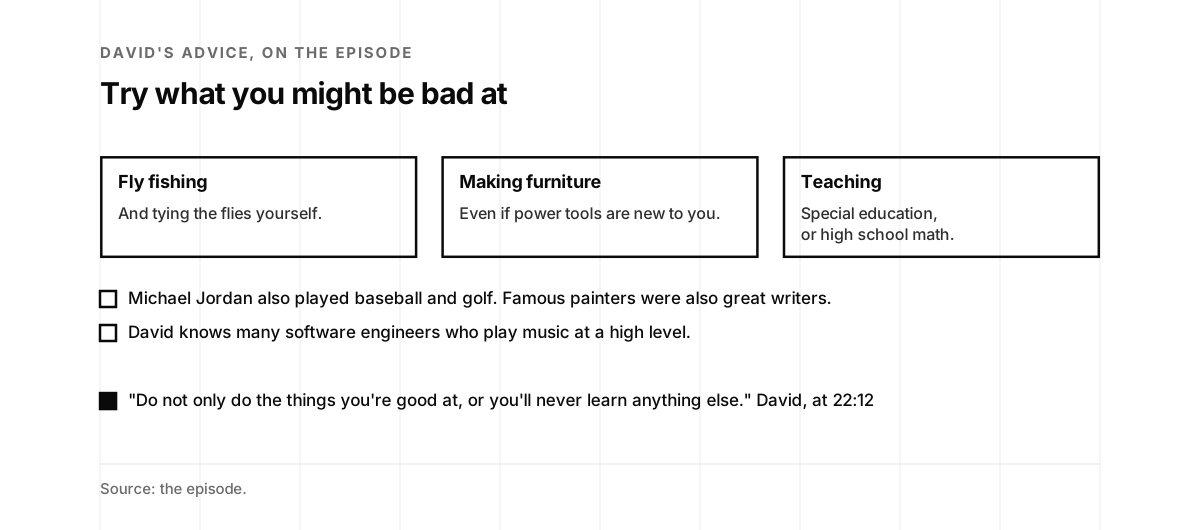
If you think your calling is fly fishing and tying flies, making furniture, special education with children, or teaching math in high school, David’s advice is to go try it, even if you might be horrible at it and don’t know how to use a power tool.
“Do not only do the things you’re good at, or you’ll never learn anything else.”
David Carpe, at 22:12
Michael Jordan was also good at baseball and golf. There were famous painters who were also phenomenal writers. David knows tons of software engineers who are phenomenal musicians. Maybe some of them belong in bands.
Security as a calling
Jon isn’t exactly sure what drew him to security. He has been lucky to find the intersection of passion and skill set, and the best way he can describe it is this:
“an irrational excitement about security”
Jon McLachlan, at 22:57
Look at what’s happening in the world, Jon said, and you notice something terribly wrong with how we handle data and security, and with what it even means to be secure.
“security is like a calling”
David Carpe, at 23:26
If we’re going to let software run the world, David said, then the security of that software holds up society.
“the security of that software is not just paramount”
David Carpe, at 23:31
David spent a lot of time on security at Microsoft, with partner-level people who were legends of security. One of them told David that the work in security was done and what was left was administration and policy: consensus, agreement and standards. David isn’t a security person and can’t judge the cryptography, but understood the point. We innovate on passwords and key fobs, and we’ve accepted that financial apps need a certain kind of login and that Wall Street needs a certain level of security on messaging. We still fight over international data holds with big tech companies.
Giver or taker
Jon said networking was something he missed early in his career, and asked how networking differs from socializing. David started with the identity you choose in your network.
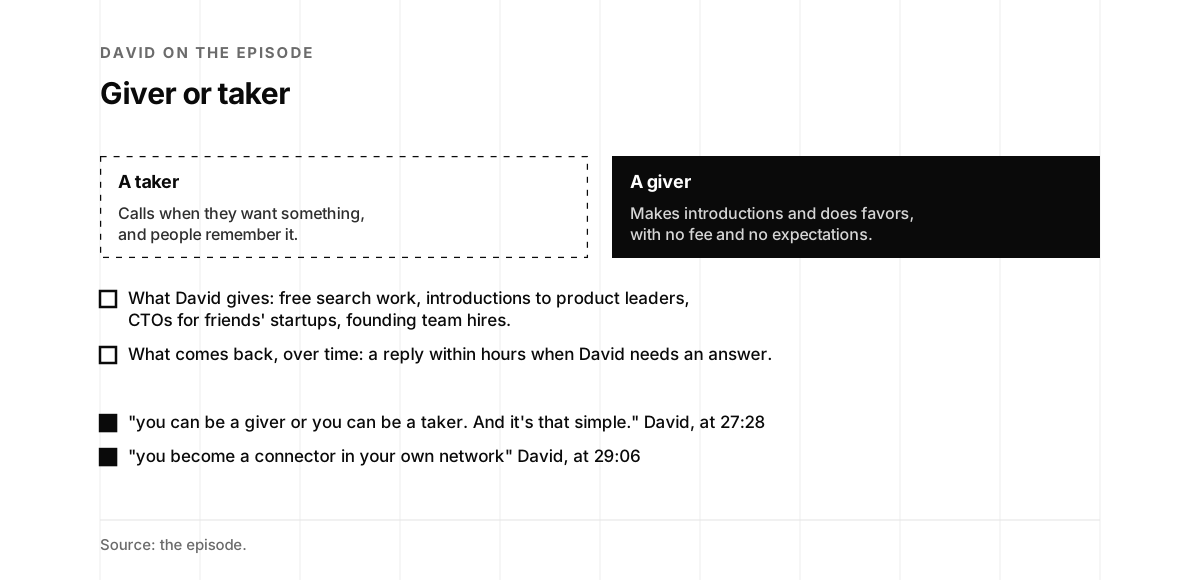
“you can be a giver or you can be a taker. And it’s that simple.”
David Carpe, at 27:28
David is a giver. On top of the searches David charges for, David does an incredible amount of search work for free: introductions for product leaders at big internet companies, CTOs for friends’ startups, and critical founding team hires with no fees. David does it with real empathy for the candidate, and with no expectations of money or gifts. David believes in karma and goodwill.
It pays back over time. When David needs an answer to an odd question, a text to the right person gets a reply in an hour or two.
“you become a connector in your own network”
David Carpe, at 29:06
The more you connect your network, the more value you give it, and the more it grows through follow-on introductions. People remember you as someone who doesn’t always want something. Jon recalled an episode of Will and Grace that split people into gardeners and flowers, givers and takers. David added that it’s how people think of their friends from growing up, even if they never call it that.
Meet everyone you work with
David sees a common problem in tech. Engineers and product people come through a university system that works as a filter, compete for top jobs, and land on a security team at a hot company with an A-to-A-plus resume. Then, a few years out of school, they focus on a big technical task: wowing a boss and wowing a team.
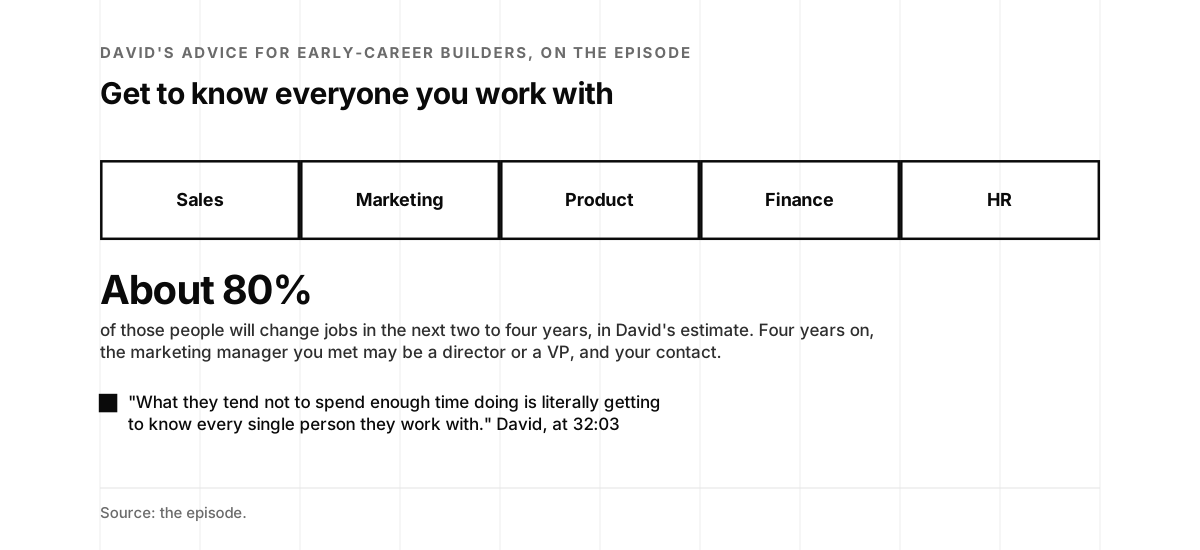
“What they tend not to spend enough time doing is literally getting to know every single person they work with.”
David Carpe, at 32:03
You don’t need conferences and events. Reach out to the people at your company in sales, marketing, product, finance and HR, and to the people in leadership roles there.
“in the next two to four years, about 80% of those people are going to change jobs”
David Carpe, at 32:35
So four years later, when you want to work on security in another industry, a marketing manager you met, who answered your questions about the product, has become a director or a VP, and your contact. Remote work makes it harder, David said. The hallway moments with the marketing team, an executive or a visiting investor don’t happen anymore, so you have to make them happen.
Small rooms beat big Zoom calls
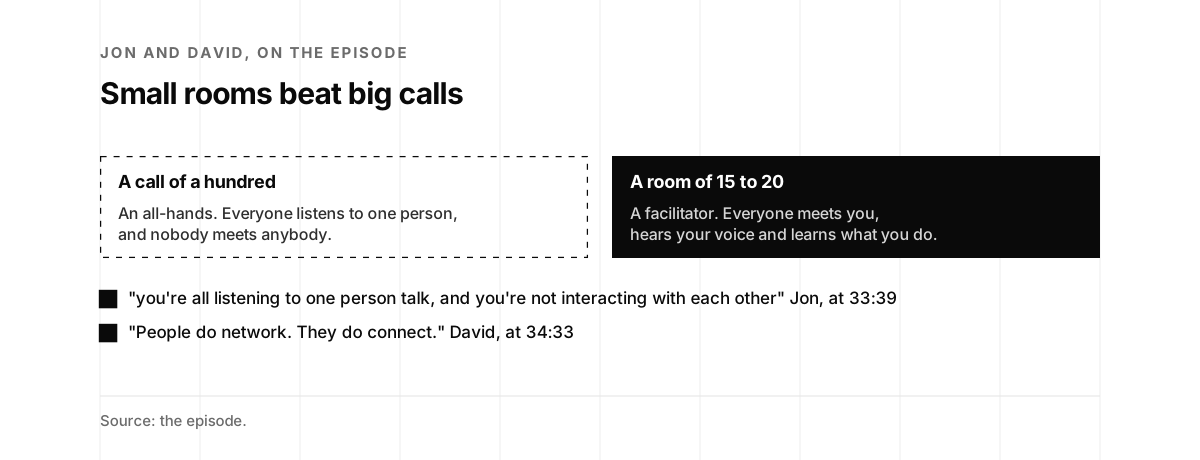
Jon named what drives him crazy about giant Zoom events: a hundred people in a call, an all-hands, and nobody meeting anybody.
“you’re all listening to one person talk, and you’re not interacting with each other”
Jon McLachlan, at 33:39
Nobody, David agreed, spots an interesting face on page three of a webinar and sends a chat. David has seen smaller events run well, with a facilitator and maybe 15 or 20 people, so everyone gets to meet you, hear your voice and know what you do. David’s team ran a bunch of them.
“People do network. They do connect.”
David Carpe, at 34:33
You always have something to give
Jon asked about the roadblocks. Being a taker, or being seen as one, is one, David said. Jon then asked the question for someone new.
“If I don’t feel like I have a give, what do I do?”
Jon McLachlan, at 34:53
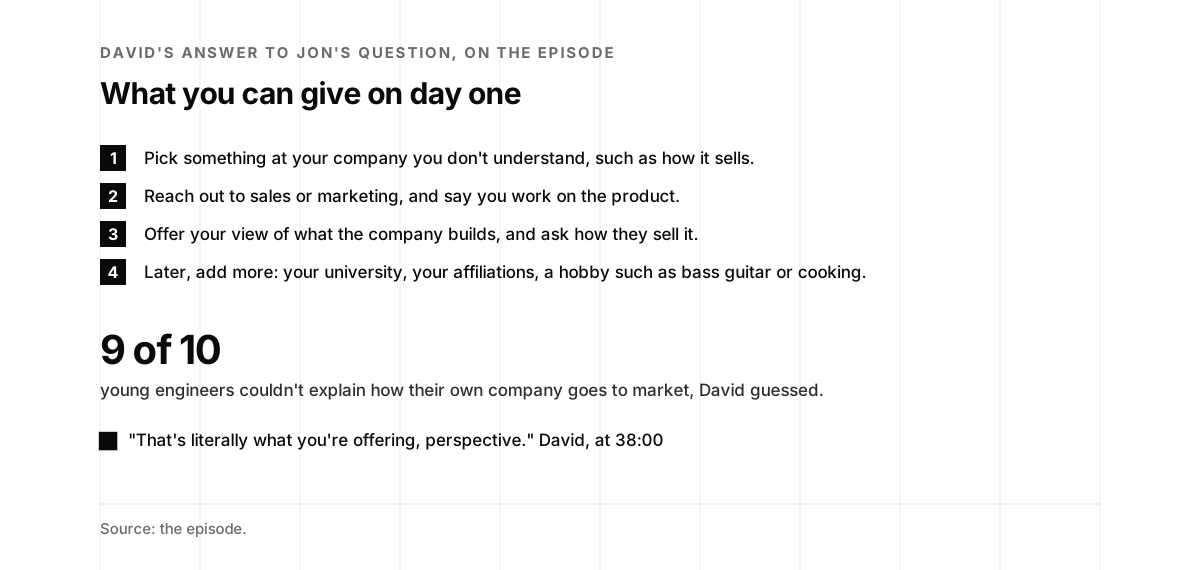
David’s answer: you always have a give. Picture yourself as an early-career engineer, buried in a feature team, fixing bugs, in a company of a thousand people. Think of something at your company that interests you and that you don’t understand.
“nine out of 10 wouldn’t be able to explain to me the go-to-market motion”
David Carpe, at 35:57
That’s David’s guess for young engineers picked at random outside an office. Most couldn’t tell you the average price, the average transaction time, how the company finds customers and leads, or how it makes the money that pays them. If you want to invest in your career, as an engineer, a product manager or anything else, you need to understand how a business works. When you’re young, networking is the only way to learn that, unless you’re a recruiter.
“you always have something to give”
David Carpe, at 37:05
Reach out to marketing or sales and say you work on the product, and ask whether you can talk about what you think you’re building, and how they sell it.
“That’s literally what you’re offering, perspective.”
David Carpe, at 38:00
Later in a career you find you have more to offer: your university, a multitude of affiliations, bass guitar, needlepoint, cooking Indian food. Through cold outreach you build rapport, and through rapport you find what you have in common.
“There’s always something that you can do and that you can offer people.”
David Carpe, at 38:41
Practice the small talk
Jon went through social awkwardness himself. He was anxious with new people and didn’t know how to start a conversation.
“There’s actually a lot of structure to that”
Jon McLachlan, at 39:29
Jon recommended a book on how to talk to anyone. It lays out the structure of small talk and how not to sound like a creep. Then you practice with low-risk people, on the sidewalk or in a cafe, where it’s safe.
From red-faced to a room of hundreds
Jon asked about the strangest place David has networked. David has had some weird connections on plane flights.
Out of college, David was so nervous meeting people, already red and sweaty. Still doing art, David went to a corporate art show and met Ned Johnson, in David’s eyes one of the wealthiest men in the world, and stuttered through it. Ned Johnson became chairman and CEO of Fidelity Investments in 1977 (Wikipedia).
Then, at some point, there was a kind of metamorphosis.
“And I think it comes with age.”
David Carpe, at 41:22
David started speaking at conferences, in front of hundreds of people.
“I could talk to anyone.”
David Carpe, at 41:38
What David enjoys most isn’t finance or building a project at a startup. It’s the endless connectivity, the tissue that connects everybody, and you can get good at it. You can be a recruiter, an operator, a salesperson or a security person. With a network, David said, you can do anything.
Avoid yes-or-no questions
David asked whether speaking has its own tips, tricks and books. Jon agreed: there’s structure to it, and with practice it becomes second nature.
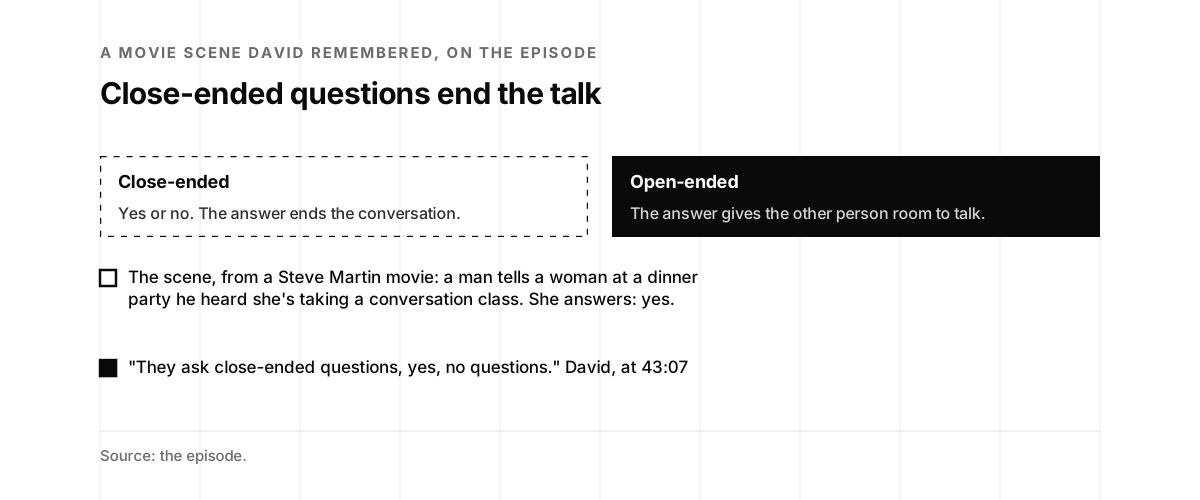
That reminded David of a scene from a Steve Martin movie. At a dinner party, a man walks up to a woman sitting silent at her table and says he heard she’s taking a course in the art of conversation. She answers: yes. That’s where conversations go when people do it wrong, David said.
“They ask close-ended questions, yes, no questions.”
David Carpe, at 43:07
You want to avoid those early in a chatty conversation.
Network with 40-year-olds
David thinks young people underestimate their appeal to older people. If you’re in your 20s:
“network with some 40-year-olds”
David Carpe, at 43:29
Look past people your own age. Reach out to the line executives at your company, the VP of marketing or the VP of sales. Skip the directors and managers. If that’s intimidating, put it out of your mind.
“These are just people.”
David Carpe, at 43:44
They’re your neighbors, or your parents’ friends. And you have something in common already, which Jon put as working together toward the same vision.
Send the note
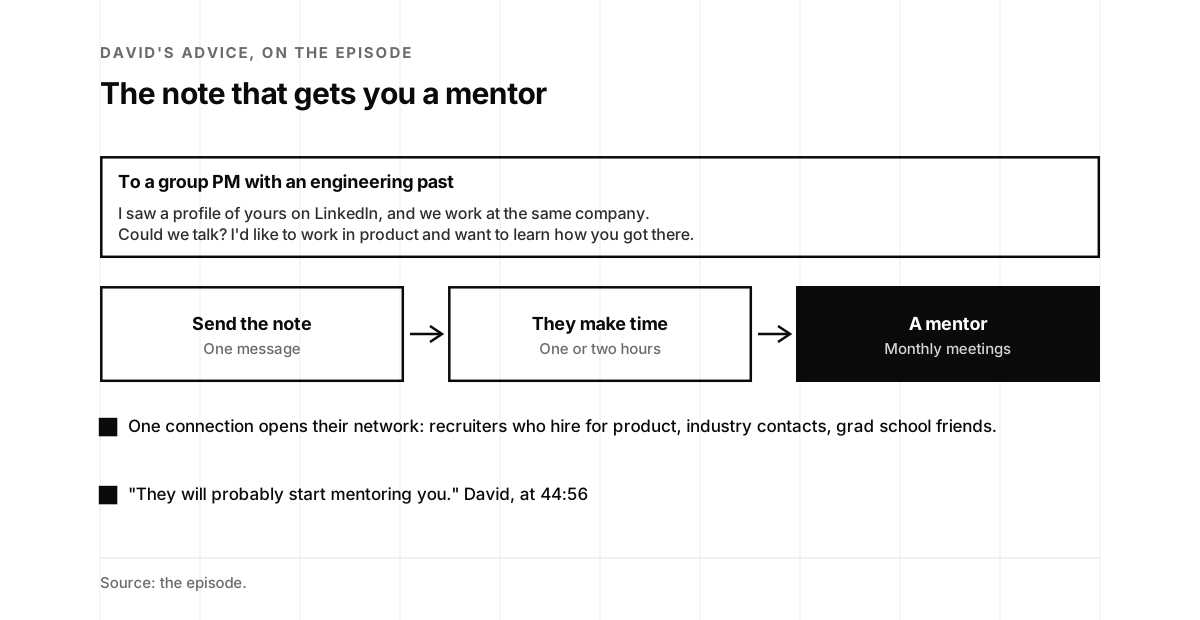
Say you’re an early-career software engineer, five years in, and drawn to product management, with no idea how to get there. Someone at your company, a group PM, came from engineering. David’s advice: send that person a note. Say you saw their background on LinkedIn, that you work together, and that you think a lot about moving into product and want to understand how they did it.
“I guarantee you that person will carve out like an hour or two hours.”
David Carpe, at 44:52
“They will probably start mentoring you.”
David Carpe, at 44:56
You’ll probably meet once a month. That one connection is also a conduit to the person’s whole network: recruiters who call about product roles, industry contacts and grad school friends.
Your network revolves around you
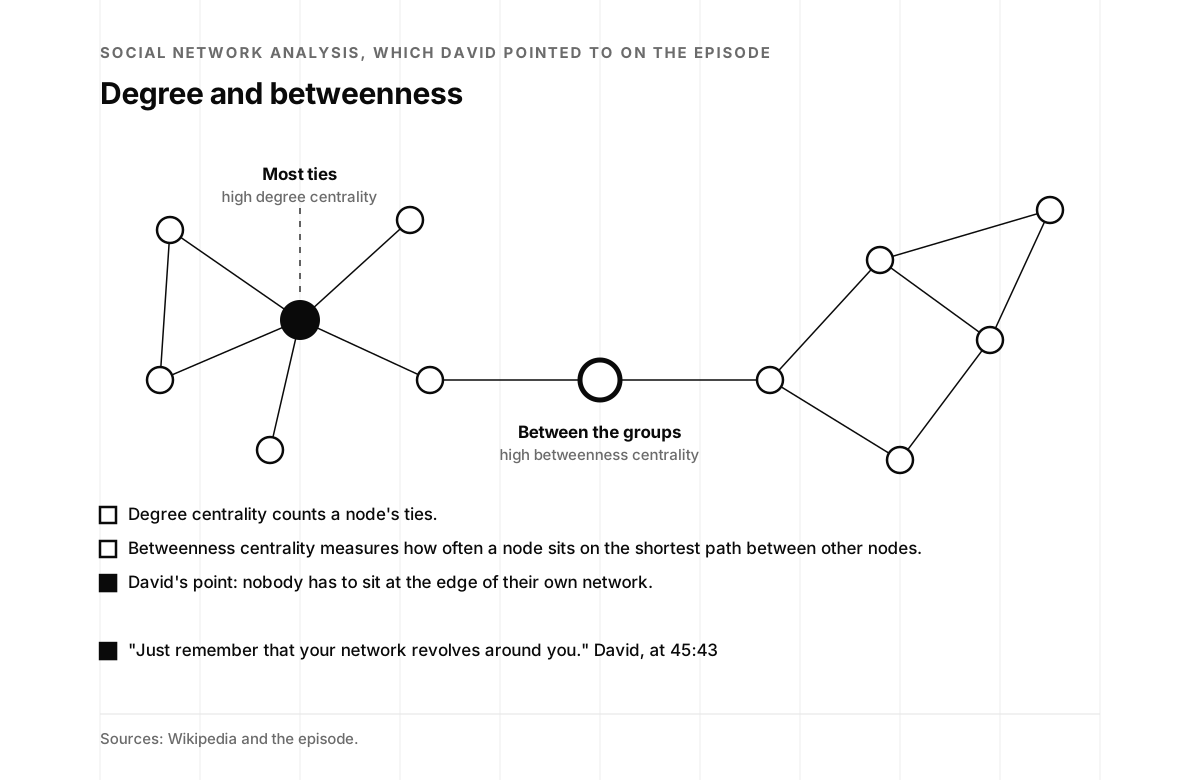
David pointed listeners to social network analysis, and to two of its measures, betweenness and degree centrality. Look at how a network works, and you see you don’t have to sit at the edge of it.
“Just remember that your network revolves around you.”
David Carpe, at 45:43
Social network analysis studies social structures as networks of nodes, people or things, joined by ties (Wikipedia). Degree centrality counts a node’s ties (Wikipedia). Betweenness centrality measures how often a node sits on the shortest path between other nodes (Wikipedia).
As a giver, David said, you keep asking where in your network there’s something that complements what someone else is reaching for. It takes time. By your 30s, it’s easy to see who should know whom: you meet someone and know right away that they’ve got to meet a friend of yours. It’s what you already do in your personal life, done at work.
Never forget your transcendental aspirations
Jon asked David for final words of wisdom, advice David wished someone had given a younger David. David chose a quote and credited it to Timothy Leary, the American psychologist and author (Wikipedia).
“never forget your transcendental aspirations”
David Carpe, at 46:41
Focus on your career, David said, and give yourself over to it. But:
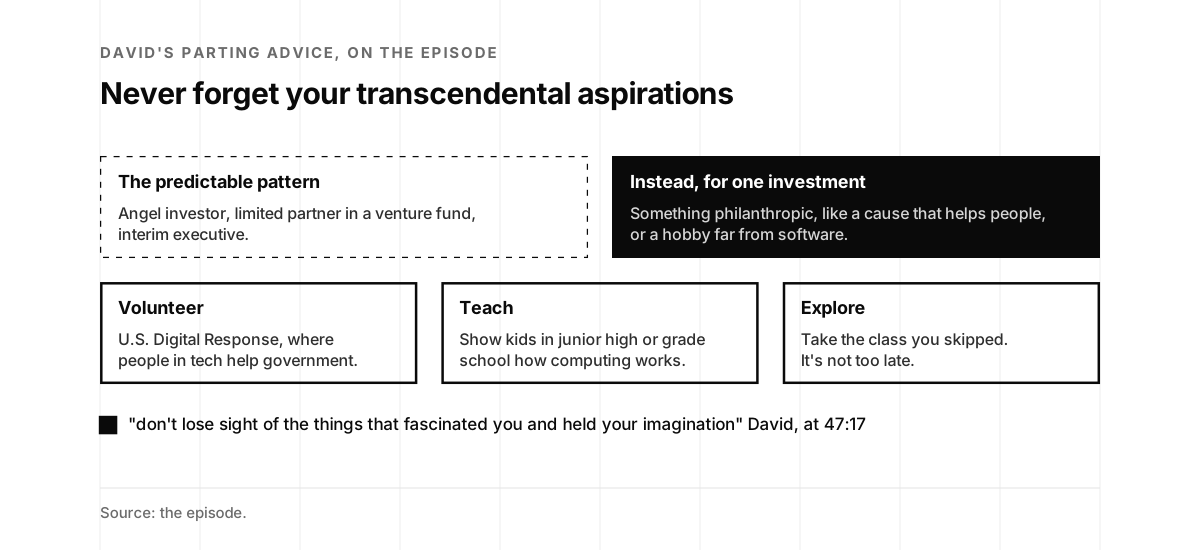
“don’t lose sight of the things that fascinated you and held your imagination”
David Carpe, at 47:17
If there’s a class you didn’t take, it’s never too late. Otherwise, decades later, people who did everything right hit an existential crisis, with money and infinite choice and no idea what motivates them. They follow a predictable pattern:
“They become angel investors.”
David Carpe, at 48:19
Or limited partners in venture funds, or interim executives. Jon added that a lot of the angels he has met are in it for the rush. David’s suggestion: for one investment, do something philanthropic, a humanitarian cause or a hobby that has nothing to do with a software company.
There are other ways to give. David has volunteered with U.S. Digital Response, a volunteer organization built around pandemic response that answers federal, state and local needs. Think of a state’s payroll systems and unemployment claims during the pandemic. Armies of volunteers who work in tech bring their know-how, project management skills and build experience.
“they’re doing civic tech”
David Carpe, at 50:17
Or, if you love engineering and want a break:
“go teach kids to code”
David Carpe, at 50:36
There are schools within a couple of miles of your home that could use a young, skilled engineer to introduce junior high or grade school kids to computing, to languages and to no-code tools.
What happened after the tape
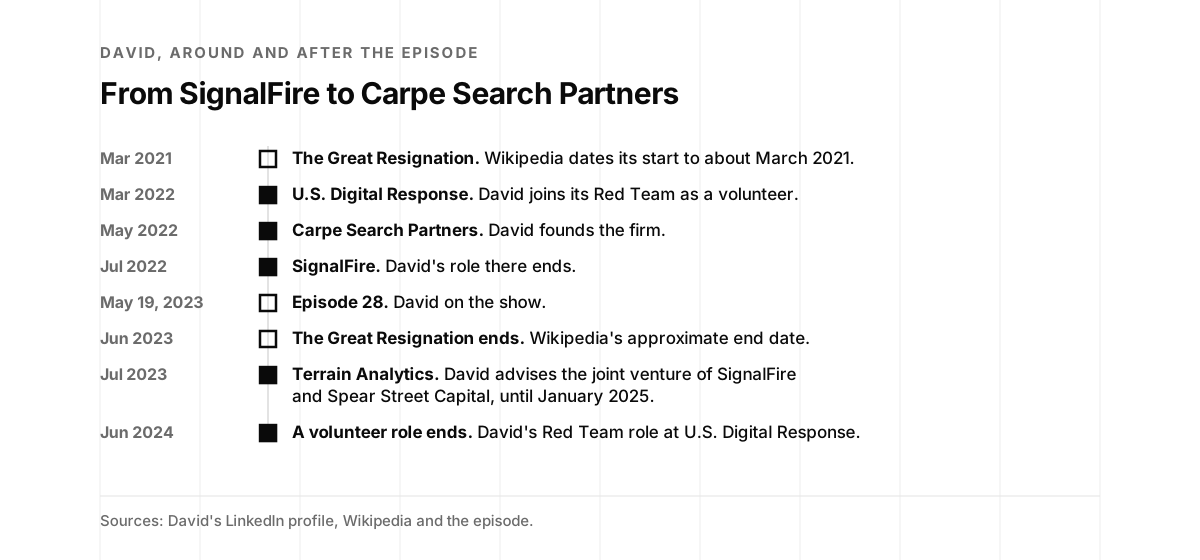
Carpe Search Partners. David’s LinkedIn lists the firm from May 2022, with David as founder: “Your partner for early stage engineering and product leadership recruiting” (LinkedIn).
SignalFire. LinkedIn ends David’s SignalFire role in July 2022. It began in 2017, when the firm had about 12 to 14 people, and ran through 500% headcount growth (LinkedIn).
U.S. Digital Response. David’s volunteer role on its Red Team ran from March 2022 to June 2024. LinkedIn describes the group as a volunteer-powered, non-partisan effort to help federal, state and local government with technology, data, design and operations needs, pro bono, during and after the COVID-19 crisis (LinkedIn).
Advising. LinkedIn lists advisor roles at Terrain Analytics, a joint venture between SignalFire and Spear Street Capital, from July 2023 to January 2025, at Hirize from March 2022 to April 2024, and at ApolloFactor from December 2021 to January 2024 (LinkedIn).
The Great Resignation wound down. Wikipedia dates it from about March 2021 to June 2023, so it ended about a month after this episode came out (Wikipedia).
Did you catch it? A seven-question quiz
Seven questions from the episode. Each answer links the moment in the transcript or its section.
Quiz · seven questions
Did you catch it?
Pick an answer to see whether you caught it.
-
What did David study before working at Fidelity?
a. A BFA in studio art, in stone sculpture. See From stone sculpture to search.
-
How did David pay back investors after shutting down the startup?
b. Plus a couple of laptops. See A worst day: the dot-com shutdown.
-
What does David call most of the talk about quiet quitting?
c. "It's a lot of corporate control narrative" Transcript, 6:42.
-
What share of the people at your company does David expect to change jobs in the next two to four years?
b. "in the next two to four years, about 80% of those people are going to change jobs" Transcript, 32:35.
-
What can a young engineer offer the sales or marketing team?
a. "That's literally what you're offering, perspective." Transcript, 38:00.
-
What does David tell someone early in a career who wants to move from engineering into product?
c. That person will probably start mentoring you. See Send the note.
-
Whose line did David leave listeners with?
b. "never forget your transcendental aspirations" Transcript, 46:41.
How well does your security team know the company?
Eight questions on how your security team connects with the rest of the company, built from the episode. Each tip links the section behind it.
Scorecard · eight questions
How well does your security team know the company?
Answer for your security team as it works today. If two answers fit, pick the lower one.
-
Does someone on your security team know a person by name in sales, marketing, product, finance and HR?
- No
- In two or three of them
- In all five
Most of those people will change jobs in two to four years, and take your name with them. See Meet everyone you work with.
-
Could your security team explain how the company sells: the price, the deal time and where leads come from?
- No
- Roughly
- Yes
David guessed that nine out of 10 young engineers couldn't. See You always have something to give.
-
When your security team reaches out to another team, does it offer something first?
- No, we ask for things
- Sometimes
- Yes, help or a view from the inside
You can be a giver or a taker. See Giver or taker.
-
How often does your security team meet people from other teams in small groups?
- Rarely
- A few times a year
- Every month
A room of 15 or 20 beats a call of a hundred. See Small rooms beat big Zoom calls.
-
Do you keep in touch with colleagues who have moved to other companies?
- No
- With a few
- Yes, on purpose
The marketing manager you met may become a director or a VP. See Meet everyone you work with.
-
Does each person on your security team have someone outside security to ask for advice?
- No
- Some do
- Yes
One note can get you a mentor. See Send the note.
-
Does your team make introductions for other people?
- No
- Sometimes
- Often
Connecting your network makes it grow. See Your network revolves around you.
-
Do people on your team open conversations with open questions?
- No, mostly yes-or-no questions
- Some of us
- Yes
Close-ended questions end the talk. See Avoid yes-or-no questions.
Security knows its own work and few people outside it. Start with one person each in sales, marketing, product, finance and HR.
Some ties reach other teams. Learn how the company sells, and offer your view of the product before you ask for anything.
Keep in touch with people who move on, make introductions, and help the newest people on your team do the same.
How far does your network reach?
David’s estimate is that about 80% of the people at your company will change jobs in two to four years. This calculator shows what a few conversations a quarter add up to.
Calculator
How far does your network reach?
Four numbers: the people outside your team you get to know each quarter, the minutes you spend with each, how many years you keep it up, and the share of them who change jobs in that time.
Get to know 6 people a quarter for 4 years and you know 96 people beyond your team. If 80% change jobs, 77 of them now work somewhere else, each a contact there. It takes 12 hours a year at 30 minutes a conversation.
The calculator counts four quarters to a year and rounds to whole people. The 80% default is David's estimate on the tape for two to four years. The other defaults are placeholders, yours to change.
From stone sculpture to startup search
David’s path, the field around it, and this show. Filter by topic.
Timeline
From stone sculpture to startup search
- Fidelity Capital Markets
David works on the trading floor, then moves to the venture side (on this page).
- The dot-com peak
The stock market bubble peaks (Wikipedia).
- No meetings
David is out raising again and can't get a meeting (on this page).
- Ray Ozzie at Microsoft
Chief technical officer and chief software architect until 2010 (Wikipedia).
- ReedShay & Company
David becomes a partner at the executive search firm (LinkedIn).
- SignalFire
David leads engineering and product leadership talent (LinkedIn).
- The Great Resignation
Employees resign en masse, mainly in the US (Wikipedia).
- ApolloFactor
David becomes an advisor, until January 2024 (LinkedIn).
- Episode 13
Paul Nguyen of Permiso on how relationships make your own luck (episode page).
- U.S. Digital Response
David volunteers on its Red Team, and starts advising Hirize (LinkedIn).
- Carpe Search Partners
David founds the firm (LinkedIn).
- Leaving SignalFire
After five and a half years (LinkedIn, on this page).
- Episode 23
David M'Raihi of Rivian, Jon's mentor (episode page).
- Episode 28
David on the show (Podbean, transcript).
- The Great Resignation ends
Wikipedia's approximate end date (Wikipedia).
- Terrain Analytics
David advises the joint venture of SignalFire and Spear Street Capital, until January 2025 (LinkedIn).
- Episode 46
Polina Morozov, then a security recruiter at Grammarly, on connecting with engineers (episode page).
- Episode 47
Clea Ostendorf on recruiting as matchmaking (episode page).
- A volunteer role ends
David's Red Team role at U.S. Digital Response (LinkedIn).
What to do this week
Five things, in the order of the episode.
- Zoom out before you plan. Decide how you want to live, and then what work is for, as in Zoom out first.
- Meet five people outside your team. One each in sales, marketing, product, finance and HR, as in Meet everyone you work with. The calculator shows what that adds up to.
- Offer your view of the product. Ask sales or marketing how they sell what you build, as in You always have something to give. The scorecard shows where else to look.
- Send one note. Write to someone who does the job you want, as in Send the note.
- Get help with it. Our vCISO Services start by learning what you sell, who buys it and what slows your growth, and Sales Support joins your sales motion as your security team. Product Security ships the security features enterprise buyers ask for, and Counter Business Espionage & IP Protection closes the paths competitors use to steal your roadmap. If you want to talk it through, book 15 minutes with us.