
Podcast Episode 27

Episode 027 44 min

Colin Bitterfield - Head of Security (Acting CISO) People Data Labs

with Colin Bitterfield · People Data Labs

0:00 / 44:00

Also on Spotify, Apple Podcasts, YouTube, Podbean, Player FM

Episode 27 of The Security Podcast of Silicon Valley, published January 16, 2023. Host Jon McLachlan talks with Colin Bitterfield, then head of security and acting CISO at People Data Labs, after 27 years in the military that included U.S. Army Cyber Command. Colin explains SOC 2 in six months and an ISO certification he called ten times harder, staying focused and saying no politely to vendors, entry-level job descriptions that are entry level, Vanta and the next certifications, making security part of the revenue cycle, reading every RFP as a list of what customers want, telling the company that security's first answer is yes, Jon's two kinds of security people, a security package in the first sales meeting, how he got into security through ISP work and the Army Reserve, attackers who read the manual, reading the cyber insurance policy, team rules and four hours of learning a week, Amazon's compliance page as a goal, FedRAMP and the system security plan, security through simplicity, and picking one standard.

Episode notes

In this episode of a YSecurity.io production, Colin Bitterfield, a key figure at People Data Labs, offers a compelling narrative on how intertwining growth with security through standardization and meticulous documentation can propel a business forward. Colin unveils his strategic blueprint for constructing and sustaining a business-first security team, where the emphasis on people ensures a win-win scenario for all stakeholders involved.

Delving into the essence of his approach, Colin articulates the significance of aligning security measures with the overarching goals of the organization. By championing standardization and proper documentation, he underscores how these practices not only enhance security postures but also streamline operations, making security an enabler rather than a bottleneck for growth.

Throughout the conversation, Colin emphasizes the importance of prioritizing people—both within the team and the broader organization. He shares insights into how a security team, when built with a business-first mindset, can foster an environment of trust, collaboration, and mutual respect. This approach not only elevates the security function but also integrates it seamlessly into the fabric of the company, ensuring that security considerations are woven into the decision-making process at every level.

Listeners will gain a wealth of knowledge on tactics for building a resilient, agile security team that is deeply attuned to the business's needs. Colin's strategies for engaging team members and stakeholders alike highlight the critical role of communication, empathy, and shared objectives in achieving security that supports and drives business outcomes.

Join us on this YSecurity.io production for an insightful discussion with Colin Bitterfield. Whether you're a security professional looking to elevate your team's impact, a business leader seeking to integrate security more effectively, or simply interested in the nexus of security and business growth, this episode offers valuable lessons on creating a security culture where everyone truly wins.

Hosted by Jon McLachlan — co-founder of YSecurity.

The deep dive

Security that says yes

Colin Bitterfield, then head of security at People Data Labs: 27 years in the Army, a company credit card on day one, SOC 2 in six months and an ISO audit with 20 interviews, RFPs read as a list of what customers want, a security package in the first sales meeting, hackers who read the manual, an insurance policy worth reading, four hours of learning every Friday, and one standard for every certification.

Episode 27 of The Security Podcast of Silicon Valley aired on January 16, 2023, with Jon McLachlan hosting. The guest was Colin Bitterfield, then head of security at People Data Labs (Podbean, Apple Podcasts, Spotify, LinkedIn). The episode is called “Colin Bitterfield - Head of Security (Acting CISO) People Data Labs.”

People Data Labs sells workforce data, on people, companies and job postings, through APIs and data feeds (People Data Labs). Colin ran IT and security there. His view of the job fits in one line he gave the whole company:

“security is here to say yes.”

Colin Bitterfield, at 11:03

This page follows the conversation in order: a section for each part of it, eighteen figures, eighteen clips from the tape, Colin’s post on LinkedIn, the full transcript, and five tools: a quiz, a scorecard for whether your security helps close deals, a calculator for the hours a ready security package saves, a timeline, and a to-do list. Where the decodes of the tape disagree on a word, the transcript puts its best guess in brackets, and the page doesn’t quote or retell those words.

From Army Cyber Command to a startup

Jon read Colin’s background from LinkedIn: the U.S. Army Reserves, a staff officer in intelligence and communications, U.S. First Army, and then U.S. Army Cyber Command, as chief of the data collections branch, an operations officer and a senior cyber warfare analyst. He also listed adjunct professorships, and a move to private industry as a principal infrastructure security engineer at Blackboard.

Colin retired from the Army in 2015 and went to the startup world. He had a reason:

“I was tired of working in the basements of buildings and I wanted some windows.”

Colin Bitterfield, at 1:28

At Blackboard he helped spin up the enterprise security division. The company went through FedRAMP certification, and he set up the vulnerability management systems and a hardening guide. Before that he spent five years as a cyber warfare officer, and much of his adult life in the intelligence community. After the war started in 2001, he gave up his civilian career and went back on active duty until 2015. In all, he said:

“I served for 27 years.”

Colin Bitterfield, at 4:26

Jon thanked him for his service, and said the best and the brightest are needed to protect the country, since information and cybersecurity will be a big part of conflicts. Colin’s LinkedIn lists the roles with dates: knowledge management officer at U.S. First Army from October 2007, information assurance officer at Army Cyber Command from August 2010, operations officer and senior cyber warfare analyst from October 2011 to February 2015, and Blackboard from April 2015 to August 2019, where he wrote about half of a FedRAMP system security plan (LinkedIn).
Listen · Colin Bitterfield on episode 27, from 1:23
About 35 seconds: Colin on leaving the Army for a startup. The clip stops on its own. Read the full transcript.
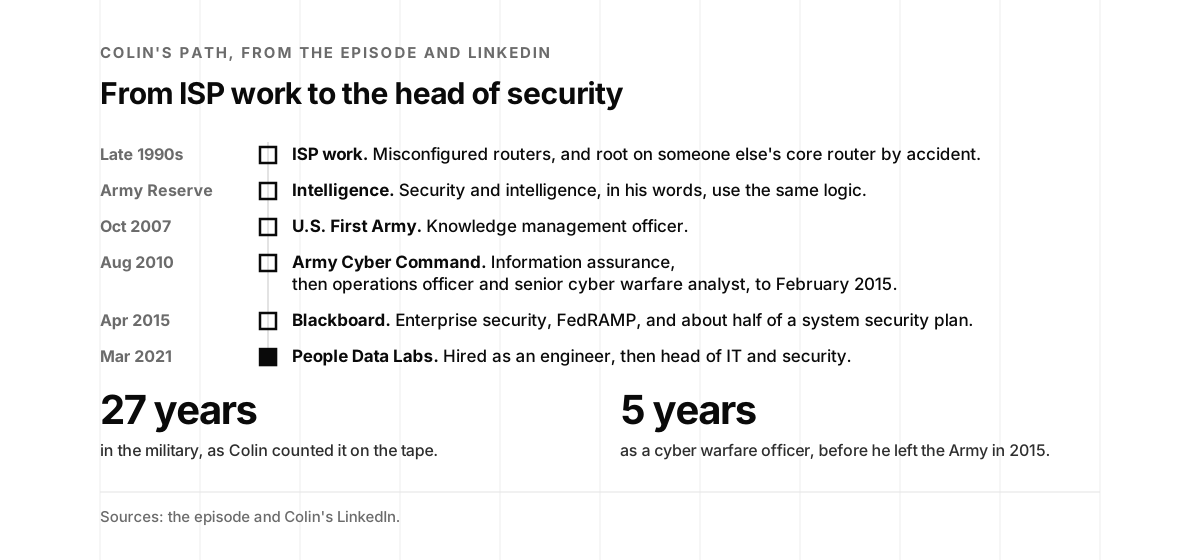
A timeline. Late 1990s, ISP work: misconfigured routers, and root on someone else's core router by accident. Army Reserve, intelligence: security and intelligence use the same logic, in his words. October 2007, U.S. First Army: knowledge management officer. August 2010, Army Cyber Command: information assurance, then operations officer and senior cyber warfare analyst, to February 2015. April 2015, Blackboard: enterprise security, FedRAMP, and about half of a system security plan. March 2021, People Data Labs, filled: hired as an engineer, then head of IT and security. Below, two numbers: 27 years in the military, as Colin counted it on the tape, and 5 years as a cyber warfare officer, before he left the Army in 2015.
Colin's path, from ISP work in the 1990s to the head of security at People Data Labs. Sources: the episode and LinkedIn.

A company credit card on day one

Colin joined People Data Labs to be an engineer. That changed fast:

“And the next thing I know, I’m the head of security running the IT and security department.”

Colin Bitterfield, at 2:39

He said the company’s leadership wanted People Data Labs to lead in security. On his first day, they handed him a company credit card and told him to make it happen and be the best. He spent a fair amount of money in the first couple of months. Jon had heard that story many times, but never on day one.

His LinkedIn lists the role as information systems and security operations manager, from March 2021 to December 2022, with IT and security operations built from the start (LinkedIn). The episode calls him head of security and acting CISO.

SOC 2 in six months, then ISO

The Army trains you to turn short orders into results, Colin said:

“You want to be SOC 2 in six months? Fine. We’ll be SOC 2 in six months.”

Colin Bitterfield, at 3:21

They made it. Then the company went through an ISO certification, and Colin compared the two:

“which, by the way, is about 10 times harder than SOC.”

Colin Bitterfield, at 3:29

For ISO, the auditors interviewed 20 people, and the team showed hundreds of pages of documentation. The auditors came back with a compliment on how well prepared the company was. Colin credited the military habit of being ready for inspections.

SOC 2 is a report from an audit, under standards of the American Institute of Certified Public Accountants, on controls for security, availability, processing integrity, confidentiality and privacy (Wikipedia). ISO/IEC 27001 sets the requirements for an information security management system (Wikipedia). People Data Labs’ security page lists both, ISO 27001 and SOC 2 Type 2 (People Data Labs).
Listen · Colin Bitterfield on episode 27, from 3:16
About 40 seconds: Colin on SOC 2 in six months, and an ISO audit. The clip stops on its own. Read the full transcript.
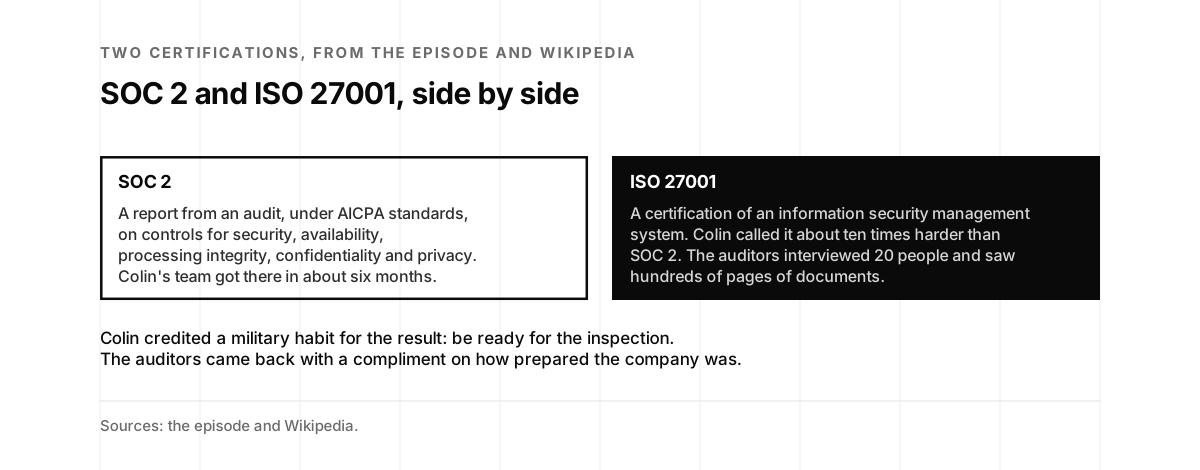
Two cards. SOC 2: a report from an audit, under AICPA standards, on controls for security, availability, processing integrity, confidentiality and privacy, and Colin's team got there in about six months. ISO 27001, filled: a certification of an information security management system, which Colin called about ten times harder than SOC 2, with 20 people interviewed by the auditors and hundreds of pages of documents. Below: Colin credited a military habit for the result, being ready for the inspection, and the auditors came back with a compliment on how prepared the company was.
SOC 2 and ISO 27001 side by side, with what Colin said about each. Sources: the episode and Wikipedia.

Focus, and a polite no

The military teaches you to stay focused, Colin said, and that helps in security. People want to talk about everything but the issue. What got the certification done was not getting sidetracked, for example by vendors:

“like the 10,000 vendors that call you every week.”

Colin Bitterfield, at 5:18

Colin said he’ll listen to a pitch for five minutes even when he can’t tell what problem it solves. Jon’s version is shorter:

“I give those calls like 30 seconds.”

Jon McLachlan, at 5:33

Colin tries to answer everyone who emails him, if only with a polite no. Jon called it seeing the person behind the hustle, who most likely means well. One pitch Colin remembers came as a cartoon on a whiteboard:

“I love your ad. I don’t need your software, but I love your ad.”

Colin Bitterfield, at 6:15

Entry-level jobs that are entry level

When Colin hired, he read hundreds of resumes himself, whatever the applicant tracking system said, because many people don’t know how to write a security resume. About 14 of his own students applied. He was teaching a program at the time, and he wrote the job descriptions so that a graduate of the program was fully qualified. Students tell him they can’t get hired after a certification, because employers want too much:

“people want them to be a purple unicorn or a dancing squirrel.”

Colin Bitterfield, at 6:58

He put the problem this way:

“the entry-level positions really aren’t entry-level.”

Colin Bitterfield, at 7:03

So he asked for a year or two of IT experience and a wish to break into security, and he hired one of his students. Colin’s LinkedIn lists teaching from 2010 to 2024 at StackRoute Learning, the University of Wisconsin-Madison, ECPI University and ITT Technical Institute (LinkedIn).
Listen · Colin Bitterfield on episode 27, from 6:53
About 20 seconds: Colin on writing a job description for entry level. The clip stops on its own. Read the full transcript.
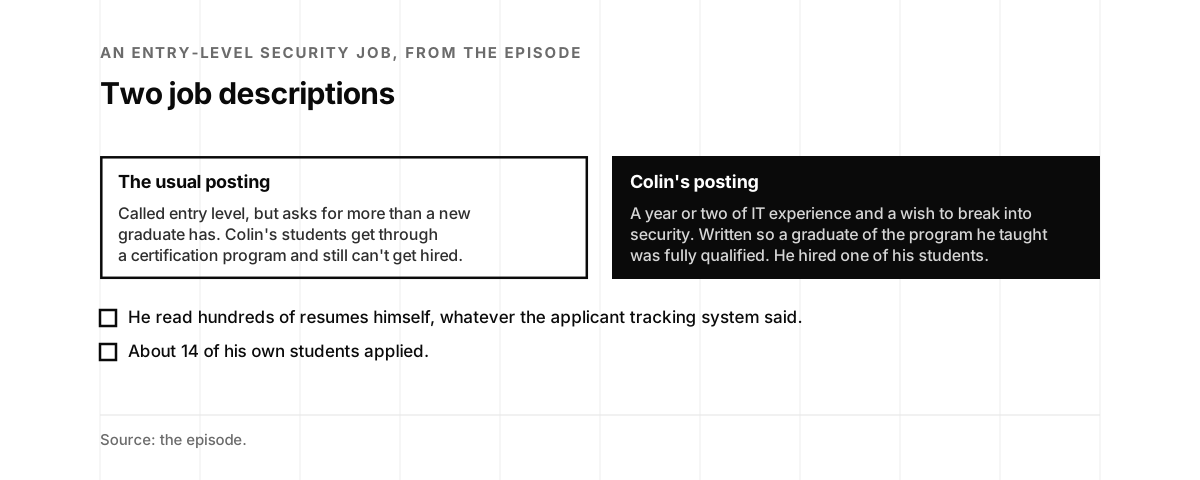
Two cards. The usual posting: called entry level, but asks for more than a new graduate has, and Colin's students get through a certification program and still can't get hired. Colin's posting, filled: a year or two of IT experience and a wish to break into security, written so a graduate of the program he taught was fully qualified, and he hired one of his students. Below, two notes: he read hundreds of resumes himself, whatever the applicant tracking system said, and about 14 of his own students applied.
Two job descriptions for an entry-level security job. Source: the episode.

One team, and security as the edge

At People Data Labs, Colin said, the whole company works as a single team:

“you don’t need to ask permission to talk to somebody, just go talk to them.”

Colin Bitterfield, at 7:58

That makes for fast action when there’s an issue. The data market is crowded, and the company chose security as the way to stand out:

“our intention to set ourselves apart is to literally be the best in security”

Colin Bitterfield, at 8:13

The aim was for customers to trust People Data Labs, and it paid off. The SOC 2 report and the ISO certification let People Data Labs work with much larger companies, who trust it because it takes the time to do everything right.

Vanta, and the next certifications

Jon guessed the company’s compliance tool, and he was right:

“It was Vanta. Vanta was great.”

Colin Bitterfield, at 8:55

In the year and a half before the episode, Colin said, Vanta had tripled or quadrupled the number of tests it runs, and had moved from SOC 2 and ISO into GDPR and CCPA, with FedRAMP likely next. People Data Labs planned to certify ISO 27017 and 27018 the next year, because of a growing business in Europe. It had hired a head of privacy six or seven months before.

ISO/IEC 27017 adds security controls for cloud service providers and their users, and ISO/IEC 27018 is a code of practice for protecting personal data in public clouds (Wikipedia, Wikipedia). Vanta was founded in 2018 by Christina Cacioppo and Erik Goldman, came out of Y Combinator, and automates security monitoring and compliance work (Wikipedia).

Colin’s summary of the company:

“And we really do everything we say we’re doing”

Colin Bitterfield, at 9:37

Jon liked the candor:

“our most valuable currency is really trust.”

Jon McLachlan, at 9:47
Listen · Colin Bitterfield on episode 27, from 8:59
About 30 seconds: Colin on Vanta and the next certifications. The clip stops on its own. Read the full transcript.
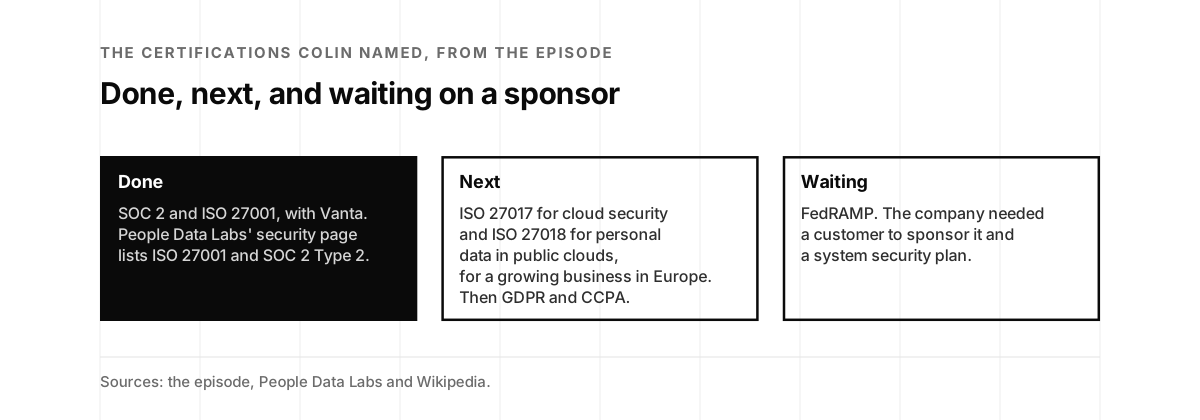
Three cards. Done, filled: SOC 2 and ISO 27001, with Vanta, and People Data Labs' security page lists ISO 27001 and SOC 2 Type 2. Next: ISO 27017 for cloud security and ISO 27018 for personal data in public clouds, for a growing business in Europe, then GDPR and CCPA. Waiting: FedRAMP, for which the company needed a customer to sponsor it and a system security plan.
Done, next, and waiting on a sponsor: the certifications Colin named. Sources: the episode and Wikipedia.

Security on the revenue side

People Data Labs used a second vendor for trust, Whistic, so salespeople could send the SOC 2 report or the ISO certificate to a customer straight from Salesforce. Colin’s department had a philosophy:

“to make security part of the revenue cycle, not just an expense category.”

Colin Bitterfield, at 10:08

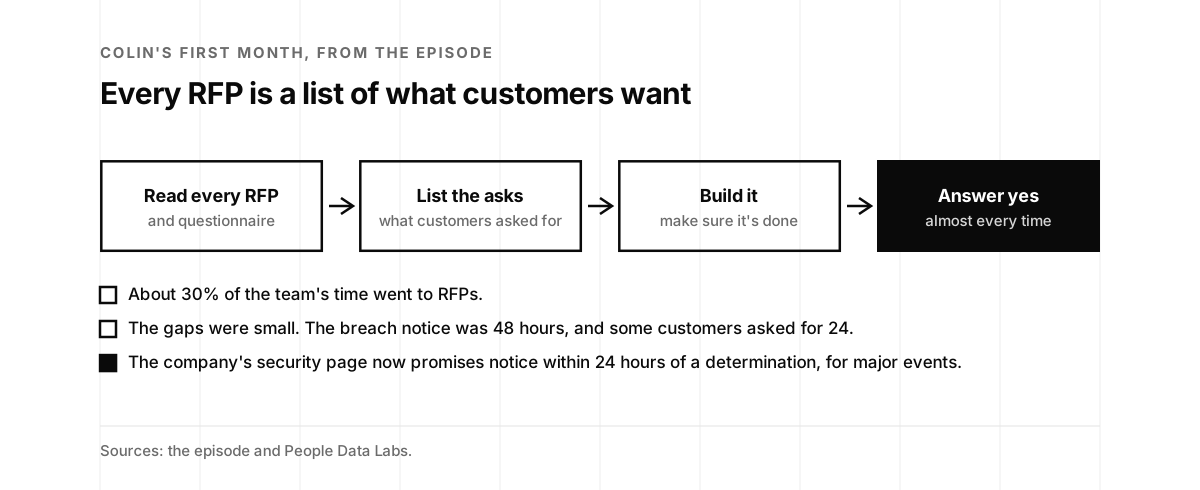
About 30% of the team’s time went to answering RFPs, the requests for proposal that buyers send to vendors. Colin said most security people miss what RFPs teach:

“And RFPs are a real valuable lesson for security people to see what your customer wants.”

Colin Bitterfield, at 10:17

In his first month, he read every RFP, put everything a customer had asked for on a list, and made sure the company did it. Now, when a customer asks whether the company does something, the answer is yes almost across the board. The gaps are small. The company’s breach notification window was 48 hours, and some customers asked for 24. People Data Labs’ security page now says it will notify affected people within 24 hours of a determination, for major events (People Data Labs).
Listen · Colin Bitterfield on episode 27, from 10:03
About 40 seconds: Colin on reading every RFP as a list of what customers want. The clip stops on its own. Read the full transcript.
Four boxes joined by arrows. Read every RFP and questionnaire. List the asks, what customers asked for. Build it, make sure it's done. Filled: answer yes, almost every time. Below, a list. About 30% of the team's time went to RFPs. The gaps were small: the breach notice was 48 hours, and some customers asked for 24. Filled: the company's security page now promises notice within 24 hours of a determination, for major events.
Read every RFP, list what customers ask for, build it, and answer yes. Source: the episode.

Security’s first answer is yes

More than a year before the episode, Colin spoke to the whole company. He told them security was there to say yes:

“Our first answer to everybody in this company is yes.”

Colin Bitterfield, at 11:06

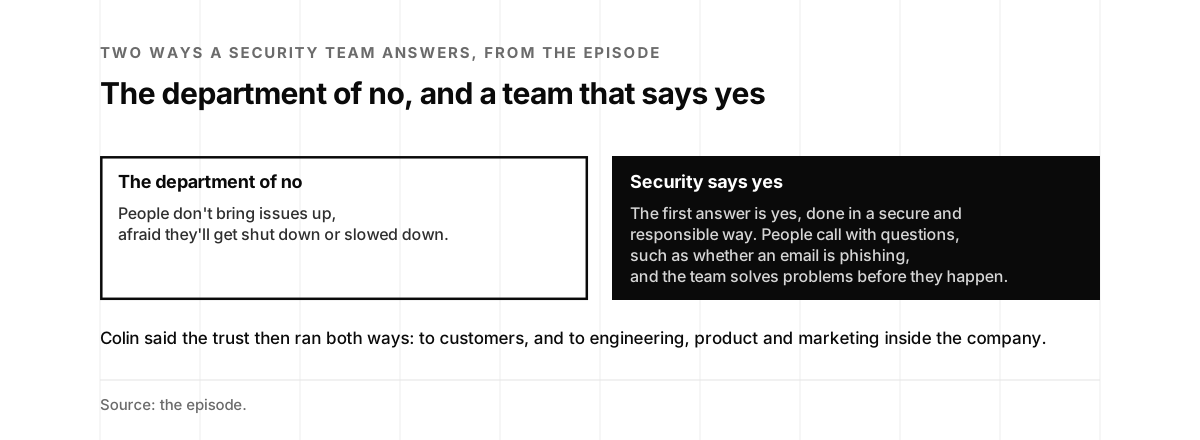
The goal was to help people do what they want, in a secure and responsible way. Because of that, people call security with questions, such as whether an email is phishing, and they don’t hide anything. Colin said that lets his team solve problems before they happen. He contrasted it with the department of no, where people don’t bring an issue up for fear it gets shut down or slows them down. He said the trust now runs to customers and to engineering, product and marketing.
Listen · Colin Bitterfield on episode 27, from 10:56
About 40 seconds: Colin on telling the company that security says yes. The clip stops on its own. Read the full transcript.
Two cards. The department of no: people don't bring issues up, afraid they'll get shut down or slowed down. Security says yes, filled: the first answer is yes, done in a secure and responsible way, people call with questions such as whether an email is phishing, and the team solves problems before they happen. Below: Colin said the trust then ran both ways, to customers, and to engineering, product and marketing inside the company.
The department of no, and a security team whose first answer is yes. Source: the episode.

Two kinds of security people

Jon has a joke about this:

“I always like to joke that there’s two types of security people in the world.”

Jon McLachlan, at 12:20

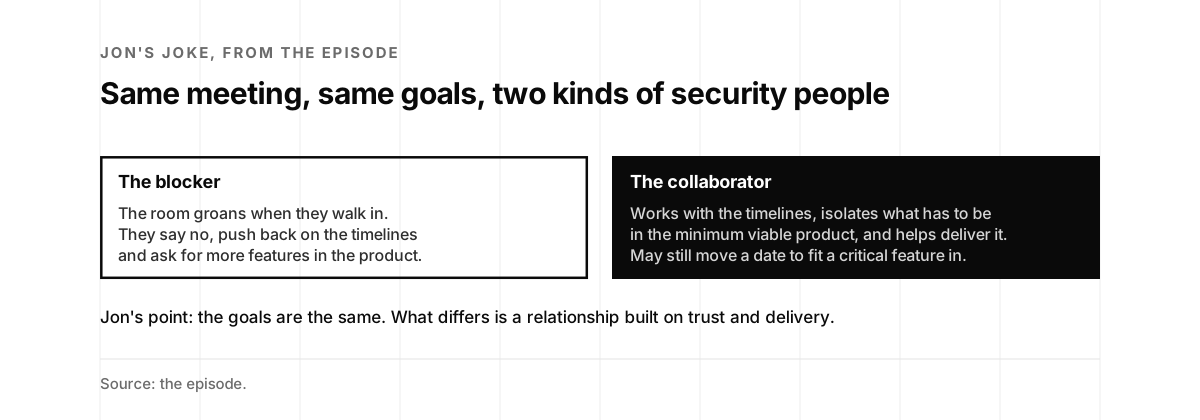
The first walks into a meeting and everyone groans, because they’ll say no, push back on the timelines and ask for more features. The second walks into the same room with the same goals, and the room sees a collaborator, someone who works with the timelines and isolates what has to be in the minimum viable product. That person may still push a date back to fit a critical feature in. Jon said the difference is a relationship built on trust and delivery.

On episode 2, Andrew Gontarczyk, then CISO of Pure Storage, described security as a team sport.
Listen · Jon McLachlan on episode 27, from 12:20
About 35 seconds: Jon on the two kinds of security people. The clip stops on its own. Read the full transcript.
Two cards. The blocker: the room groans when they walk in, and they say no, push back on the timelines and ask for more features in the product. The collaborator, filled: works with the timelines, isolates what has to be in the minimum viable product, and helps deliver it, and may still move a date to fit a critical feature in. Below: Jon's point is that the goals are the same, and what differs is a relationship built on trust and delivery.
Same meeting, same goals, two kinds of security people. Source: the episode.

Engineers who help other teams ship

Colin’s engineers help other teams finish. When a team runs behind on a project, or has to add a security control under a deadline, his engineers step in and do the work with them. The company had grown from about 56 people a year earlier to 150. During the ISO audit, the auditor wanted to talk to the leadership team. Colin messaged the CEO on Slack, and the CEO joined the meeting about 10 minutes later.

Colin offers the same help to sales. If a salesperson needs someone to talk to a customer’s CISO, he will join the call, any time, to close the deal.

A third of every sale

Colin’s department aims to shorten the sales cycle by taking away security objections:

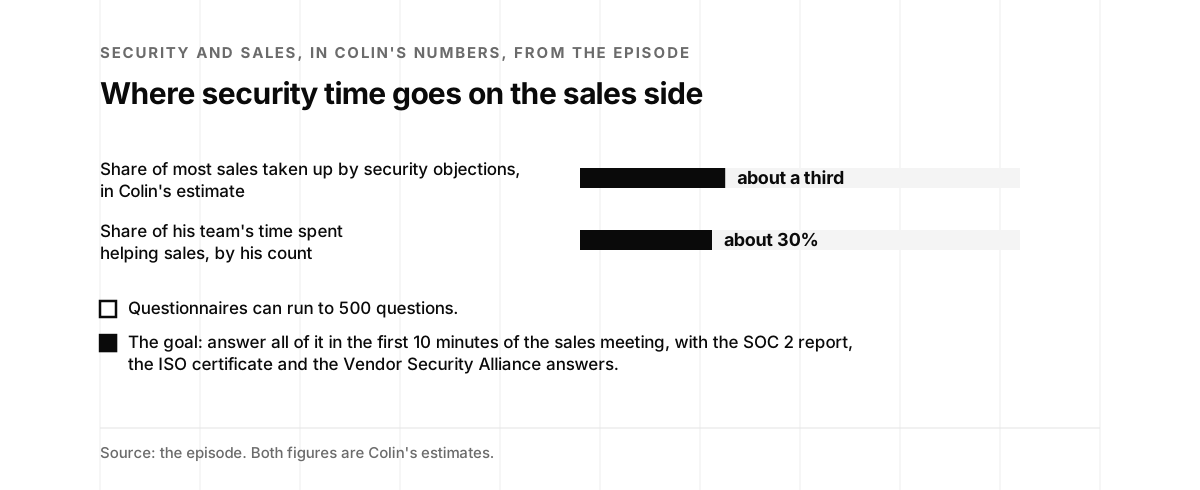
“because that’s about a third of most sales.”

Colin Bitterfield, at 14:33

Do you have a SOC 2 report? Do you do this, do you do that? Questionnaires can run to 500 questions. The goal is to answer all of it at the start:

“our goal is to take that away in the first 10 minutes of the customer meeting.”

Colin Bitterfield, at 14:42

That means the SOC 2 report, the ISO certificate and the answers to the Vendor Security Alliance questions, so security questions don’t slow the sale at all. Jon went further:

“You can turn those security teams and those potential customer deals into your biggest champions.”

Jon McLachlan, at 14:58

Colin said about a third of his team’s time goes to helping the sales team. One of the first things he did was write questions and answers for sales, so everyone gave customers the same correct answer, without guessing. The pages say what a SOC 2 report means, what the policies are, and what the company does and doesn’t do. He said security takes more writing than people think:

“You wouldn’t think that there was so much writing with security, but there is.”

Colin Bitterfield, at 15:36

The sales and platform teams backed him for it. Before the SOC 2 audit, with a week to go, everyone in the company had to finish security awareness training and sign off on the policies. The whole company did it in two days.

The Vendor Security Alliance released its first questionnaire on October 1, 2016, built by security leaders from ten companies so vendors could be assessed the same way each time (Help Net Security).
Listen · Colin Bitterfield on episode 27, from 14:35
About 20 seconds: Colin on taking security questions off the table in the first meeting. The clip stops on its own. Read the full transcript.
Two bars. Share of most sales taken up by security objections, in Colin's estimate: about a third. Share of his team's time spent helping sales, by his count: about 30%. Below, a list. Questionnaires can run to 500 questions. Filled: the goal is to answer all of it in the first 10 minutes of the sales meeting, with the SOC 2 report, the ISO certificate and the Vendor Security Alliance answers.
Where security time goes on the sales side, in Colin's numbers. Source: the episode.

How Colin got into security

Jon asked how Colin first got into security. Colin grew up in a time when hackers weren’t bad people:

“They were people who just wanted to explore the world around them and the technology that was evolving.”

Colin Bitterfield, at 16:33

In the late 1990s, he worked in the internet service provider business and saw misconfigurations causing security problems. He remembered routers from Ascend. Working on an ISP, his team logged into the wrong IP address by accident and found they had root on someone else’s core router. The owner had left the default password on it. They told the owner. Colin put it around 1995 or 1996, and he saw where things were heading.

Next he helped a consulting firm with security as Novell moved from IPX to IP addressing, and he designed their routing and their security. At the same time he served in the intelligence community in the Army Reserve:

“So security and intelligence work together. It’s the same logic.”

Colin Bitterfield, at 18:02

In 2010, he moved from knowledge management at First Army to the unit that became Army Cyber Command, a chance to help stand up a new command. Ascend Communications made dial-up equipment for internet providers and was bought by Lucent in 1999 (Wikipedia). Army Cyber Command was established on October 1, 2010 (Wikipedia).

Listen · Colin Bitterfield on episode 27, from 17:12
About 25 seconds: Colin on root access to someone else's router. The clip stops on its own. Read the full transcript.

What it does, and what it shouldn’t do

Jon offered a way to look at it. Quality assurance asks whether a thing does what we intend. Security asks a slightly different question:

“does this thing do things that we don’t intend it to do?”

Jon McLachlan, at 18:56

He said picking something apart to understand it draws many people into the field.
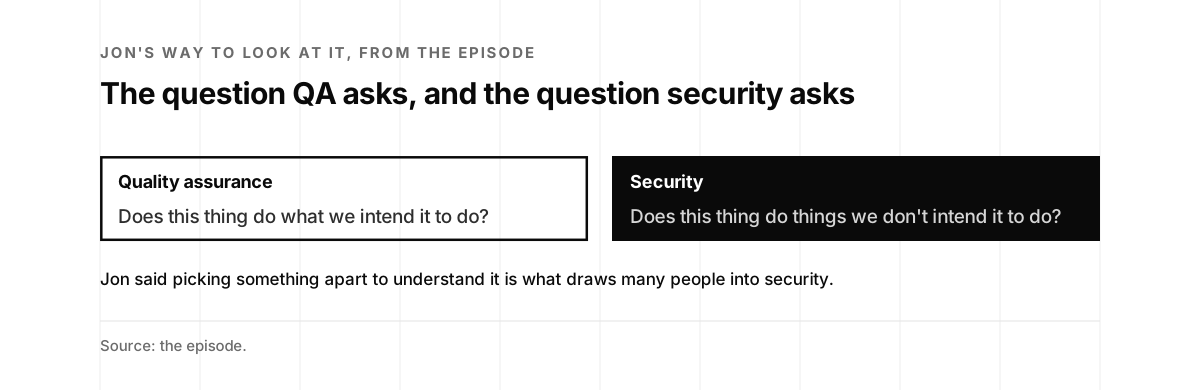
Two cards. Quality assurance: does this thing do what we intend it to do? Security, filled: does this thing do things we don't intend it to do? Below: Jon said picking something apart to understand it is what draws many people into security.
The question QA asks, and the question security asks. Source: the episode.

Attackers think like generals

Colin compared cyberattacks to Roman military tactics, with probing and cavalry actions, and said his military training carries straight over. He named a computer wargame, The Perfect General, as a way to see how a hacker looks at a target.

The attacker’s first move is to enumerate and probe your defenses. Colin’s view of hackers:

“Hackers are just people who read the manual better than the owner, most of the time.”

Colin Bitterfield, at 20:20

Most attacks, he said, use known vulnerabilities, where someone forgot the mitigating control or didn’t get to it. He named the Colonial Pipeline attack as an example of a missing patch. Wikipedia’s account says the attackers got in with a compromised password for an inactive VPN account that didn’t have multi-factor authentication, on May 7, 2021 (Wikipedia). The Perfect General came out in 1991 for the Amiga and MS-DOS (Wikipedia).

Colin likened security to riding a motorcycle:

“It’s not a matter of if, it’s a matter of when.”

Colin Bitterfield, at 20:43

The reason, he said, is that an attacker only has to be right once. The defender has a harder job:

“You have to be right every day.”

Colin Bitterfield, at 20:49
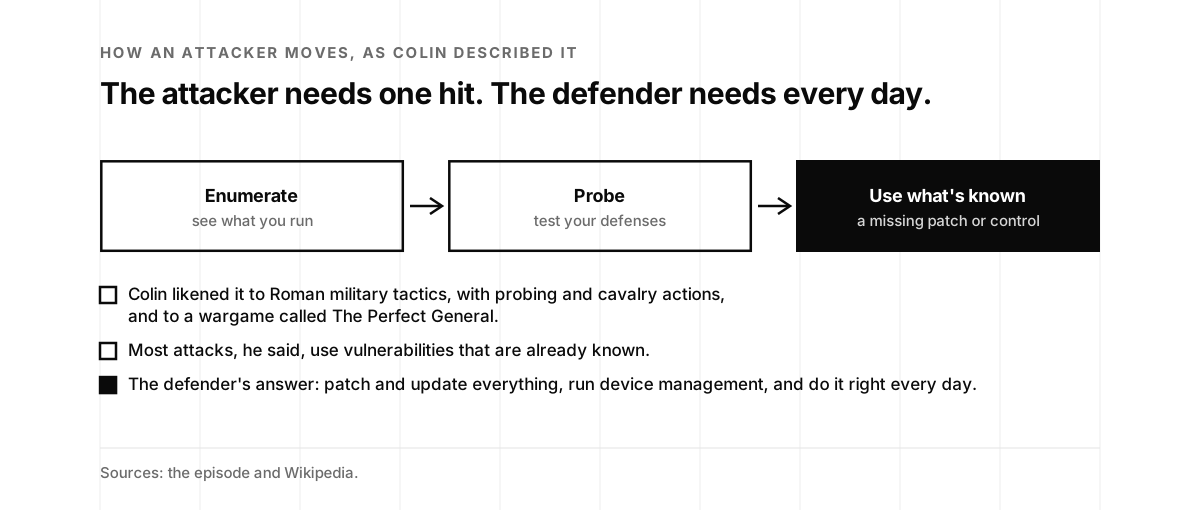
Three boxes joined by arrows. Enumerate, see what you run. Probe, test your defenses. Filled: use what's known, a missing patch or control. Below, a list. Colin likened it to Roman military tactics, with probing and cavalry actions, and to a wargame called The Perfect General. Most attacks, he said, use vulnerabilities that are already known. Filled: the defender's answer is to patch and update everything, run device management, and do it right every day.
How an attacker moves, as Colin described it, and what the defender has to do every day. Sources: the episode and Wikipedia.

Do it right, every day

Doing everything right every day is part of what keeps customers’ trust, Colin said, even after an incident, because you can show you did it right. His team patches and updates everything and runs mobile device management.

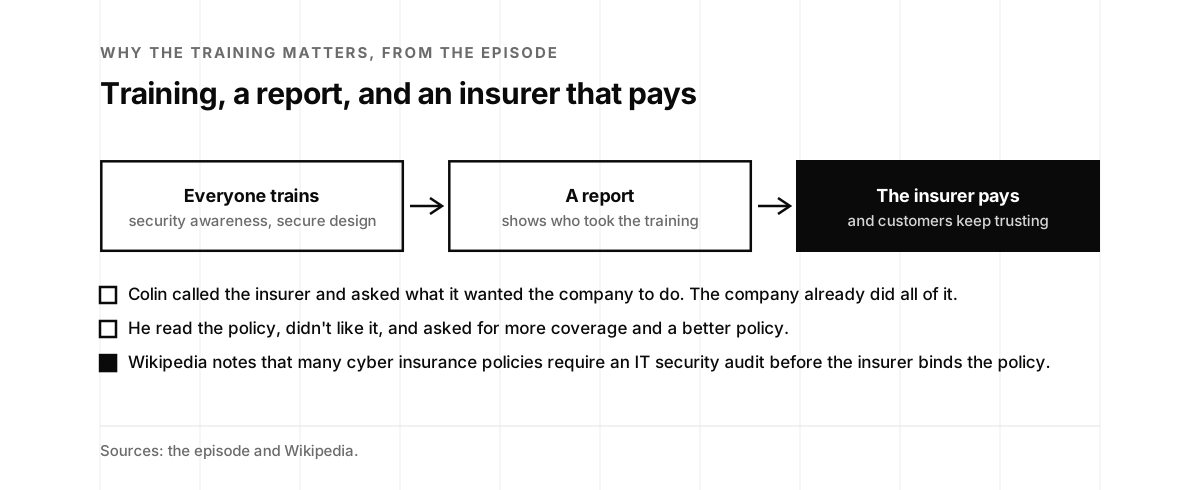
Engineers ask him why they need security awareness training when they know what attackers do. His answer is the insurance:

“our insurance won’t pay off if there’s a problem.”

Colin Bitterfield, at 21:35

He needs a report that shows everyone took the training, so the insurer pays and customers keep trusting the company. Every engineer also takes training in secure coding and secure design.

Listen · Colin Bitterfield on episode 27, from 21:22
About 25 seconds: Colin on why engineers take the training. The clip stops on its own. Read the full transcript.

Read your cyber insurance policy

Colin called the company’s insurer and asked what it wanted the company to do. The insurer sent a short list, and the company was already doing all of it. He still checked:

“I don’t know how many security people actually call their cybersecurity insurance company and find out what the requirements are, or even look at the policy.”

Colin Bitterfield, at 22:12

He reviewed the policy, didn’t like it, and asked the CEO for more coverage and a better policy. Part of his job, he joked, is keeping the company off the front page of The Wall Street Journal. He asked Jon how many security people have read the insurance that covers them. Jon couldn’t say, and compared it to car insurance:

“it’s just like you never drive a car without insurance”

Jon McLachlan, at 23:10

Many cyber insurance policies require an IT security audit before the insurer will bind the policy (Wikipedia). On episode 2, Andrew Gontarczyk talked about cyber insurance too.
Listen · Colin Bitterfield on episode 27, from 21:58
About 20 seconds: Colin on calling the insurer. The clip stops on its own. Read the full transcript.
Three boxes joined by arrows. Everyone trains, in security awareness and secure design. A report shows who took the training. Filled: the insurer pays, and customers keep trusting. Below, a list. Colin called the insurer and asked what it wanted the company to do, and the company already did all of it. He read the policy, didn't like it, and asked for more coverage and a better policy. Filled: Wikipedia notes that many cyber insurance policies require an IT security audit before the insurer binds the policy.
Training, a report, and an insurer that pays. Sources: the episode and Wikipedia.

The security package in ten minutes

When a customer asks to see something, Colin’s team shows it. Vanta let them email a trust report that shows the controls around the clock, and they used it with some bigger customers:

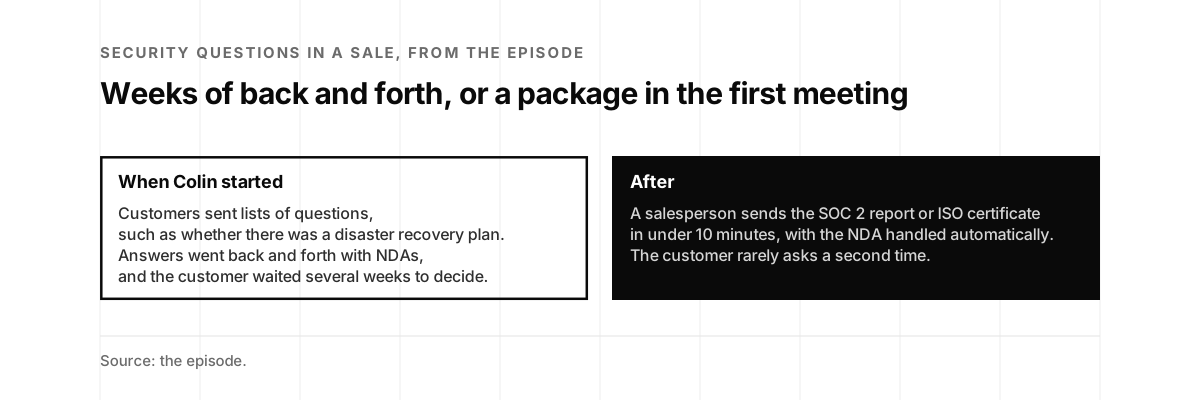
“Every salesperson in our company can send a SOC 2 or an ISO certification in like less than 10 minutes.”

Colin Bitterfield, at 23:54

The NDAs are automatic. The customer usually has all the security documents after the first meeting with sales. It wasn’t always that way. When Colin started, customers sent lists of questions, such as whether there was a disaster recovery plan, and answers went back and forth with NDAs:

“It was taking several weeks to get the customer the information that they wanted to make the decision to buy”

Colin Bitterfield, at 24:42

Now, he said, they rarely hear from the customer a second time after sales sends the security package. Only a big customer with a validation company behind it asks more. He said this shows the value of security:

“a lot of companies look at security as an expense category, not as a revenue category.”

Colin Bitterfield, at 25:12

Helping sales also makes it easier to get funding. If he needs something, he gets it, sometimes after a couple of weeks. Jon said Vanta sounded like an easy purchase to justify:

“It’s a game changer.”

Colin Bitterfield, at 25:36

On episode 64, Daniel Marashlian of Drata told how a customer’s request for a SOC 2 report pulled engineers off the roadmap at his previous company.
Listen · Colin Bitterfield on episode 27, from 24:28
About 25 seconds: Colin on weeks of back and forth before the security package. The clip stops on its own. Read the full transcript.
Two cards. When Colin started: customers sent lists of questions, such as whether there was a disaster recovery plan, answers went back and forth with NDAs, and the customer waited several weeks to decide. After, filled: a salesperson sends the SOC 2 report or ISO certificate in under 10 minutes, with the NDA handled automatically, and the customer rarely asks a second time.
Weeks of back and forth, or a security package in the first meeting. Source: the episode.
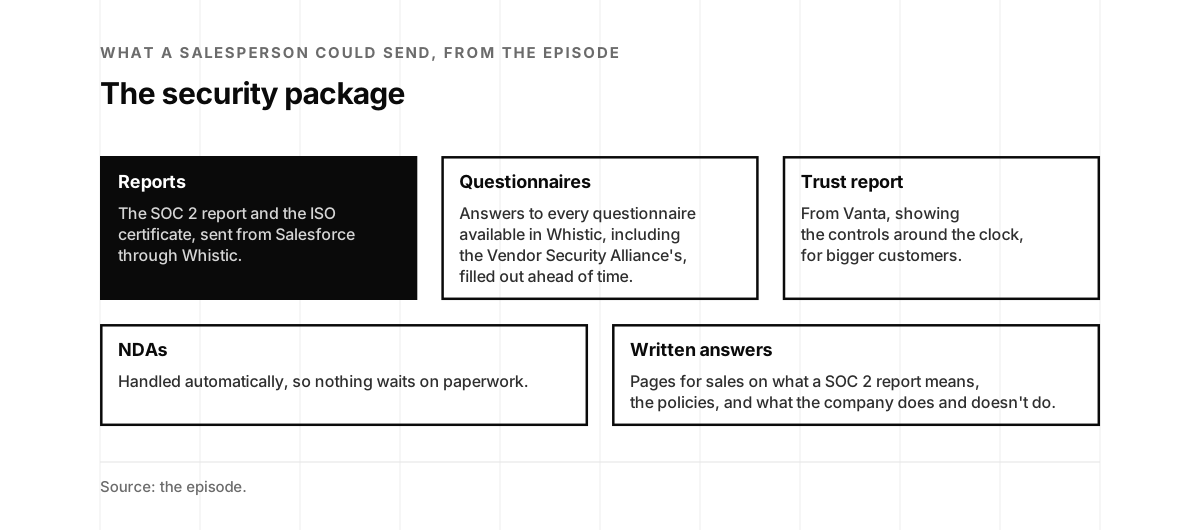
Five cards. Reports, filled: the SOC 2 report and the ISO certificate, sent from Salesforce through Whistic. Questionnaires: answers to every questionnaire available in Whistic, including the Vendor Security Alliance's, filled out ahead of time. Trust report: from Vanta, showing the controls around the clock, for bigger customers. NDAs: handled automatically, so nothing waits on paperwork. Written answers: pages for sales on what a SOC 2 report means, the policies, and what the company does and doesn't do.
What goes in the security package Colin described. Sources: the episode and People Data Labs.

Best day, worst day

Jon asked for Colin’s best day at People Data Labs so far. Colin’s answer:

“Tomorrow. The next day.”

Colin Bitterfield, at 25:44

Every day brings something new, he said, and none of it is bad. In the military, part of his work was to imagine what the bad guys would do and solve it first. At People Data Labs, the team tries to stay ahead of what customers and the industry ask for. When a salesperson asks for something, the answer is usually a link, dropped into Slack within minutes. He had the backing he wanted:

“I literally have zero pushback from any engineer on security requirements”

Colin Bitterfield, at 26:32

The leadership team supported the work, too. Jon asked for the worst day. Colin named a hard week, the ISO audit, with long days of preparation the week before. It was tiring, he said, but it didn’t feel bad, and in almost two years he hadn’t had a day he didn’t want to go to work.

Listen · Colin Bitterfield on episode 27, from 25:47
About 20 seconds: Colin on the best day. The clip stops on its own. Read the full transcript.

Fix it, and fix mistakes together

Colin gives his team a short set of rules. If you can fix something, handle it. If you need help, ask. And if you make a mistake:

“And if you make a mistake, we’ll fix it together.”

Colin Bitterfield, at 27:40

Nobody needs permission:

“If you know how to do it, do it.”

Colin Bitterfield, at 27:47

The result, he said, was IT tickets of every kind closed in about 40 minutes on average. Jon was impressed:

“That’s incredible and almost unheard of.”

Jon McLachlan, at 28:00

As they spoke, the queue had no open tickets. If someone needs something to do their job, they buy it and expense it. People Data Labs is a remote company, with its headquarters in San Francisco and an office in New York for FinTech, and no one has to go in. Half of Colin’s team was on the East Coast and half on the West Coast.
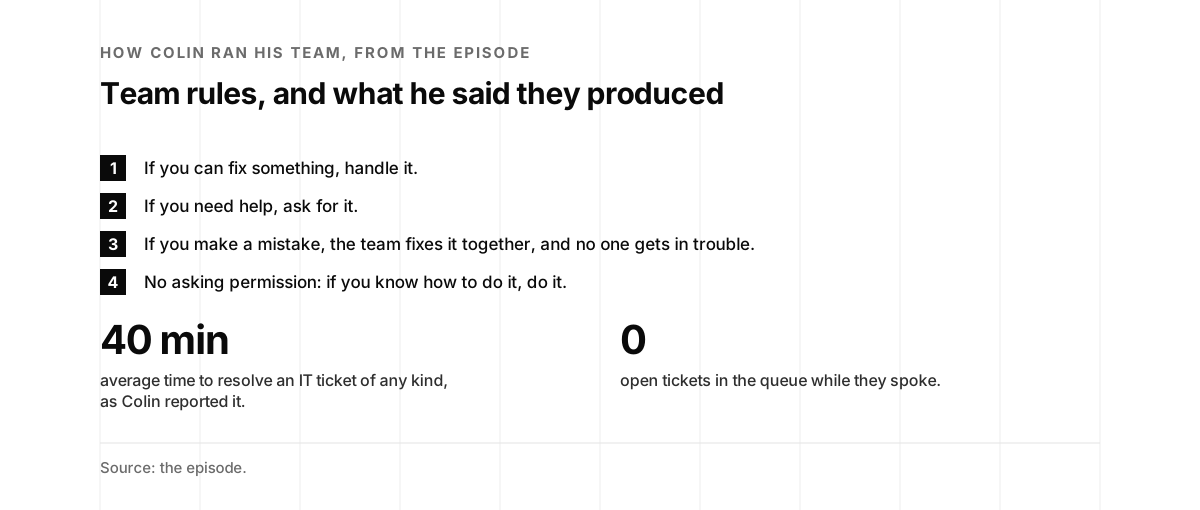
A numbered list. One: if you can fix something, handle it. Two: if you need help, ask for it. Three: if you make a mistake, the team fixes it together, and no one gets in trouble. Four: no asking permission, if you know how to do it, do it. Below, two numbers: 40 minutes, the average time to resolve an IT ticket of any kind, as Colin reported it, and 0 open tickets in the queue while they spoke.
The team rules Colin gave, and the results he reported. Source: the episode.

A side project, and four hours on Friday

Jon asked for Colin’s favorite interview question. Colin teaches it to his students too:

“what’s their side project?”

Colin Bitterfield, at 29:14

What do they do in IT that no one requires? Colin does 3D printing and programs Arduinos. Someone without a pet project or a new technology they’re learning is probably not a fit, he said:

“If you love the work, you’re doing that. If you are just doing a job, you’re not doing that.”

Colin Bitterfield, at 29:49

Jon agreed that the best engineers always have a side project or a hobby they poke at to understand it. Colin’s department gives every engineer four hours on Fridays, staffed so there’s always coverage, to learn anything they want, even a database the company doesn’t use:

“But spend four hours a week improving your professional skills.”

Colin Bitterfield, at 30:32

He took the idea from officer development in the Army, where everyone is expected to keep getting better. He pays for online training, and engineers can use an Amazon account to practice:

“But the idea is to be a better professional every week”

Colin Bitterfield, at 31:01

Jon called it a growth mindset. Colin added that he had watched the platform team play Oculus games together after hours.
Listen · Colin Bitterfield on episode 27, from 30:18
About 20 seconds: Colin on four hours of learning a week. The clip stops on its own. Read the full transcript.
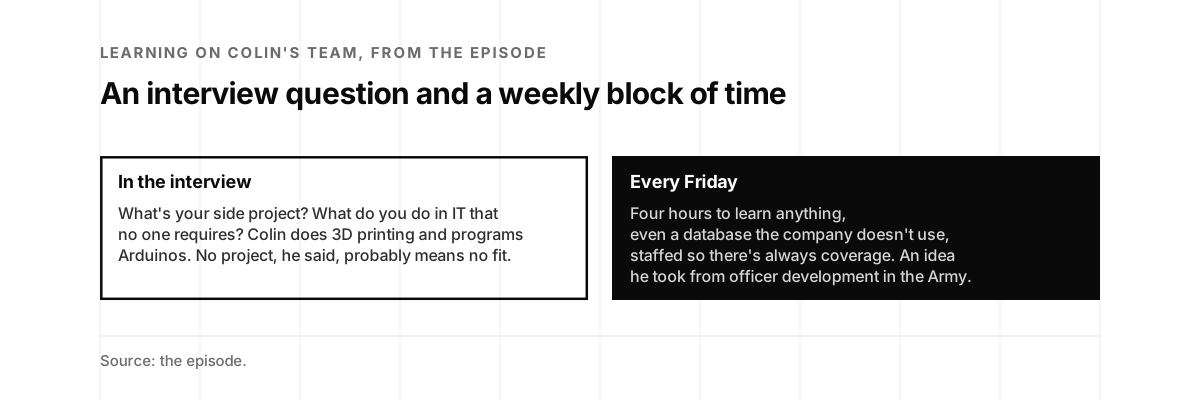
Two cards. In the interview: what's your side project, and what do you do in IT that no one requires? Colin does 3D printing and programs Arduinos, and no project, he said, probably means no fit. Every Friday, filled: four hours to learn anything, even a database the company doesn't use, staffed so there's always coverage, an idea he took from officer development in the Army.
An interview question and a weekly block of time, both about learning. Source: the episode.

Amazon’s compliance page as the goal

Colin called People Data Labs a NIST-heavy shop that also follows the best practices of its vendors, including Amazon for its infrastructure. Jon asked what tool or service he wished someone would build. Colin wanted a couple of vendors to grow, and named a target:

“right now we’re focused on that page that Amazon has with all their certifications.”

Colin Bitterfield, at 32:39

Jon agreed it’s a giant page. Amazon Web Services lists its compliance programs there: certifications and attestations such as SOC, ISO 27001, ISO 27017, ISO 27018, FedRAMP and HITRUST CSF, laws and regulations, frameworks such as NIST 800-53, and privacy pages for GDPR and CCPA (AWS). Colin wanted the same set of certifications for People Data Labs. They were planning which certifications to get and in what order: ISO 27017 and 27018 next, then GDPR and CCPA. When he worried about what came next, he said, Vanta had a dozen new kinds of certification in the works a week later. The team had also filled out every questionnaire it could find in Whistic, including the Vendor Security Alliance’s, even where it wasn’t certified, so it could send any of them fast.

FedRAMP needs a sponsor

Colin jokes with the salespeople that FedRAMP is one customer away:

“The only thing we’re missing is an SSP and a customer.”

Colin Bitterfield, at 34:05

The customer would sponsor the authorization. The SSP, or system security plan, is the security document FedRAMP requires:

“Basically, it’s every security control you have and how you’re doing it.”

Colin Bitterfield, at 34:16

He guessed it would take a few days to a week to write. FedRAMP is the U.S. government’s program for a standard approach to security assessment, authorization and continuous monitoring of cloud products. A memo from the Office of Management and Budget set it up in 2011 (Wikipedia). At Blackboard, Colin wrote about half of a FedRAMP system security plan himself (LinkedIn).

Listen · Colin Bitterfield on episode 27, from 33:56
About 30 seconds: Colin on FedRAMP, one sponsor away. The clip stops on its own. Read the full transcript.

Data where the customer works

Jon said Colin saw security as a way to open up growth. Colin listed the work in progress: integrating customers with Azure and Databricks, and already with Snowflake, where some customers like to work. People Data Labs puts its data sets there so customers can connect to them, and it was working on GCP too. He came back to his number: 30% of the team’s time goes to the revenue side, by anticipating needs. People Data Labs’ site now lists data sharing through Snowflake and Databricks, and data feeds delivered on AWS and GCP (People Data Labs).

The same rules everywhere

The salespeople thank the whole security team, Colin said, and so do customers, because the answers are honest and easy to follow. Do you encrypt data at rest? Yes, everywhere. In transit? Yes, everywhere, at all levels. His name for it:

“security through simplicity is not having different rules for different areas. It’s applying the same rules everywhere.”

Colin Bitterfield, at 36:09
Listen · Colin Bitterfield on episode 27, from 35:50
About 25 seconds: Colin on security through simplicity. The clip stops on its own. Read the full transcript.
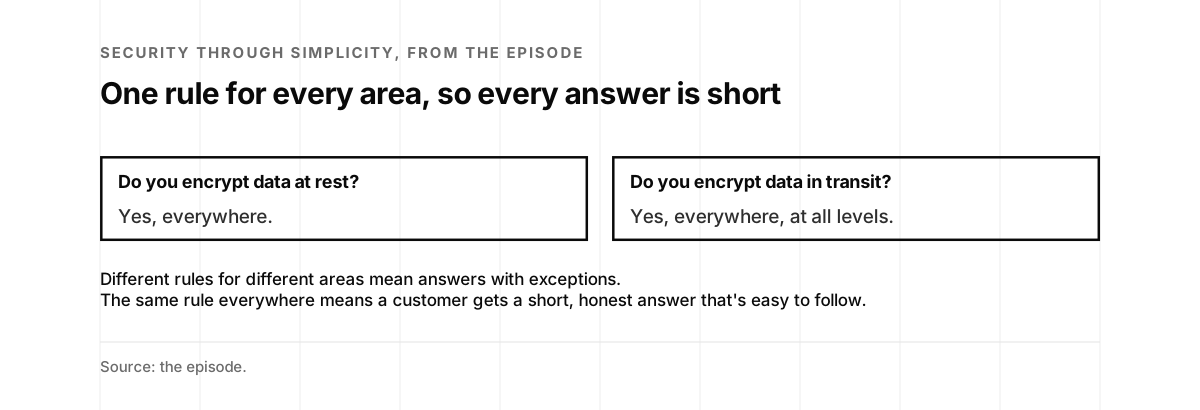
Two cards, each a customer's question and the answer. Do you encrypt data at rest? Yes, everywhere. Do you encrypt data in transit? Yes, everywhere, at all levels. Below: different rules for different areas mean answers with exceptions, and the same rule everywhere means a customer gets a short, honest answer that's easy to follow.
One rule for every area, so every answer is short. Source: the episode.

Advice for a younger Colin

Jon asked what Colin would tell his younger self. His first answer was not to micromanage your team, and Jon seconded it. The second:

“Hire people better than yourself.”

Colin Bitterfield, at 36:45

On his team, everyone has skills the others don’t, and together they did what no one could do alone. He asked how many companies can say they got ISO certified in six months. It was the whole company pulling together, he said. His advice is to get past yourself, and he gave the Army’s version:

“the credit goes to the team, and the blame goes to the leader.”

Colin Bitterfield, at 37:53

He tells his people that a mistake gets fixed together, and no one gets in trouble. That gives them the freedom to take initiative, take a risk and stretch, which helps the team move fast. Jon said autonomy, ownership and respect help a team and the people in it reach their full potential. On episode 45, Craig Goodwin, who also came to security from military intelligence, said everything is about people.

Listen · Colin Bitterfield on episode 27, from 37:45
About 40 seconds: Colin on credit, blame and mistakes. The clip stops on its own. Read the full transcript.

Pick one standard

Colin’s second piece of advice:

“pick a standard.”

Colin Bitterfield, at 38:44

He had recently been at a roundtable of CISOs with people from Amazon. The most successful companies there picked one standard and stuck to it:

“not chasing a certification.”

Colin Bitterfield, at 38:55

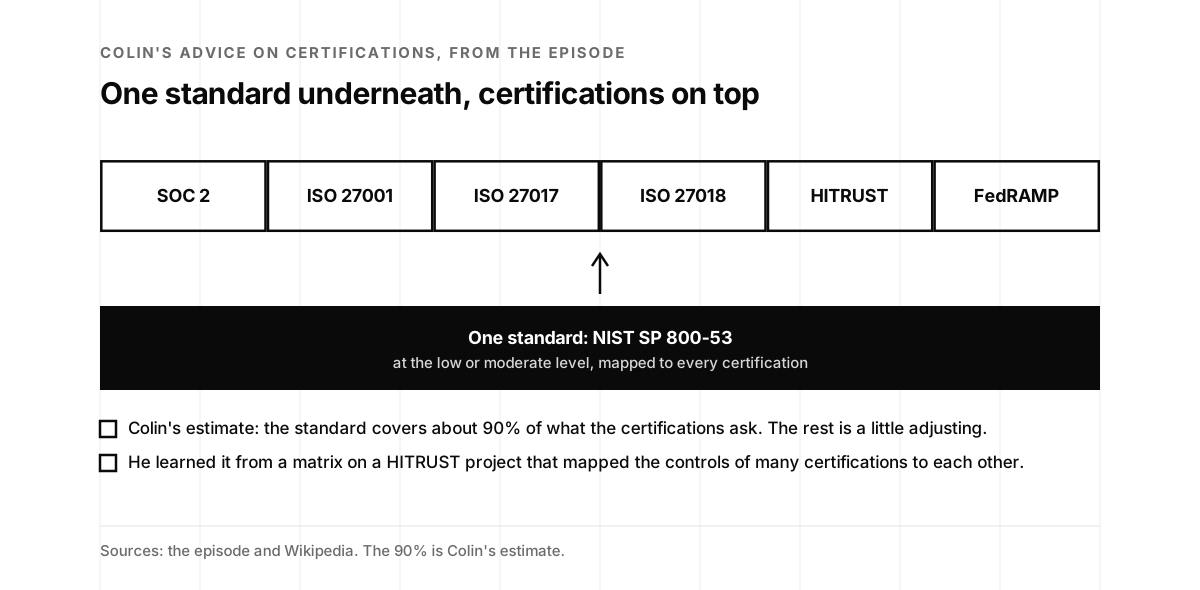
It can be CIS, ISO or another one. People Data Labs uses NIST. Treat security as one program, he said, and fit each certification to it. If you implement NIST 800 at the low or moderate level, you cover most of what any certification asks:

“you hit all the buttons for 90% of everything.”

Colin Bitterfield, at 39:29

Then each certification takes a little adjusting. He learned it long ago on a HITRUST project for a medical customer, from a matrix that mapped the controls of many certifications to each other:

“There are certain controls that are just universal across all the standards, all the certifications.”

Colin Bitterfield, at 39:53

NIST Special Publication 800-53 is a catalog of security and privacy controls, and since its fifth revision, released on September 23, 2020, it is a standard for general use (Wikipedia). HITRUST provides risk management and compliance assessments and certifications (Wikipedia). The 90% is Colin’s estimate from his own work.
Listen · Colin Bitterfield on episode 27, from 38:42
About 35 seconds: Colin on picking one standard. The clip stops on its own. Read the full transcript.
A row of six certifications: SOC 2, ISO 27001, ISO 27017, ISO 27018, HITRUST and FedRAMP. An arrow points up to them from a filled box below: one standard, NIST SP 800-53, at the low or moderate level, mapped to every certification. Below, a list. Colin's estimate is that the standard covers about 90% of what the certifications ask, and the rest is a little adjusting. He learned it from a matrix on a HITRUST project that mapped the controls of many certifications to each other.
One standard underneath, and the certifications on top of it. Sources: the episode and Wikipedia.

Vanta or Drata

Jon asked how Colin chose Vanta. He didn’t. The company had bought it about two weeks before he arrived. He could have switched, and had looked at the biggest competitor:

“I have looked at Drata, which is the biggest competitor, and I’ve heard good things about it.”

Colin Bitterfield, at 40:29

At the roundtable, companies using each tool reported similar experiences. Switching would mean a long learning curve, since the tool was tied into all their systems, and he had no reason to switch. His verdict on Vanta:

“we wouldn’t have achieved the certification as quickly without it.”

Colin Bitterfield, at 41:06

Vanta had started to add standards, including NIST 800-53, which matched People Data Labs’ plans. Colin called the trust report a big feature in the sales cycle. On episode 64, Daniel Marashlian, a co-founder of Drata, told the story of building that company.

Privacy, and the honest way

Jon noted that consumer apps now show how they use data, what they track and which third-party services they use, on the App Store. Colin said privacy is serious at People Data Labs:

“Yeah, we’re very serious about privacy here.”

Colin Bitterfield, at 42:09

The company follows GDPR and CCPA, handles data subject access requests by the rules, without deviating, and has a dedicated privacy team. Jon said he wouldn’t mind a future where companies behave like this. Colin said being direct is simpler:

“it’s easier to be direct and honest”

Colin Bitterfield, at 42:46

He ended on the culture he saw at the company:

“But that is our culture, to be honest and to do things the right way.”

Colin Bitterfield, at 43:57

On episode 52, Suha Can, then CISO of Grammarly, covered the questions enterprises ask about where their data goes.

What happened after the tape

Colin’s next roles. His LinkedIn shows People Data Labs until December 2022. Since then he has run Temple of Epiphany, a practice for CISO and virtual CISO work. Its clients include Spire Global, as principal GRC consultant, Verizon Wireless and TracFone, as principal security consultant, and ThreatMate, as virtual CISO and advisory board member. He also taught security certification courses at StackRoute Learning until November 2024 (LinkedIn).

People Data Labs’ security page. The page lists ISO 27001 and SOC 2 Type 2, standards from NIST, CIS and ISO, encryption at rest and in transit, and time-based access to critical tools. It says the company runs external penetration tests every quarter, and that for major events it will notify affected people within 24 hours of a determination, half the 48 hours Colin gave on the tape (People Data Labs). Its blog post on SOC 2 explains that a Type I report starts a review period of at least six months before a Type II report (People Data Labs).

The company’s money. On November 16, 2021, People Data Labs raised a $45 million Series B led by Craft Ventures, with $55.3 million raised in all, according to SiliconANGLE. The company was founded in 2015, and SiliconANGLE put its data at more than 3 billion profiles (SiliconANGLE). The company’s own post said it had 80 employees and planned to double in 2022 (People Data Labs).

Colin’s numbers. On August 12, 2025, Colin published “Building Security Culture: From Military Command to Silicon Valley Startups.” He reports that after the SOC 2 certification at People Data Labs, sales cycles went from 9 months to 5.4 months, deal values from $50,000 to $100,000 up to $500,000 to $1.2 million, and the cost of winning a customer dropped 35% (LinkedIn). These are his figures, from his own article.

A guide for new analysts. On October 14, 2026, Colin shared a free field guide for new security analysts, Blue Team Loadout, with entries on standards, laws, court cases, tools and platforms, each linked to its source (cyberguy.site).

Colin Bitterfield on LinkedIn, October 14, 2026: a field guide for new security analysts, and a request for feedback.

Colin Bitterfield · October 14, 2026
Colin's post on the field guide. View on LinkedIn.

Vanta grew. Vanta reached a valuation above a billion dollars in 2022, added AI features in 2023, and was valued at $4.15 billion in 2025 (Wikipedia).
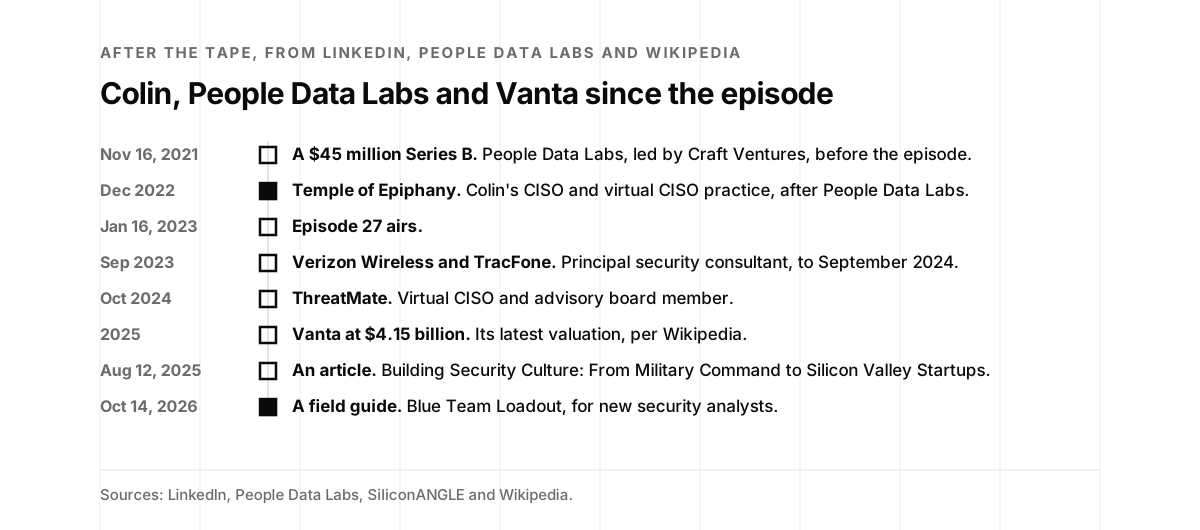
A timeline. November 16, 2021: a $45 million Series B for People Data Labs, led by Craft Ventures, before the episode. December 2022, filled: Temple of Epiphany, Colin's CISO and virtual CISO practice, after People Data Labs. January 16, 2023: episode 27 airs. September 2023: Verizon Wireless and TracFone, principal security consultant, to September 2024. October 2024: ThreatMate, virtual CISO and advisory board member. 2025: Vanta at $4.15 billion, its latest valuation, per Wikipedia. August 12, 2025: an article, Building Security Culture: From Military Command to Silicon Valley Startups. October 14, 2026, filled: a field guide, Blue Team Loadout, for new security analysts.
After the tape: Colin's roles, People Data Labs' security page and funding, and Vanta. Sources: LinkedIn, People Data Labs, SiliconANGLE and Wikipedia.

Did you catch it? A seven-question quiz

Seven questions from the episode. Each answer links the moment in the transcript or its section.

Quiz · seven questions

Did you catch it?

Pick an answer to see whether you caught it.

  1. How long did Colin say it took People Data Labs to get SOC 2?

    b. "We'll be SOC 2 in six months." Transcript, 3:23.

  2. How much harder than SOC 2 did Colin call ISO?

    c. The auditors interviewed 20 people and saw hundreds of pages. See SOC 2 in six months, then ISO.

  3. What did Colin do with every RFP in his first month?

    a. Now the answer to most questions is yes. See Security on the revenue side.

  4. About how much of most sales did Colin say security objections are?

    b. "because that's about a third of most sales." Transcript, 14:33.

  5. Why do engineers at People Data Labs take security awareness training even if they know the threats?

    c. "our insurance won't pay off if there's a problem." Transcript, 21:35.

  6. How fast could a salesperson send the SOC 2 report or ISO certificate?

    a. With the NDA handled automatically. See The security package in ten minutes.

  7. What did Colin say the most successful companies at a CISO roundtable did?

    b. People Data Labs uses NIST. See Pick one standard.

Does your security help close deals?

Eight questions on whether your security program helps the sales team, built from the episode. Each tip links the section behind it.

Scorecard · eight questions

Does your security help close deals?

Answer for the deals you sell today. If two answers fit, pick the lower one.

  1. Can a salesperson send your SOC 2 report or ISO certificate in the first meeting?

    • We don't have one yet
    • Yes, after security signs off
    • Yes, in minutes, with the NDA built in

    Colin's salespeople could send one in under 10 minutes. See The security package in ten minutes.

  2. How long does a security questionnaire take you today?

    • Weeks
    • Days
    • Hours, from answers we already have

    Weeks of back and forth is what Colin found on day one. See The security package in ten minutes.

  3. Do you track what customers ask for in RFPs and questionnaires?

    • No
    • We read them as they come
    • We keep a list and build against it

    Every RFP is a list of what customers want. See Security on the revenue side.

  4. Does your sales team have written answers to common security questions?

    • No
    • A few
    • Pages on what we do and don't do

    Everyone gives the same correct answer. See A third of every sale.

  5. What is security's first answer when someone at your company asks for something?

    • Usually no
    • It depends who asks
    • Yes, done safely

    People bring problems early when the answer is yes. See Security's first answer is yes.

  6. Do you build to one standard?

    • Each certification on its own
    • Some controls shared
    • One standard, mapped to every certification

    Pick a standard and stop chasing certifications. See Pick one standard.

  7. Does someone from security join sales calls with a customer's CISO?

    • No
    • For big deals
    • Whenever sales asks

    Colin would join any call to close a deal. See Engineers who help other teams ship.

  8. Have you read your cyber insurance policy and asked the insurer what it requires?

    • No
    • We read the policy
    • Both, and we do what it asks

    Colin called his insurer for the list. See Read your cyber insurance policy.

An expense line

Security slows deals more than it helps them. Start with a SOC 2 report salespeople can send, and written answers for the questions you get most.

Getting there

The pieces exist, but sales still waits on security. Put the documents and answers where salespeople can send them in the first meeting.

Part of the sales team

Security answers before the customer asks. Keep the list of customer asks current, and map the next certification to the standard you already follow.

What does a ready security package save?

Colin’s goal was to answer the security questions in the first 10 minutes of a sales meeting. This calculator shows the hours a package of ready answers saves on security reviews.

Calculator

What does a ready security package save?

Five numbers: security reviews a quarter, questions in each, minutes to write an answer from scratch, the share of questions your package already answers, and minutes to point a customer to a ready answer.

72.0hours saved a quarter
160.0hours without a package
88.0hours with the package
9.0working days saved

At 12 reviews a quarter with 200 questions each, writing every answer takes 160.0 hours. With 60% of the answers ready in the package, it takes 88.0 hours, 72.0 hours less, about 9.0 working days.

The calculator counts only the time to answer, at eight hours a working day. It doesn't count the days a deal waits. The default numbers are placeholders: Colin gave 500 questions as the long end, and the other numbers are yours to put in. If a ready answer takes longer than a new one, the saving goes below zero.

From Army Cyber Command to a security package

Colin’s roles, People Data Labs, the standards on the tape, and this show. Filter by topic.

Timeline

From Army Cyber Command to a security package

  1. U.S. First Army

    Knowledge management officer (LinkedIn).

  2. U.S. Army Cyber Command

    Information assurance officer and chief of the data collections branch (LinkedIn, on this page).

  3. Army Cyber Command

    The command is established (Wikipedia).

  4. FedRAMP

    A memo from the Office of Management and Budget establishes the program (Wikipedia).

  5. Cyber warfare

    Operations officer and senior cyber warfare analyst, to February 2015 (LinkedIn).

  6. Blackboard

    Principal infrastructure security engineer, through FedRAMP (LinkedIn, on this page).

  7. People Data Labs

    The company is founded (SiliconANGLE).

  8. The VSA questionnaire

    The Vendor Security Alliance releases its first questionnaire (Help Net Security).

  9. Vanta

    Founded by Christina Cacioppo and Erik Goldman (Wikipedia).

  10. NIST SP 800-53, revision 5

    The control catalog becomes a standard for general use (Wikipedia, on this page).

  11. Colin joins People Data Labs

    To run IT and security (LinkedIn, on this page).

  12. Colonial Pipeline

    A ransomware attack that began with a compromised VPN password (Wikipedia, on this page).

  13. Episode 2

    Andrew Gontarczyk on building a security team (episode page).

  14. A $45 million Series B

    Led by Craft Ventures (SiliconANGLE).

  15. Temple of Epiphany

    CISO and virtual CISO practice (LinkedIn).

  16. Episode 27

    Colin on the show (Podbean, transcript).

  17. Verizon Wireless and TracFone

    Principal security consultant, to September 2024 (LinkedIn).

  18. Episode 45

    Craig Goodwin on security for small businesses (episode page).

  19. Episode 52

    Suha Can on safeguarding user data (episode page).

  20. ThreatMate

    Virtual CISO and advisory board member (LinkedIn).

  21. Episode 64

    Daniel Marashlian of Drata (episode page).

  22. Vanta at $4.15 billion

    Its latest valuation (Wikipedia).

  23. Building Security Culture

    Colin's article on military leadership and startup security (LinkedIn, on this page).

  24. A field guide

    Blue Team Loadout, for new security analysts (LinkedIn).

What to do this week

Five things, in the order of the episode.

  1. Read your last five RFPs. List everything the customers asked for, and mark what you can say yes to today, as in Security on the revenue side.
  2. Build the security package. Put the SOC 2 report, the certificates and your written answers where a salesperson can send them in the first meeting, as in The security package in ten minutes. The calculator shows the hours it saves.
  3. Call your insurer. Ask what the policy requires, and check you can prove each item, as in Read your cyber insurance policy.
  4. Pick one standard. Map your next certification to the standard you already follow, as in Pick one standard.
  5. Get help with it. Our Sales Support team answers questionnaires and joins your sales calls as your security team, and SOC 2 Type 2 gets you the report buyers ask for. vCISO Services gives you a security leader, and FedRAMP Readiness writes the system security plan for when a federal sponsor appears. If you want to talk it through, book 15 minutes with us.

Key takeaways

  1. Security can help sell

    Colin's department treated security as part of the revenue cycle. About 30% of its time went to RFPs and sales, and a ready security package answered most questions in the first sales meeting.

  2. RFPs show what customers want

    In his first month, Colin listed everything customers asked for in RFPs and made sure the company did it, so the answer to most questions became yes.

  3. Security's first answer is yes

    Colin told the whole company that security is there to say yes, done in a secure and responsible way. People then bring questions early, such as whether an email is phishing, and his team solves problems before they happen.

  4. Send the package in the first meeting

    Salespeople could send the SOC 2 report or ISO certificate in under 10 minutes, with NDAs handled automatically. Before that, security questions took weeks of back and forth.

  5. Read your insurance policy

    Colin called the company's insurer to ask what it required, checked that the company already did it, and asked for a better policy. Training reports help make sure the insurer pays.

  6. Pick one standard

    Build to one standard, such as NIST, and map each certification to it. Colin estimated that NIST 800 at the low or moderate level covers about 90% of what certifications ask.

  7. The same rules everywhere

    Security through simplicity means one rule for every area, such as encryption at rest and in transit everywhere, so every answer to a customer is short.

  8. Fix mistakes together

    Colin's team rules: handle what you can, ask for help, and fix mistakes together with no one in trouble. He reported IT tickets resolved in about 40 minutes.

Chapters

Tap a chapter to play from there.

Pull quotes

“security is here to say yes.”

Colin Bitterfield ·

“You want to be SOC 2 in six months? Fine. We'll be SOC 2 in six months.”

Colin Bitterfield ·

“which, by the way, is about 10 times harder than SOC.”

Colin Bitterfield ·

“the entry-level positions really aren't entry-level.”

Colin Bitterfield ·

“our most valuable currency is really trust.”

Jon McLachlan ·

“to make security part of the revenue cycle, not just an expense category.”

Colin Bitterfield ·

“Our first answer to everybody in this company is yes.”

Colin Bitterfield ·

“I always like to joke that there's two types of security people in the world.”

Jon McLachlan ·

“our goal is to take that away in the first 10 minutes of the customer meeting.”

Colin Bitterfield ·

“Hackers are just people who read the manual better than the owner, most of the time.”

Colin Bitterfield ·

“Every salesperson in our company can send a SOC 2 or an ISO certification in like less than 10 minutes.”

Colin Bitterfield ·

“a lot of companies look at security as an expense category, not as a revenue category.”

Colin Bitterfield ·

“security through simplicity is not having different rules for different areas. It's applying the same rules everywhere.”

Colin Bitterfield ·

“the credit goes to the team, and the blame goes to the leader.”

Colin Bitterfield ·

“you hit all the buttons for 90% of everything.”

Colin Bitterfield ·

About the guest

Colin Bitterfield, Head of Security (Acting CISO), People Data Labs

Colin Bitterfield is a security leader who served 27 years in the military, including as a knowledge management officer at U.S. First Army and, at U.S. Army Cyber Command, as an information assurance officer, an operations officer and a senior cyber warfare analyst. He was a principal infrastructure security engineer at Blackboard, where the company went through FedRAMP, and a principal infrastructure security consultant at B3Partners. At the time of this episode he was head of security and acting CISO at People Data Labs, which he joined in March 2021 to build IT and security operations. Since December 2022 he has run Temple of Epiphany, a CISO and virtual CISO practice. He has taught security at StackRoute Learning, the University of Wisconsin-Madison, ECPI University and ITT Technical Institute, and holds a master's degree in information assurance from Capitol Technology University.

About the host

Jon McLachlan is co-founder of YSecurity, the on-demand cybersecurity team for startups, and of Cyberbase.ai. The Security Podcast of Silicon Valley is hosted by Jon McLachlan and Sasha Sinkevich. Jon McLachlan on LinkedIn ↗

Context and sources

  • Episode 27 on Podbean: Colin Bitterfield - Head of Security (Acting CISO) People Data Labs. Source ↗
  • Colin Bitterfield's LinkedIn: U.S. First Army from October 2007, U.S. Army Cyber Command from August 2010 to February 2015, Blackboard from April 2015 to August 2019, B3Partners from September 2019, People Data Labs from March 2021 to December 2022, and Temple of Epiphany from December 2022, with clients including Spire Global, Verizon Wireless and TracFone, and ThreatMate. Source ↗
  • Colin Bitterfield on LinkedIn, August 12, 2025: Building Security Culture: From Military Command to Silicon Valley Startups, with the sales cycle, deal size and acquisition cost figures he reports for People Data Labs after SOC 2. Source ↗
  • Colin Bitterfield on LinkedIn, October 14, 2026: a field guide for new security analysts, with a request for feedback. Source ↗
  • People Data Labs: workforce data on people, companies and job postings, through APIs, data license feeds, Snowflake and Databricks. Source ↗
  • People Data Labs security page: ISO 27001, SOC 2 Type 2, NIST, CIS and ISO standards, quarterly external penetration tests, and notice to affected people within 24 hours of a determination for major events. Source ↗
  • People Data Labs blog: SOC 2 Type I accreditation, and the six-month review period before SOC 2 Type II. Source ↗
  • SiliconANGLE, November 16, 2021: People Data Labs raises a $45 million Series B led by Craft Ventures, with $55.3 million raised in all. The company was founded in 2015. Source ↗
  • People Data Labs, November 16, 2021: the Series B, a team of 80, and plans to double in 2022. Source ↗
  • AWS Compliance Programs: certifications and attestations, laws and regulations, frameworks such as NIST 800-53, and privacy pages. Source ↗
  • Help Net Security, October 6, 2016: the Vendor Security Alliance releases its first questionnaire, on October 1, 2016. Source ↗
  • Wikipedia, System and Organization Controls: the AICPA's suite of audit reports, and the Trust Services Criteria behind SOC 2. Source ↗
  • Wikipedia, ISO/IEC 27001, ISO/IEC 27017 and ISO/IEC 27018: an information security management system, cloud security controls, and protecting personal data in public clouds. Source ↗
  • Wikipedia, NIST SP 800-53: a catalog of security and privacy controls, released as revision 5 on September 23, 2020. Source ↗
  • Wikipedia, FedRAMP: the U.S. government's program for security assessment, authorization and continuous monitoring of cloud products, established by an OMB memo in 2011. Source ↗
  • Wikipedia, Vanta: founded in 2018 by Christina Cacioppo and Erik Goldman, valued at $4.15 billion in 2025. Source ↗
  • Wikipedia, Colonial Pipeline ransomware attack: May 7, 2021, through a compromised password for an inactive VPN account without multi-factor authentication. Source ↗
  • Wikipedia, United States Army Cyber Command: established on October 1, 2010. Source ↗
  • Wikipedia, Cyber insurance: many policies require an IT security audit before the insurer binds the policy. Source ↗

Transcript

Automatic transcription. Jon McLachlan hosts this episode with Colin Bitterfield, then head of security at People Data Labs. There is no diarization on the tape, so speaker labels were assigned from the content and checked against reference recordings of each voice from this episode and against voice pitch, and a few short lines may sit with the wrong speaker. Names and terms were normalized where the recognizer misheard them (Jon McLachlan, Colin Bitterfield, People Data Labs, Vanta, Whistic, SOC 2). Words in [brackets] are best guesses where the audio is unclear, and [...] marks words no decode made out. Answers are transcribed as spoken, though many repeated words and false starts are left out. Short backchannels such as "yeah" and "right" are left out where they overlap the other speaker.

Read the full transcript 8,287 words

Jon McLachlan

Hello, everyone, and welcome to another episode of the Security Podcast in Silicon Valley. I'm here today with a very special guest, Colin Bitterfield, the head of security at People Data Labs. Welcome to the show, Colin.

Colin Bitterfield

Thank you. I'm looking forward to telling you all about all the great work we're doing here and how we're going to be the leader in this space in security. And that is our goal.

Jon McLachlan

Sounds very ambitious. Just to share with our listeners a little bit about your background, it looks like you came up through the engineering side of the house. If you on your LinkedIn, it looks like your first gig was with Sun Microsystems, the systems engineer. You worked for the National Security Agency for a bit, then joined the U.S. Army Reserves. You were [a G2, G6] staff officer, intelligence and communications, along with a lot of very specific gigs and U.S. First Army and then U.S. Army Cyber Command. You were an information affairs officer there, chief of the data collections branch. Other roles in the Army Cyber Command included, you were an operations officer, a cyber warfare analyst, a senior cyber warfare analyst, and took some adjunct professorships. Then it looks like you cut into private industry as a principal infrastructure security engineer at Blackboard. The DC area?

Colin Bitterfield

It is. I retired out of the Army in 2015 and I joined, I was tired of working in the basements of buildings and I wanted some windows. So I went to the startup space, which Blackboard is still the startup, and I helped them spin up their enterprise security division. And we wound up going through FedRAMP certification, all of that kind of cool stuff. I set up all the [SIEM] and the vulnerability management systems and hardening guide and all kinds of cool stuff. Before that, I did five years as a cyber warfare officer. I spent a good chunk of my adult life in the intelligence community.

Jon McLachlan

Wow.

Colin Bitterfield

And after the war started in 2001, I gave up my civilian career, went back onto active duty, and I served there until 2015. I retired out of the military in 2015 and went back into the civilian world. I've been working with computers since the 70s. My dad was an engineer, and I spent most of my childhood in a lab learning how to overclock systems that were in the megahertz. We went from a half a megahertz to one megahertz back in the day. So I've been playing with this technology for like my whole life. I came to People Data Labs last March and I was supposed to be an engineer. And the next thing I know, I'm the head of security running the IT and security department. And the C-staff here is extremely serious about being the leader in security. They gave me a corporate credit card and said, whatever you need, make it happen. Be the best.

Jon McLachlan

And here come all the [...].

Colin Bitterfield

Yeah, exactly. I spent a fair amount of money in that first couple of months.

Jon McLachlan

I've heard that story many times, but I've never heard it in the context of just one day. So that's very impressive.

Colin Bitterfield

You got the job, you're starting on, I think it was like a Tuesday or something. And yeah, here's your corporate credit card. Like, literally, first day, you got your corporate credit card, and we want to be the best in security. Oh, but in the Army, we're used to like taking very short instructions and turning them into things. You want to be SOC 2 in six months? Fine. We'll be SOC 2 in six months. And we achieved that. And one of the coolest parts was we just went through an ISO certification, which, by the way, is about 10 times harder than SOC. I don't know who ever said that SOC was hard. ISO, we had 20 people interviewed by the auditors. We had [to] show hundreds of pages of documentation. But what was really cool is that the auditors actually sent us back a fairly nice compliment about how well prepared we were and how everything was ready. Like I said, some of the military experience about being prepared for inspections.

Jon McLachlan

Absolutely. So, before we go deeper into that, I want to share a very public, warm, and authentic thank you for your service and all of the time that you've spent in the military serving. I know that going forward, information and cybersecurity are going to be a big part of conflicts, and having the best and the brightest help protect the country is extremely important. So, a huge thank you, Colin.

Colin Bitterfield

I appreciate that. And I had a lot of good experiences in the military. I served for 27 years.

Jon McLachlan

Yeah, that's amazing. I come from a little bit of, there's some military in my family, too. So, I understand some of the sacrifices that have to be made.

Colin Bitterfield

I don't regret anything I've done in the military. Neither did my father nor my grandfather. My grandfather served World War I and my father Vietnam, and now my son serves.

Jon McLachlan

Wow. Long family of service.

Colin Bitterfield

I was the only one that was a career, though. My son may be a career, but my father and grandfather were to those wars. But one of the things the military teaches you is how to stay focused and keep your eye on a target. And that really helps in security. You and I were chatting earlier about dealing with people. Sometimes people want to talk about everything but the issue, but it can take a while to dig in. And so, what really, I think it helped us achieve this certification was keeping things focused and not getting sidetracked by all the things that can happen, like the 10,000 vendors that call you every week. I get a lot of calls, crazy SaaS startup applications. I'm like, I don't even know where the problem is you're trying to solve, but sure, I'll listen to you for five minutes. I get that on a pretty regular basis.

Jon McLachlan

Very generous with your time. I give those calls like 30 seconds.

Colin Bitterfield

I try to actually respond to everybody that emails me in a polite way. Thank you, but no, thank you. But I try to at least actually respond.

Jon McLachlan

Acknowledge this humanity behind the hustle, behind the person trying to, I guess, they have good intentions. They're trying to help change the world for the better. And sometimes it's just a different perspective and different set of values that drive it.

Colin Bitterfield

My dad, my parents taught me to be polite. And I think ghosting people and not responding is impolite. I've had some guys send me some really nice sales pitches. One guy wrote me like a, I don't know, like a whiteboard, like one of those little cartoony things. He was like doing this. I'm like, I love your ad. I don't need your software, but I love your ad. And I wrote back to him and said that. But I do, it's like when we were interviewing, I actually reviewed, I don't know how many hundreds of resumes for positions. And even though I reviewed them all, no matter what the applicant tracking system said, because one of the problems is a lot of people don't know how to write a resume, especially for security. I was really privileged that about 14 of my students had applied. I had, when I was asked to rehire, I went and I wrote job descriptions specifically for entry-level for a program I was teaching. So basically, if they graduated the program, they were fully qualified for the job. Because so many students talk about how they can't get a job. They go through a certification program, but people want them to be a purple unicorn or a dancing squirrel. And what they're, the entry-level positions really aren't entry-level.

Jon McLachlan

Yeah.

Colin Bitterfield

So I was very careful. I wrote a job description for somebody who had a year or two of IT experience and wanted to break into security, and wound up actually hiring one of my students from the University of Miami. And the guy is incredible.

Jon McLachlan

He's still there with you at the People Data Labs?

Colin Bitterfield

He is. [Victor Santo]. He is an incredible young man. He thinks like a senior person. He just needs experience and he's incredibly good. I've got another guy, Ruben, who worked for a game company for a long time, really experienced. We have a really good team. One of the engineers of my team has been there since the company started, [Sean Thawn]. He's been there since the, he was employee number seven, and he's now on my team. Also incredibly gifted. The thing that's really nice at People Data Labs is the whole company is a single team. No matter what department you're in, part of the corporate culture is you don't need to ask permission to talk to somebody, just go talk to them. And so there's a lot of really fast action that can happen, especially when you need to deal with an issue. We've been very lucky. Our space is crowded in the data space, but our intention to set ourselves apart is to literally be the best in security so the customers trust us. And we've been seeing that pay dividends. The SOC certification, the ISO certification has allowed us to interact with much larger companies, and they trust us because we're taking the time to do everything right.

Jon McLachlan

That's right. It's been a really nice journey. And actionable security maturity with those certifications, demonstrated through those certifications. I think a lot of people like really struggle with the certification piece of security. Yeah. I'm curious, do you happen to use like a vendor to help navigate those requirements? Was it Vanta, by chance, or?

Colin Bitterfield

It was Vanta. Vanta was great. I deal with Michelle over there. It's a great company. In the last year and a half, I think they have tripled or quadrupled the number of tests they provide. And now they've gone from SOC 2 and ISO into GDPR and CCPA, and I think FedRAMP's coming up next. By next year, we plan to be certified ISO [27017] and [27018] for privacy and GDPR, because we have a growing business model in Europe. So we're trying to really get those certifications under control and all and completely certified. We hired a head of privacy about six, seven months ago, doing an incredible job making sure we're compliant with everything to do with privacy. And we really do everything we say we're doing, which is really nice.

Jon McLachlan

I like the candor of that. That's good. I think a big piece of being in the security space is our most valuable currency is really trust.

Colin Bitterfield

It is. What's really nice is we use a couple of different vendors to help us with that. Whistic is another one. So our salespeople directly from Salesforce can send out a SOC 2 or an ISO certification directly to a customer. And part of the philosophy that I have, and that my department has, is to make security part of the revenue cycle, not just an expense category. So, about 30% of our time is answering RFPs. And RFPs are a real valuable lesson for security people to see what your customer wants. And a lot of people don't pay attention to that. So, the first month or so I was at the company, I'm reviewing all the RFPs and anything that was in an RFP a customer wanted, I put it on a list and made sure we did it. Literally, now when a customer asks us, do you do this or do you do that? We can say yes almost without any exception across the board everywhere. Some things we might do a little differently, like our breach notification is 48 hours. Some customers request 24. But that's like the differential between what we do and what the customer wants. And it's not much. And our goal is to really say yes to everything. And part of the thing that we started in the company more than a year ago was I got to talk to the whole company. I said, listen, security is here to say yes. Our first answer to everybody in this company is yes. Just ask us. Our goal is to help you do whatever you want to do, but do it in a secure and responsible manner. And we rarely say no to anything. But because we're open and people know that, people will call us up and they'll say, hey, is this a phishing email, or should I be doing this, or any number of questions. And they're not hiding anything. And that gives us a tremendous leap on solving problems before they happen. I think in a lot of companies, [security's seen as] the department of no, and if people don't want to bring an issue up because they're afraid they're going to get shut down or it'll affect their velocity. But we've been able to establish trust not only with our customers, but our internal engineering departments and product and marketing, almost across the board.

Jon McLachlan

So you built up that trust, and then from that, confidence that you're part of the delivery component. So people bring difficult problems to you and are optimistic of getting something aligned with the aggressive timelines that maybe are presented from a business perspective. So, that's amazing. That actually takes a lot of very dedicated, focused, hard work. I know that firsthand. I always like to joke that there's two types of security people in the world. There's one type where you will walk into a meeting room and everyone will go, oh no, so-and-so is here, and they're going to say no, and they're going to push back on the timelines and ask all of us to build all these things into this product, and it's going to just impact everything, like, in a negative sense. And there's another type of security person that will walk into that exact same meeting room and have exactly the same goals, but they'll be perceived as a collaborator, someone who's going to work with the aggressive timelines and isolate out exactly what needs to be in the MVP and help deliver those things. And it may even end up pushing the timelines back a little bit to get some of those critical features in. But it's all in the perception that's different between these two. You may actually be effective at influencing change in your organization, but building that relationship around trust and delivery, as opposed to control and arbitrary structure, makes a huge difference.

Colin Bitterfield

Yeah. And our engineers on our team will actually go out. If we have a platform and they're running behind on a project, we'll help them. If they need to put a security control in and they're just running behind because of a deliverable, our engineers will just roll up their sleeves and help with the work. And that's what I mean about the whole company operating as a team. Because a year ago, we were 56 people-ish. Now we're 150 people. At 50 people, everybody was like rolling up sleeves and getting stuff done. And it's like I was going through the ISO certification, the auditor wanted to talk to the C-staff. So I Slacked the CEO of the company, and he hops on the meeting like 10 minutes later. That's the kind of support we're getting from our C-staff. They will drop everything if we need them for something. And if somebody needs something done, we get it done for them. Sometimes it's, okay, what do you need? What help do you need? It's like I tell our salespeople, if you need me on a call with a customer to talk to a CISO, I will hop on a call with any customer you want, anytime you want, to close the deal. Because by shortening the revenue cycle, one of the goals in our department is to affect the revenue cycle by taking away the objections of security, because that's about a third of most sales.

Jon McLachlan

Yes.

Colin Bitterfield

Do you have a SOC? Do you have this? Do you do that? There's like questionnaires up the yin-yang of 500 questions and such. And our goal is to take that away in the first 10 minutes of the customer meeting. Here's everything you need, Mr. Customer. Here's our SOC 2. Here's our ISO. Here's our VSA questions. Everything you need, so that the sales cycle is not impacted at all by security questions.

Jon McLachlan

In fact, the opposite. You can turn those security teams and those potential customer deals into your biggest champions.

Colin Bitterfield

Exactly. And so we really do see about a third of our time spent on helping the sales team. One of the first things I did was prepare [guides], questions and answers for the sales team, so that everybody was giving the customers the correct and the same answer, not guessing. So we prepared a number of pages in our internal system, and it'd say, okay, we have a SOC 2. This is what it means. Here's our policies. Here's what we do. Here's what we don't do. And we prepared a bunch of sales materials. It was like one of the first things I did in the first month: prepare sales materials. You wouldn't think that there was so much writing with security, but there is. But by doing so, we've gotten huge support from the entire sales team, from the platform team, and it's made a huge difference. I remember going into the SOC 2 audit, and we had a week, and we had to get everybody in the company security awareness trained and policy signed off on, and the entire company worked on it for two days till the entire company was done. Wow. That's the kind of teamwork we have.

Jon McLachlan

That sounds like an amazing group of people. And you sound like you're very effective at what you do. You're putting all of your great experience to use, but there's also passion behind it, I can tell. And so, I'm super curious, and I'm sure our listeners are: how did you first get into security? Was there something that drew you into this field?

Colin Bitterfield

I'm not exactly sure about the security. I was always interested. I was one of those kids who grew up when hackers weren't bad people. They were people who just wanted to explore the world around them and the technology that was evolving. It's a different kind of group than what hackers are today. And my dad was an engineer in this biotech lab, and we were constantly taking things apart and putting them together and making them do things that were new. I got a real passion for that one. It's like, under 10. And then in the late 90s, I got into the ISP business, and I could see that there were a lot of misconfiguration issues leading to security problems. There was this, I can't remember the name of the company, it was a router, Ascend routers. That was it. They were really big for a while. I don't know whatever happened to them, but they vanished. And I remember we were working on an ISP, and we logged into an IP address by accident, like the wrong IP address, and we had a root on somebody else's router. I'm like, this is not a good thing. Oops. And so we contacted them, let them know that they had the default password on there, and you could just log into the router and make serious changes to a core router, and they had no security on it. And that was like '95, '96, that time frame. And I could see the writing on the wall. And then I wound up working for this company, a [...] consulting group out of [Charlestown], Massachusetts. And they needed help with a security run on Novell, as Novell was transitioning from IPX to NWIP, IP addresses, basically. So I helped them develop their routing scheme and their security, and I kind of got a knack for it. And at the same time, I was working in the intelligence community in the Army Reserve. So security and intelligence work together. It's the same logic. It's very simple. And I just kind of evolved into that. And then in 2010, I was at First Army doing knowledge management, and I got a chance to move over to what was the [GNOSC], which will become Army Cyber Command a year later. And that was a great opportunity that I took, to stand up a new command. And so it was a really good thing. But I've always been interested in computers and seeing how they work and how to make them work better.

Jon McLachlan

Yeah. And it's funny. One way to look at security, through the lens of QA, the traditional quality [assurance], it's answering the question: hey, does this thing do what we intend it to do? And security, through a very similar QA lens, is asking a very similar question, but slightly different, in that, does this thing do things that we don't intend it to do? And picking something apart just to understand it and to see what you can do with it is actually something that I hear quite often, and it draws in this passion just to understand.

Colin Bitterfield

It really is. And [...] security is a lot like warfare, although people don't always equate it that way. Everything that you do in a cyber attack is very much like Roman military tactics, probing, cavalry actions, and things like that. So the military training I received really relates directly into cybersecurity, because you're looking at how things happen. What are the tactics? What are the responses? When you're doing cyber warfare in a combat environment, which I did in Iraq, it's a very different world, because you have different levels of things you can do that are just not possible in the civilian sector, like shutting off an entire country from the internet if you want to. We could do that. Or stopping an attack by dropping a bomb on the bad guys. Can't do that in the civilian world. You can do that in the military. But it's very much the same thing as you would look at tactics. So if you like to play a game like The Perfect General, it's a lot like how a hacker looks at it. What is the first thing he tries to do? Enumerate and probe your defenses, see what you're doing. Hackers are just people who read the manual better than the owner, most of the time. If you look at most of the attacks, they're based on vulnerabilities that are known. People should have put the mitigating controls in and forgot or just didn't get to it. Look at the Colonial Pipeline. No patch, just 10 years. What did you expect? And the other thing I look at security is, it's a lot like riding a motorcycle. It's not a matter of if, it's a matter of when.

Jon McLachlan

Right.

Colin Bitterfield

Because the bad guy only has to be right once. You have to be right every day.

Jon McLachlan

That's right.

Colin Bitterfield

But part of the trust mechanism in cybersecurity is to make sure you did everything right every day, so that your customers still trust you, even if there was an issue. And I know that doesn't quite sound like where cybersecurity is, but you have to do everything right so that you can actually say you did it right too. So we patch everything, we update everything, we do mobile device management. Everything that needs to be done, we do it. And there's a couple of reasons why most people escape them. Like, one of the things that people don't understand is, why do I do security awareness training? I know what the bad guys are doing, right? How many times have you heard that? And I have these crazy engineers, right? And so they'll say that to me, I know what I'm saying. Okay, here's the problem. What you don't know is, if you don't take the cybersecurity awareness, our insurance won't pay off if there's a problem. So go take your training. [Don't] care if you know everything. I need a report that says you did the training, so that if we ever have a problem, the insurance company pays and our customers still trust us, right? So you're going to do that, and you're also going to take secure coding principles and secure design principles. Every engineer in our company takes design training in addition to their security awareness training.

Jon McLachlan

That's good.

Colin Bitterfield

I even contacted our insurance company to make sure there were no hidden, what do you want us to take? You tell me [whatever] you want from the insurance perspective, and I'll make sure we get it. And I actually heard back from them, and they gave me a little list of things. I'm like, yeah, we're already doing those, but I still verified it. I don't know how many security people actually call their cybersecurity insurance company and find out what the requirements are, or even look at the policy. I wound up reviewing our policy last November, and it was good enough. I didn't like it. So I actually talked to our CEO, and I said, hey, I want to bump up our cybersecurity insurance to $2 million, and I want a better policy.

Jon McLachlan

Nice. So it covers labor, and it has a larger liability payout?

Colin Bitterfield

Yeah. People don't realize what the cost of anything could be. And sometimes, so part of my job is to make sure the company, I usually joke about that, is making sure we're not on the Wall Street Journal above the fold. You don't want to be there. No, and, but it's, how many cyber professionals do you think have actually looked at the insurance that's protecting them?

Jon McLachlan

I wouldn't be able to say how many do and how many don't. It's an important part of that blanket coverage, right? Just to make sure you're dotting your I's and you're crossing your T's. And it's just like you never drive a car without insurance, because a very brief lapse in judgment, an innocent mistake, could really bring a lot of harm to people.

Colin Bitterfield

So the way we look at it is, we want to do everything right. We're not just saying we're doing it, we're doing it. And part of that is to make sure that the organization is protected and our customers trust us. And I've gotten into several meetings with customers. They're like, can you show me this? Sure. What would you like to see? Vanta is really good, because it allows us to email a trust report showing the controls on a 24-7 basis to our customers. And we do take advantage of that occasionally with some bigger customers. They really want to see stuff, and we can provide it pretty much instantaneously. Every salesperson in our company can send a SOC 2 or an ISO certification in like less than 10 minutes. And it does automatic NDAs for everything that's required. And the customer has all the security documentation they need, usually in the first meeting with a salesperson. It really takes it out of the loop.

Jon McLachlan

No, that's a very powerful position to put the sales folks in. That, coupled with all of the scripts that it sounds that you help write, giving them all of the ammunition that they need, really.

Colin Bitterfield

Yeah. I mean, the thing is, when I first got here and a customer would ask you, they always have a list of questions that somebody read off of a Google page. Do you have a disaster recovery plan? Do you have a [COOP] plan? Do you have this? Do you have that? Do you have the other thing? It was taking several weeks to get the customer the information that they wanted to make the decision to buy, because it was a back and forth, a continuous back and forth with NDAs. By taking that out of the loop, usually we don't hear from the customer a second time after the salesperson has sent them over the security package. Only on rare occasion, a really big customer with a validation company behind them, they'll ask some more questions, but it's pretty rare. So it's a good position. It actually shows a lot of value for security, because a lot of companies look at security as an expense category, not as a revenue category.

Jon McLachlan

That's right.

Colin Bitterfield

And by helping the sales team, we shift that position, so it's a lot easier to get funding for things we want. And like I said, [our C-staff], if I really need something, I get it. Sometimes I have to wait a couple of weeks, but not longer than that.

Jon McLachlan

No, it sounds like Vanta is an easy justification.

Colin Bitterfield

Game changer. It's a game changer.

Jon McLachlan

Game changer. So, what's the best day that you've had in your journey so far at People Data Labs?

Colin Bitterfield

Tomorrow. The next day.

Jon McLachlan

Okay, so it's in the future.

Colin Bitterfield

I look forward to my job every day. Every day is something new. Every day is a new challenge. And none of it's bad. I mean, every time somebody asks for something, they're like, yeah, here it is. We got it ready for you. Part of the work I used to do in the military was to dream up what bad guys would do, and then solve it before they did it. And so we try to stay ahead of what the customers are asking for, what the industry is doing. And so I haven't had an occasion yet, I'm sure it'll happen, but I haven't had one yet where a salesperson says, do you have this? And the answer is usually, here it is, and here's a link, or we drop it into Slack, and they have it in a couple of minutes. Every day is a good day here. I'm working with incredible people who are incredibly focused on what they're doing. I literally have zero pushback from any engineer on security requirements, total support from the C-staff and executive leadership committee to the things we're working on. What else could you ask for as a cyber professional?

Jon McLachlan

This is going to make my next question extremely boring, then, because you probably don't have one. But was there a worse day in your journey so far?

Colin Bitterfield

No. There's been some challenging days. I can tell you, going through an ISO audit for a week, and it's [12] hours a day preparing for it for the week prior. It was tiring. I was tired, but it didn't feel bad. I haven't had any bad days where I go, oh my God, I don't want to go to work. I've never had a day like that, not in almost two years now. And my team is the same. Everybody on my team, I get Slack messages like at crazy hours. Nobody's ever required to answer in them outside of normal hours. If you post something out there, it gets answered pretty quick. It's really nice working on an A-team where everybody knows what they're doing and everything's working. Part of the thing that I worked with my team was, I tell my team, if you can fix it, if you need help, ask for it. And if you make a mistake, we'll fix it together. But just handle it. And so there's no mother-may-I, can I do this or can I? If you know how to do it, do it.

Jon McLachlan

Yep.

Colin Bitterfield

And as a result, our velocity, we're running about, on all IT tickets across the board of every kind, about a 40-minute resolution time.

Jon McLachlan

That's incredible and almost unheard of.

Colin Bitterfield

Right now, we have no open tickets in our queue, because I'm actually, I can see it right now on my other screen. No open tickets. And so the next ticket that comes in will get answered probably in a few minutes. Depends on who's watching it, of course. But everybody in the company is very, very happy about the service they're getting, and onboarding time is very short. Some great policies. If you need something to do your job, buy it, expense it, pretty much. And we're a remote company. We're never going to be back in offices. We have an office in California and San Francisco, our headquarters, and we have another one in New York for FinTech, but no one's required to be there. That's for bringing customers in or working collaboratively. We're a remote company, and we have the best and brightest from all over the country. Half my team is on the East Coast, half my team is on the West Coast. We all work together without any issues.

Jon McLachlan

That sounds like a super healthy culture. I feel team building is one of those things that leaders often take very seriously. Do you have a favorite interview question? And what is it that you really try to get at?

Colin Bitterfield

So, one of the things, and I teach this to my students as well, one of the things that tells me whether somebody's serious about this is, what's their side project? What are they doing in IT that they're not required to do? Like, I do 3D printing and I program Arduinos and I make all kinds of cool stuff, and I built some stuff for my buddy['s] sailboat.

Jon McLachlan

Yep.

Colin Bitterfield

That's my side gig. I love doing that stuff. If somebody doesn't have a pet project that they're working on, or some new technology they're learning, they're probably not a good fit for the team. Everybody on my team has something they're doing like that. It could be anything, but, what language are you learning? Something. And in the interview, it's like this. If you love the work, you're doing that. If you are just doing a job, you're not doing that. And it's an easy way to weed people out.

Jon McLachlan

Yeah, that's fair. 100%. I always say that the best engineers in the world always have some sort of side hustle or a side project or new technology or a hobby that they're poking at, just to understand, learn, and appreciate.

Colin Bitterfield

And in my department, all the engineers have four hours a day dedicated to learning anything they want.

Jon McLachlan

Wow.

Colin Bitterfield

Every week, you got four hours on Friday. We staff it so that we always have coverage. But if you want to take a class, anything you want to learn, Mongo. We're not even using Mongo, learn Mongo. You want to learn Oracle? Learn Oracle. You want to learn Python? Learn Go, whatever you want to learn. But spend four hours a week improving your professional skills.

Jon McLachlan

Amazing.

Colin Bitterfield

And that's kind of a lesson learned from the Army about it. It's called Officer Development, [or] the ODP program, which is, everybody should be being a better professional all the time. And it's a great thing. And I pay for, I don't know, for some people, it's [Cloud Guru], some people it's LinkedIn Learning. There's another one. But everybody has access to an Amazon account if they want to do some Amazon work. But the idea is to be a better professional every week, to be better at your job.

Jon McLachlan

Yep. Growth mindset.

Colin Bitterfield

And I'm sure it's the same in other departments. I just can't speak for other departments.

Jon McLachlan

I imagine that it's probably not too far off. And it sounds like a very healthy culture there at People Data Labs, just in general.

Colin Bitterfield

So I'd be surprised [...] what was missing. I watched the platform team playing on Oculus games together as a team after hours. I watch all kinds of stuff. We had a great company get-together down in Texas for the whole company a bunch of months ago. I don't remember. I think it was April-ish. No, December-ish, maybe. There's so much that happens every day. Me keeping a timeline on it is a little hard. But we leverage our tools and, in a philosophy way, we make sure that we're using the vendor best practices. So we actually review them, we take a look at them. Like I said, we're a NIST-heavy shop, but we're also an Amazon customer for our infrastructure, so we make sure that we're following all the best practices of Amazon too.

Jon McLachlan

Perfect. So if we fast forward into the future, and I'll let you decide like how far into the future you'd like to [fast] forward, but is there something, is there a gap, or a tool, or maybe a service that could fill this gap, that you wish someone would just step forward and build already, that you haven't had an opportunity really to fill yourself, or [that would] seem like a good solution for you?

Colin Bitterfield

I'd like a couple of our vendors to grow a little bit, but right now we're focused on that page that Amazon has with all their certifications.

Jon McLachlan

Yep.

Colin Bitterfield

And it's a giant page.

Jon McLachlan

It is.

Colin Bitterfield

Yeah, that's what we want to do for People Data Labs. We want to have all those same kind of certifications, so that in the space, we look just like that. And what we're doing now is we're planning which certifications in what order. So the next ones, like I was telling you earlier, are 27017 and 18 in ISO, plus GDPR and CCPA separately, although those are very complementary control things. And the idea is to maintain, not only just have customer trust, but to maintain. And the vendor we have, Vanta, they've been growing very rapidly into these spaces. So when I was a little worried that, hey, what's next? I looked over at Vanta the next week, and there's 12 new things that they're putting together for different kinds of certifications.

Jon McLachlan

Nice.

Colin Bitterfield

We took the time to go through Whistic and answer all of the various questionnaires, even if we're not certified in them. [We're] doing the VSA, the Vendor Security Alliance. Every questionnaire that's pretty much available to us, we filled out in that form. So if a customer asks for any of them, we can provide them pretty quickly. I joke with our salespeople, if you want to be FedRAMP certified, get me a customer who will sponsor us, and we'll get there.

Jon McLachlan

Yeah.

Colin Bitterfield

The only thing we're missing is an SSP and a customer.

Jon McLachlan

What's SSP stand for, for all?

Colin Bitterfield

It's the security document that you need for FedRAMP. Basically, it's every security control you have and how you're doing it. And it'll take a couple of days to write something like that, maybe a week, but that's all we would need.

Jon McLachlan

I know. I love how your sense of focus is being driven by a strong need on the business side of the house, and how you see security as a mechanism to open up new growth for the company.

Colin Bitterfield

We're doing work every day for new possibilities, like researching how we're going to integrate customers with Azure and Databricks. We've already started integrating customers with Snowflake. So we have certain customers, they like to work in Snowflake. We put our data sets up there, and they can attach to us on Snowflake, Databricks, Azure buckets. We're doing all kinds of things with any technology that we can possibly leverage to help the salespeople sell more. And we're already working and connecting GCP and other places. Like I said, 30% of our time is spent helping the company on the revenue side by anticipating needs.

Jon McLachlan

No, it sounds like People Data Labs is very fortunate to have such a strong leader to be able to help them connect the dots between what's going on and the security side of the house, not just to stay out of the news for the wrong reasons, but really facilitate the continued success and growth of the company.

Colin Bitterfield

It feels good, and the salespeople do thank us, all of us, not just me. It's a whole team thing. But they do thank us for it, and they are appreciative. And so are the customers, because we can give them honest, straightforward, easy-to-digest answers. It's not this, but not that. And it's not a complicated answer. It's, do you do data at rest? Yes, everywhere. Do you do data in transit encryption? Yes, everywhere. All levels. So, as I said, security through simplicity is not having different rules for different areas. It's applying the same rules everywhere.

Jon McLachlan

No, that's amazing. And that's a big part of making security work in the organization. I'm curious, would you like to leave our listeners with any pearls of wisdom, or maybe advice for a younger Colin that you never had the opportunity to hear yourself [...], but you'd like to share with our listeners?

Colin Bitterfield

Don't micromanage your team.

Jon McLachlan

Don't micromanage your team. That's a good one. I would second that.

Colin Bitterfield

Hire people better than yourself. Oh, that's the best part of building a team, is you get a lot of things I don't. See, the thing is, on my team, we all have different skills, but all the skills mesh to make us all better together. So [they have] skills I just don't have. One of [the] team members is far better at Google than I am. And another one is better at various databases than I am. But we all have these complementary skills that worked together. I don't think that any of us could do it alone, but together we were able to accomplish some great things. How many companies can say they did ISO certification to standard in six months?

Jon McLachlan

Probably not very many at all.

Colin Bitterfield

I don't think so. And that's a testament to the team and to the company as a whole. It's not just, like I said, it's not just me. It's not just my team. It's the whole company pulling together when necessary to get things done. And I think that's the thing. My advice to people is, don't be so full of yourself. Get past yourself. In the military, we used to say that when the team is successful, the credit goes to the team, and the blame goes to the leader. I'm really strong about telling my people, if they make a mistake, we're just going to fix it together, and nobody's going to get in trouble. Just be honest and sincere in your work. A mistake happens. We really haven't had anything of any major level, but I think that gives people the freedom to use initiative and to solve problems. And that helps our velocity, because they're not worried, are they going to get punished if they take a risk, or if they fix something, if they stretch a little.

Jon McLachlan

I think [...] people, autonomy, and a strong sense of ownership and respect to go off and do great things is essential for helping teams realize their full potential, and the individuals in those teams too.

Colin Bitterfield

Yeah, that would be my advice. And the other one would be, pick a standard. I was just in a CISO roundtable with some Amazon people, and the companies that are the most successful are the ones that are picking a standard and adhering to it, not chasing a certification. So, whether it's CIS or ISO or whatever the standard is, we're using NIST, have that standard that you're applying and stick to that. And it's a lot easier to get the certifications. Don't try to do each certification as an individual endeavor. [Approach] security as a whole, a holistic approach to security. Most of the controls you implement, if you implement NIST 800, which is the U.S. national standard, if you implement that, even at the basic or the moderate, low or moderate level, you hit all the buttons for 90% of everything. And then it's just a little bit of adjusting for the certification. And that's how we were able to do it. Yeah, what taught me that was, a long time ago, I looked at a matrix. I was working on a HITRUST thing for a medical customer, and I had a matrix that had all the different certifications and controls mapped to each other. And I looked at it, I'm like, oh, I get this. There are certain controls that are just universal across all the standards, all the certifications. So just go for those. It's easier.

Jon McLachlan

And I'm sure faster too. At the end of the day, when you're looking at the bigger picture, can maybe help our listeners understand just a little bit. I'm sure you looked at different vendors when you decided on Vanta. How did you [...]?

Colin Bitterfield

I did, but the company had just acquired Vanta as a tool, I don't know, two weeks before I got there.

Jon McLachlan

Oh, I see. So the decision was made for you.

Colin Bitterfield

It was made for me, but I did have the autonomy to change it if I wanted to. I have looked at Drata, which is the biggest competitor, and I've heard good things about it. And in the roundtable, there were a number of companies using both Vanta and Drata and had similar experiences. It's just, we have a very long learning curve until everybody knows how to use it, tightly integrated to all of our systems. But if I needed to change it, I have that autonomy. I just would have to go to the C-staff and say, I want to do this, and give them a good reason. And they'd say, go ahead and do it. But I don't have a good reason, and it's working beautifully. But there are other tools. It's not the only one. I've heard good things about Drata. I can say good things about Vanta for certain. I could also say we wouldn't have achieved the certification as quickly without it. It really does help you focus your efforts.

Jon McLachlan

Do they do the standards as well as the certifications that you were just...

Colin Bitterfield

They do. They just started. They have NIST 800-53. They're spinning up. They're moving into a whole space of new things. And that's really encouraging, because it's really lining up with our business goals.

Jon McLachlan

Perfect.

Colin Bitterfield

And being able to send your trust report out to all your customers is a really big feature, especially in that sales revenue cycle.

Jon McLachlan

Oh, I imagine it is, 100%. Even in the consumer space, this sort of thing is starting to take hold, with apps on the App Store sharing how they use certain types of information, or if they're tracking, or third-party services. That's the beginnings of, you know, you're in the B2B space, and all of your [reports] are going out to other companies that have huge security teams behind them looking at their vendors that they're using. But even in the consumer space, there's a refreshing [revamp] towards privacy and security controls.

Colin Bitterfield

Yeah, we're very serious about privacy here. We are really serious about it. We adhere to all of the requirements for GDPR and CCPA and [NYPA]. We do all of our DSARs in accordance with the rules. We do it exactly the way it's supposed to be done, and we don't deviate, not even a little bit. And we have a dedicated privacy team that is very serious about it.

Jon McLachlan

That sounds like a future that I wouldn't mind living in, or companies to behave like this.

Colin Bitterfield

It's easier to be honest about that. I know that sounds weird, but it's easier to be direct and honest and move in this path than it is to have all these crazy stuff. Look what happened to Uber recently. Didn't they just get hit with some kind of a massive fine for hiding evidence or something?

Jon McLachlan

Reading the news, I think their CISO is actually facing criminal charges now, at this point. Wasn't he found guilty? And then the next phase of the trial is going to be all about sentencing. Yeah. So, yeah, there's some serious repercussions if you're...

Colin Bitterfield

[He] was convicted on covering up a 2016 data breach. Just [pulled] it up, just to make sure I got my numbers correctly. Yep. And they paid the hackers a ransom of $100,000.

Jon McLachlan

Yep. They wrote a blog post on the difference between a bug bounty and a bribe.

Colin Bitterfield

A bribe, yes. The thing is, I know that everybody [at] People Data Labs is doing it right and doing it honestly. I absolutely know that for a fact. And that makes me feel good. I mean, [it's been] going on before I got there, and it'll be going on long after I leave. But that is our culture, to be honest and to do things the right way.

Jon McLachlan

This was amazing. I just wanted to say thank you and express my absolute gratitude for you jumping on the show and sharing some of your experiences with myself and all of our listeners here. And thank our listeners for tuning in for this episode of the Security Podcast in Silicon Valley. So, a huge thanks, Colin.

Colin Bitterfield

You're [welcome]. Good talking to you.

FAQ

Questions this episode answers

Who is Colin Bitterfield?
Colin Bitterfield is a security leader who served 27 years in the military, including at U.S. First Army and U.S. Army Cyber Command, and then worked as a principal infrastructure security engineer at Blackboard. At the time of this episode he was head of security and acting CISO at People Data Labs, which he joined in March 2021. Since December 2022 he has run Temple of Epiphany, a CISO and virtual CISO practice.
What is People Data Labs?
A data company that sells workforce data, on people, companies and job postings, through APIs and data feeds. It was founded in 2015 and raised a $45 million Series B in November 2021. Its security page lists ISO 27001 and SOC 2 Type 2.
How did People Data Labs get SOC 2 in six months?
Colin said the Army taught him to turn short orders into results, and the company kept its focus. It used Vanta, wrote answers for the sales team, and had everyone in the company finish security awareness training and sign the policies in two days before the audit.
Is ISO 27001 harder than SOC 2?
Colin called it about ten times harder. For the ISO audit, the auditors interviewed 20 people and the team showed hundreds of pages of documentation. SOC 2 is an audit report under AICPA standards, and ISO 27001 sets the requirements for an information security management system.
How can a security team help close deals?
Answer security questions before the customer asks. Colin's team made the SOC 2 report, the ISO certificate and standard questionnaire answers ready to send in the first meeting, wrote answers for sales, and joined calls with customers' CISOs. He said security objections are about a third of most sales.
Why should a security leader read the cyber insurance policy?
The insurer may not pay if the company doesn't meet its requirements. Colin's engineers take security awareness training partly so there is a report for the insurer, and he called the insurer to ask what it requires.
What does it mean to pick a standard?
Build the security program to one standard, such as NIST SP 800-53, CIS or ISO, and map each certification to it. Colin said the most successful companies at a CISO roundtable did that, and weren't chasing certifications.
What is a FedRAMP system security plan?
The SSP is the security document FedRAMP requires. Colin described it as every security control you have and how you do it. He said People Data Labs needed only the SSP and a customer to sponsor it.
New episodes every other Tuesday

Got a story like this one?

We're always looking for practitioners who've been in the room when it mattered.