
Episode 22 of The Security Podcast of Silicon Valley aired on October 1, 2022, with Jon McLachlan hosting. The guest was Michael Crandell, then CEO of Bitwarden, the open source password manager (Podbean, Apple Podcasts, Spotify). The episode is called “Michael Crandell, CEO at Bitwarden Inc., on Open Source Security.”
Jon introduced Bitwarden as an open source password manager for individuals, teams and business organizations, and Michael as Entrepreneur of the Year at the South Coast Business and Technology Award. Bitwarden’s site states the aim Michael described on the tape: “Bitwarden envisions a world where no one gets hacked” (Bitwarden).
This page follows the conversation in order: a section for each part of it, thirteen figures, eight clips from the tape, a Bitwarden video on Send, the full transcript, and five tools: a quiz, a scorecard for your team’s passwords, a calculator for what a slow security review costs, a timeline, and a to-do list. Where the decodes of the tape disagree on a word, the transcript puts its best guess in brackets, and the page doesn’t quote or retell those words.
From eFax to Bitwarden
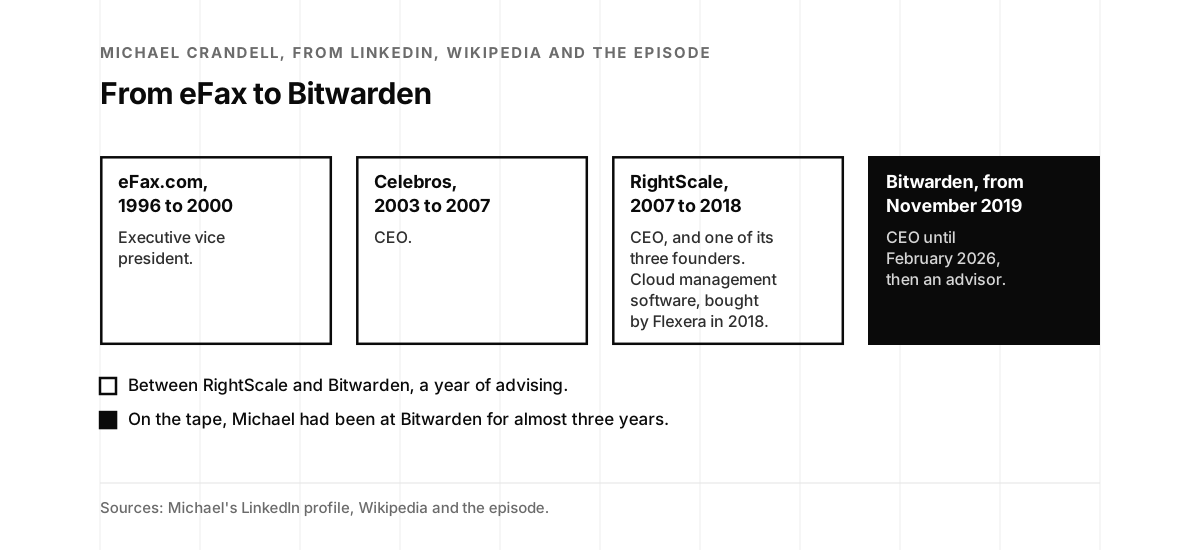
Michael’s LinkedIn lists the path: executive vice president at eFax.com from 1996 to 2000, CEO of Celebros from 2003 to 2007, CEO and founder of RightScale from June 2007 to October 2018, a year of advising, and CEO of Bitwarden from November 2019 (LinkedIn). Wikipedia names Michael as one of RightScale’s three founders. RightScale sold software as a service for managing cloud computing across providers, and Flexera Software bought it in 2018 (Wikipedia).
On the tape, Michael had been at Bitwarden for almost three years. With software, Michael said, people sometimes forget how much quality matters in the user experience, and Bitwarden pays a lot of attention to it.
Unique and complex
Jon asked what problem password management solves. At a high level, Michael said, it’s about making security easy.
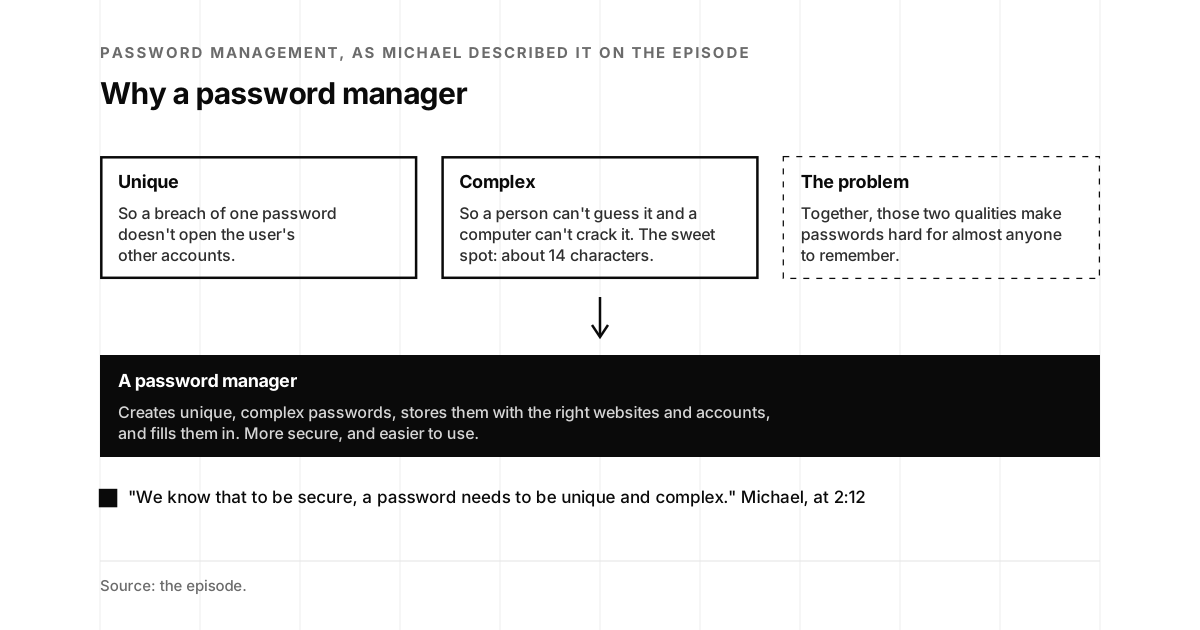
“We know that to be secure, a password needs to be unique and complex.”
Michael Crandell, at 2:12
Unique, so that a breach of one password doesn’t compromise the user’s other accounts. Complex, so a person can’t guess it and a computer can’t crack it. Michael put the sweet spot at about 14 characters. Together, those two qualities make passwords hard for almost anyone to remember.
A password manager creates unique, complex passwords, stores them with the websites and accounts they belong to, and fills them in for you.
“it’s a double win. It’s both more secure and easier to use”
Michael Crandell, at 3:02
That’s something the security world doesn’t often get, Michael said.
The knob
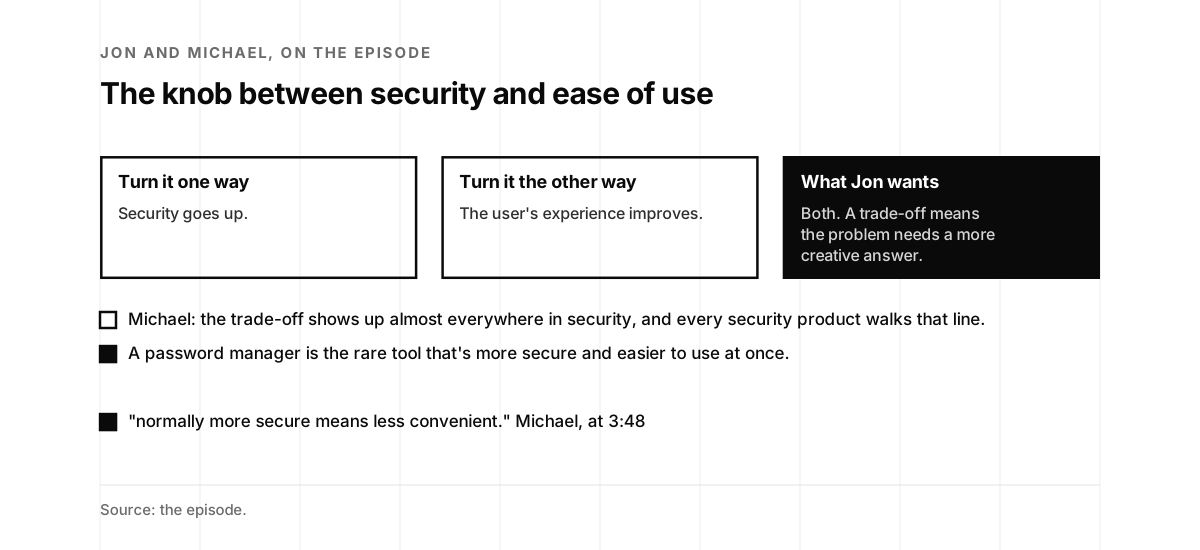
Jon described a knob that keeps turning up in security problems. Turn it one way and security goes up. Turn it the other way and the user’s experience improves, and the choice feels like a compromise.
“And whenever I bump into a problem like that in the security space, I think of it as a cop-out.”
Jon McLachlan, at 3:29
Jon wants both security and usability. Michael said the trade-off shows up almost everywhere in security.
“normally more secure means less convenient. So it’s a tightrope that every security product has to walk.”
Michael Crandell, at 3:48
Secure and easy to use, together, is what drew Michael to password management, and to Bitwarden.
Episode 30 takes the same question to another password manager: Dominik Schürmann of heylogin, a password manager with no master password, on why security that prevents adoption doesn’t help (episode 30).
Built by one founder
Michael joined a company that Kyle Spearrin had already founded. Kyle, the founder and CTO, built Bitwarden alone, set out to do better than the competition, and made it open source. Starting a company often means quitting a job, Michael said, and that carries risk.
Bitwarden’s first release came on August 10, 2016: apps for iOS and Android, browser extensions for Chrome and Opera, and a web vault (Wikipedia).
Don’t break what works
Jon asked what it was like to come in as CEO next to a founder who was also the CTO.
“One of my mantras when I joined Bitwarden was not to screw up anything that’s already working.”
Michael Crandell, at 5:26
What Kyle had built was simple. It does what you need, does no more, and stays out of your way. It was open source and built around a community, and the company kept growing that community around the world. Anyone can look at the code, review it, vet it and contribute to it, and many people do. Jon’s view: enable people, and participation becomes power.
The best day
Michael’s best day was every day, an answer Michael called a little corny. More seriously, it was the first time a support email came in thanking Bitwarden for the product and cheering the team on. Most support messages are about problems and complaints. Bitwarden gets messages of “Bitwarden love” almost every day.
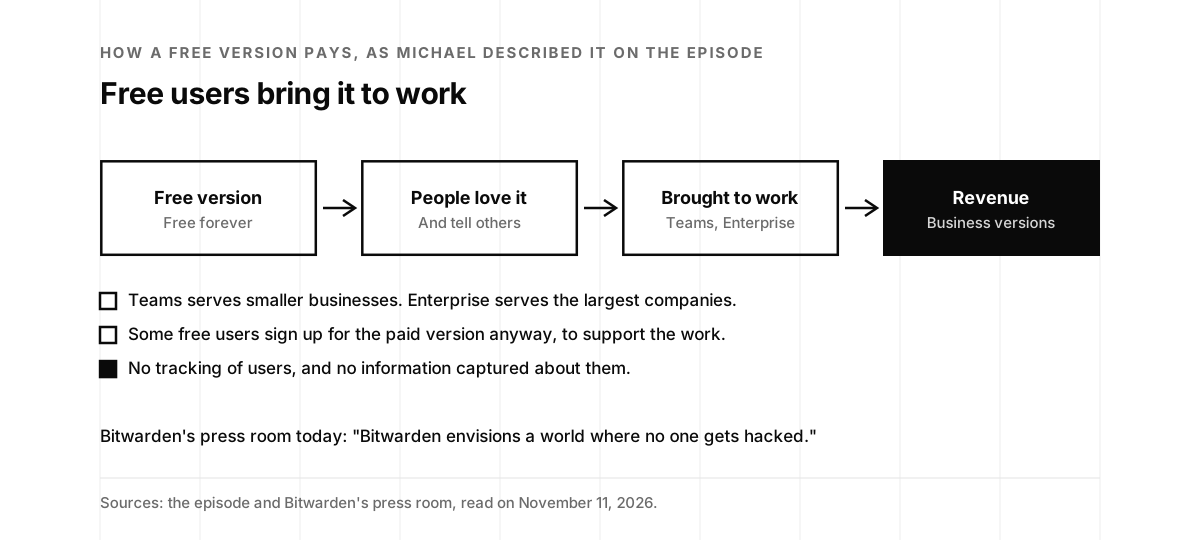
They come from the free version, full-featured and free forever, in keeping with open source. Many people sign up for the paid version as a way to support the work of keeping people safe online. It’s a core belief at Bitwarden that everybody has the right to be safe online, Michael said.
“Everybody should have that right.”
Michael Crandell, at 7:26
Nobody is the product
Jon pointed out that Bitwarden needs back-end components to run. Anyone could run all of it, since it’s open source, but a SaaS that’s set up and ready to go, for free, is convenient.
Michael tied the free version to that aim. Some people hear “free” and suspect a trick: the users are the product, or someone sells ads against their data.
“We don’t track users, we don’t capture any information.”
Michael Crandell, at 8:44
Free users who love the product tell others, and many bring Bitwarden to work. That’s where Bitwarden makes its money, mostly with business versions: Enterprise for the largest companies, and Teams for smaller ones.
From consumer to business
Jon asked whether Michael helped Bitwarden pivot from consumers to businesses. Michael helped the emphasis. Kyle had already built the Teams and Enterprise versions, and Michael knew from experience what enterprises need and want.
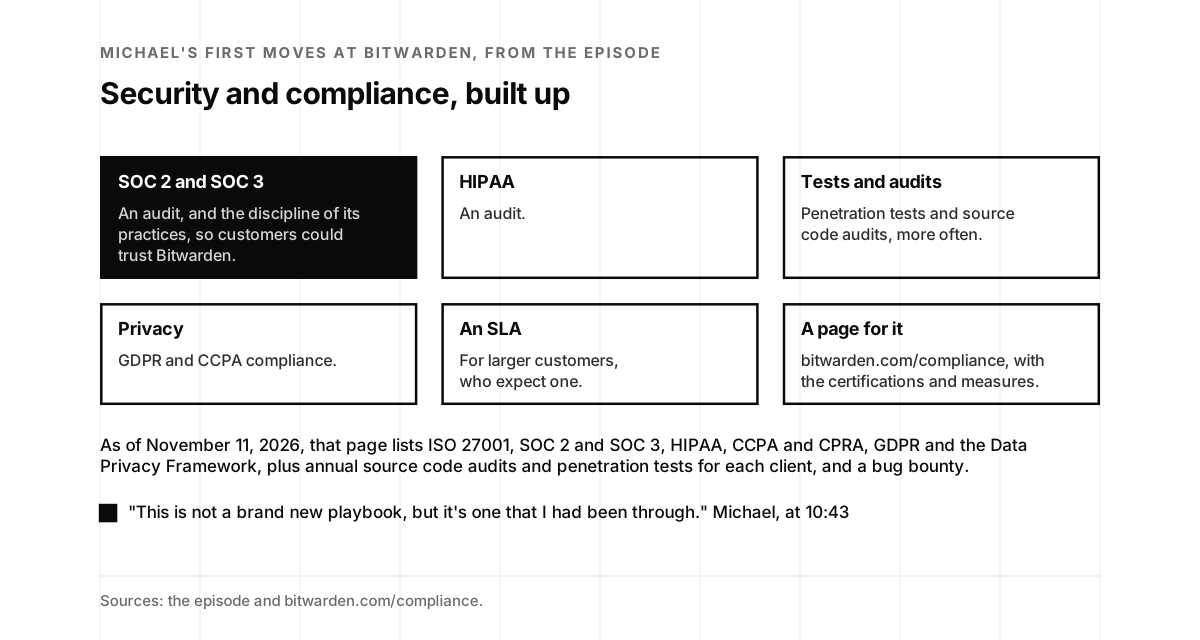
One of the first things Michael did was build up Bitwarden’s security and compliance profile:
- A SOC 2 and SOC 3 audit, and the discipline of those practices, so customers could trust Bitwarden.
- A HIPAA audit.
- More frequent penetration tests and source code audits.
- GDPR and CCPA compliance, for privacy.
- An SLA for larger customers.
“This is not a brand new playbook, but it’s one that I had been through.”
Michael Crandell, at 10:43
Michael sent listeners to bitwarden.com/compliance. As of November 11, 2026, that page lists ISO 27001, SOC 2 and SOC 3, HIPAA, CCPA and CPRA, GDPR, and the Data Privacy Framework. It also lists annual source code audits and penetration tests for each client, annual network security assessments, and a bug bounty on HackerOne (Bitwarden). Wikipedia notes a security assessment, code audit and cryptographic analysis by Cure53 in October 2018 (Wikipedia).
GDPR is a European Union regulation on information privacy, adopted on April 14, 2016 and in effect since May 25, 2018 (Wikipedia). The California Consumer Privacy Act was signed on June 28, 2018 and took effect on January 1, 2020 (Wikipedia).
Lean in with the security team
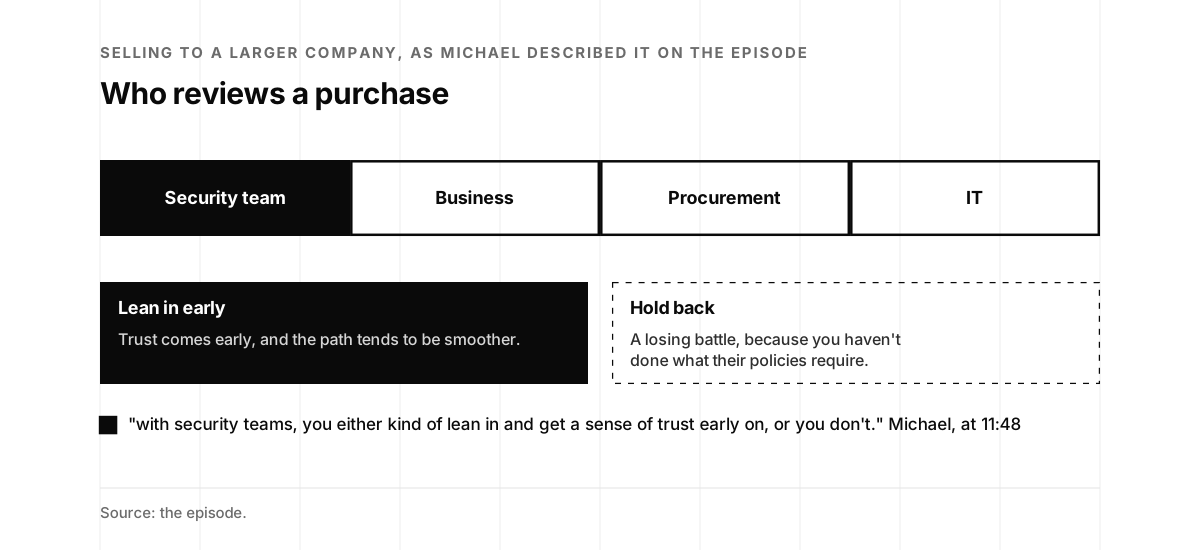
At larger companies, Michael learned, several teams review a purchase: usually a security team, the business folks, procurement and IT.
“with security teams, you either kind of lean in and get a sense of trust early on, or you don’t.”
Michael Crandell, at 11:48
Lean in, and the path tends to be smoother. Otherwise you fight a losing battle, because you haven’t done what their policies require. Michael called that understandable, since they all have policies to follow. Jon agreed: security teams have a tough job, they’re in the same community, and they’re trying to protect their business.
Jon, who has worked on many business-to-business plays, called the certifications Michael listed serious contributions to a product’s security, more than checkboxes. The calculator further down puts a number on a review that stalls.
A worst day with a template
Jon asked about a worst day. Michael has one, and it repeats.
“It’s the same day over and over.”
Michael Crandell, at 12:43
Government agencies, in the U.S. or overseas, contact Bitwarden about data breaches that are being exposed on the dark web. You can hardly read the news without a new breach or a ransomware attack. What bothers Michael most is a breach that came from insecure password practices and could have been avoided. Rolling out password management at a company is simple, and so is signing up yourself.
Jon shares the feeling. The technology exists to stop nearly every kind of breach, Jon said, and it takes effort to commit to raising the security bar. Michael takes it as motivation to get more people onto the platform.
What sets Bitwarden apart
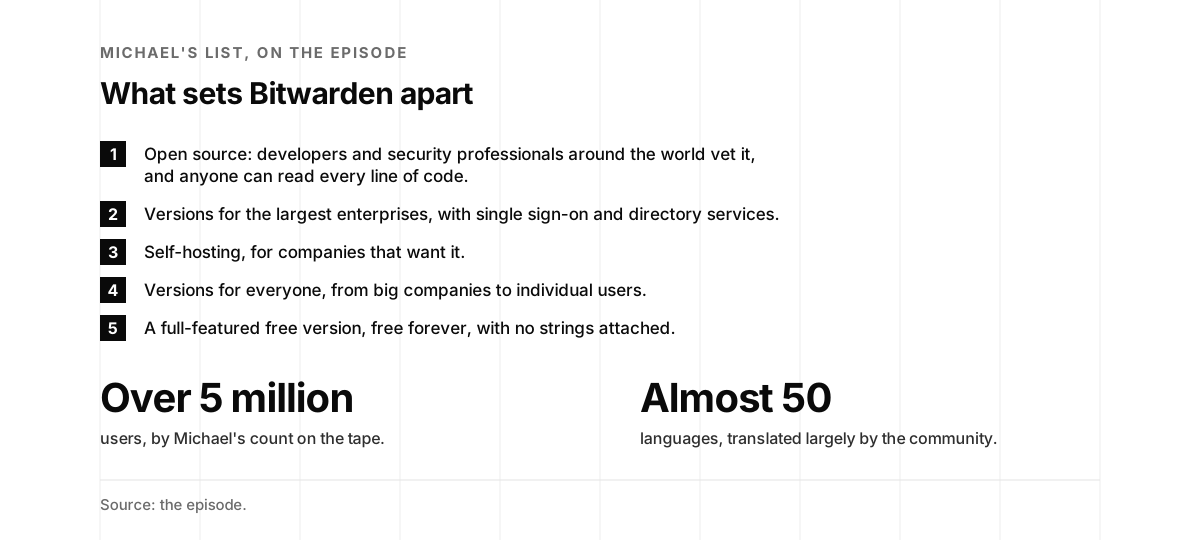
Jon asked what makes Bitwarden special. Michael’s list:
- Open source. Developers and security professionals around the world vet the product, and anyone can read every line of code.
- Versions for the largest enterprises, with integrations for single sign-on and directory services.
- Self-hosting, for companies that want it.
- Versions for everyone from big companies to individual users.
- A full-featured free version, free forever, with no strings attached.
The free version helped build a community of over 5 million users, by Michael’s count on the tape. The product has been translated into almost 50 languages, largely by that community.
Jon wondered aloud why anyone would use anything else. Michael said Bitwarden wonders that sometimes too.
Couldn’t someone copy it?
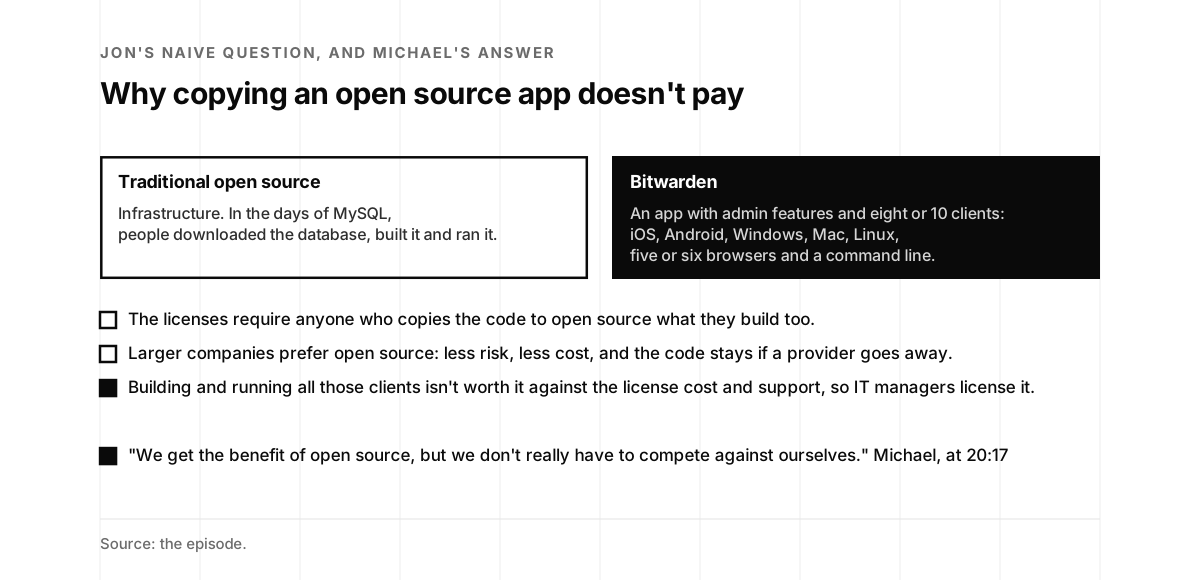
Jon asked the naive question: with the code open, couldn’t someone copy the whole business? In a way, Michael said. Open source licenses require whoever copies the code to open source what they build too. It hasn’t happened much.
“we try to remember that imitation is the sincerest form of flattery.”
Michael Crandell, at 17:21
Wikipedia lists Bitwarden’s licenses: AGPL-3.0 for the server, GPL-3.0 for the clients, and proprietary terms for some modules (Wikipedia).
What open source gives Bitwarden, as Michael put it:
- Anyone can check the encryption. People can see how Bitwarden handles sensitive data, how it encrypts and where. They can confirm that all their data is end-to-end encrypted, so Bitwarden can’t touch it. Researchers look at it.
- Anyone can build on it. People contribute, build on the code and add modules.
- Larger companies prefer it. Open source reduces their risk and their cost. If a provider goes away, they still have the source code.
The danger to the business is small, because so few people build Bitwarden from scratch to use it. Traditional open source was infrastructure. In the days of MySQL, people downloaded the database, built it and ran it. Bitwarden is an app with admin features and eight or 10 clients: iOS, Android, Windows, Mac, Linux, five or six browsers and a command line. Building and running all of that isn’t worth it against the license cost and support, and IT managers would rather license it.
MySQL is a free and open-source relational database. Its first version appeared on May 23, 1995 (Wikipedia).
Jon’s answer: let the people who wrote the software run it.
“They know it best. They know how to configure it.”
Jon McLachlan, at 20:05
A multi-tenant service is more efficient, Jon added, and passes the savings and the expertise on to every customer.
“We get the benefit of open source, but we don’t really have to compete against ourselves.”
Michael Crandell, at 20:17
End to end, or on your own servers
Jon asked a follow-up. If everything is end-to-end encrypted and Bitwarden can’t see the data, why would a business run the whole stack on its own servers?
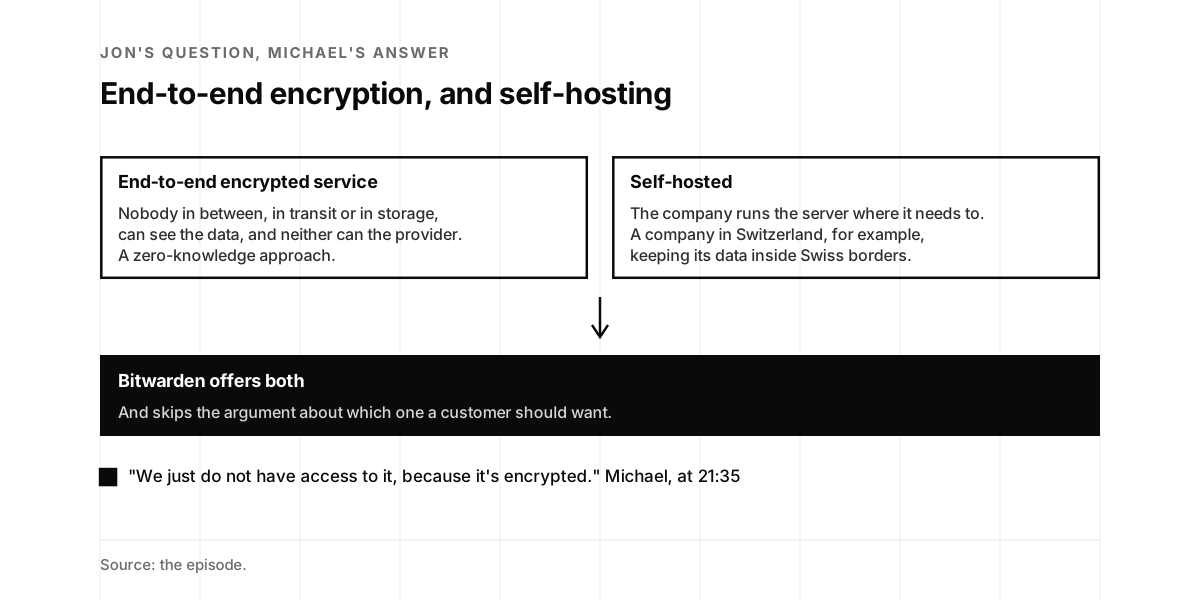
End-to-end encryption means nobody in between, in transit or in storage, can see your data, and neither can the company that provides the product, Michael said.
“We just do not have access to it, because it’s encrypted.”
Michael Crandell, at 21:35
Michael called it a zero-knowledge approach, popular over the last half dozen years. Some companies still want to self-host, sometimes for regulatory reasons. A company in Switzerland, for example, may have to keep all its data inside Swiss borders. That’s data residency, and running the server there meets it. Bitwarden found it productive to skip arguments with customers about which way they want, and to offer both.
Jon keeps hearing about data governance and data residency, and hopes storage can sit behind a layer that keeps multi-tenancy and still meets those rules. Michael expects more of it, with privacy requirements coming from the EU.
A remote company that spells GRIT
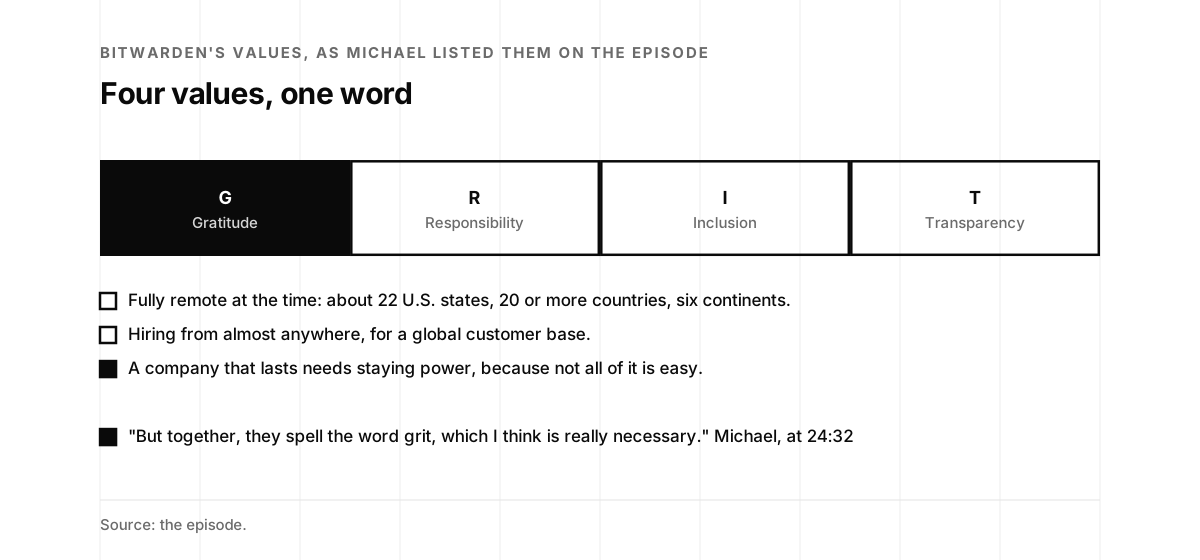
Jon asked what joining Bitwarden would feel like. They’d love to have Jon, Michael said. Bitwarden was fully remote, with people in about 22 U.S. states, 20 or more countries and six continents. That let the company hire the best people from almost anywhere in the world, and lean into diversity on the team. A global customer base calls for a global team.
The company had four values: gratitude, responsibility, inclusion and transparency.
“But together, they spell the word grit, which I think is really necessary.”
Michael Crandell, at 24:32
A company that lasts and keeps innovating needs staying power, Michael said, because not all of it is easy. Jon liked the word for the entrepreneurial mindset it brings.
The interview question about age 16
Michael still interviewed everyone who joined Bitwarden. Outsiders may think a technology company is all about technical wizardry, Michael said, but people build the technology. Michael’s question for every candidate: what did you like to do when you were 16 years old?
“You tend to get authentic answers, because it’s not a question that anyone rehearses for in a job interview.”
Michael Crandell, at 25:56
The question isn’t hard, and it shows something about the candidate as a person. Jon liked that it has nothing to do with the technical pieces, and that it lets a candidate share a passion that’s still there.
Passwords and passwordless
Jon asked about all the talk of going passwordless.
“First, passwords are not going away.”
Michael Crandell, at 26:48
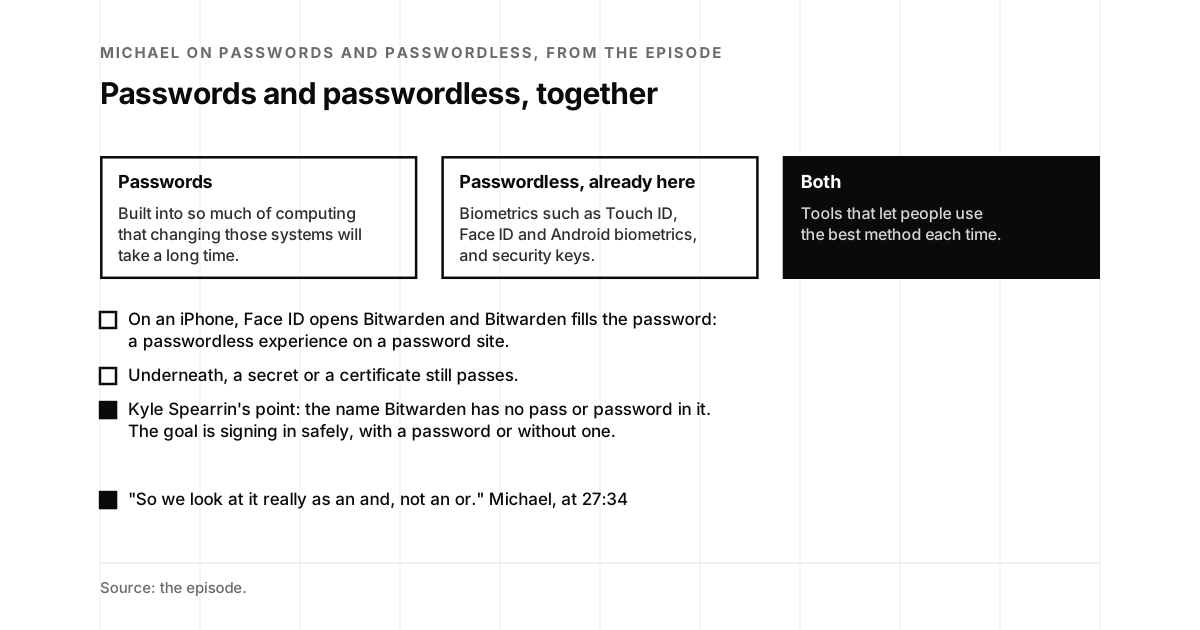
Passwords are built into so much of computing that changing all those systems will take a long time. Passwordless technologies are already here and useful: biometrics such as Touch ID, Face ID and Android biometrics, and security keys. Bitwarden supported the common ones and planned to keep up as passwordless evolves.
“So we look at it really as an and, not an or.”
Michael Crandell, at 27:34
People will want tools that let them use the best method each time. Kyle has a saying about the company’s name: there’s a reason the word pass, or password, isn’t in it. The larger goal is helping people authenticate safely online, with a password or without one.
WebAuthn is the W3C web standard that websites use to sign people in with WebAuthn credentials, commonly known as passkeys. Its first level became a W3C Recommendation on March 4, 2019 (Wikipedia). Episode 61 goes back to the start: Taher Elgamal, known as the father of SSL, on how the password became the way everyone logs in (episode 61).
Face ID fills the password
One of Michael’s favorite features is on the iPhone. Password managers can plug into the phone’s password autofill. On a site that asks for a password, Michael taps the password button, Bitwarden comes up, Face ID opens it, and the password fills in.
“So even though it’s a password-based site, the experience is pretty much passwordless”
Michael Crandell, at 28:53
Jon pointed to what sits underneath: secure enclaves and protected memory in iOS that users never think about. Episode 92 goes further into that hardware, with Jasson Casey of Beyond Identity on the secure coprocessors already in phones and laptops (episode 92).
At the bottom of it all is still a secret, Michael added: a certificate, or something like a password, that passes under the covers. Most people aren’t opinionated about technology. They want to get their work done the quickest, easiest way. So make the password site easy, and make the passwordless one easy too.
Episode 19 makes a related point from the identity side: Aaron Painter of Nametag on why passkeys still validate the device (episode 19).
Password rules, and a comic
Jon’s pet peeve: password rules that cap length at around 32 characters and demand certain kinds of characters, so you hit reset on your password manager’s generator until a password fits.
Michael knew a comic’s routine on how those rules evolved. In the beginning, everyone had one password and used it everywhere. Then sites said that wasn’t secure enough and asked for a capital letter, so everyone capitalized the first letter. The routine moves on to special characters, numbers and the rest. It got laughs because it’s what everybody did.
Send, and what’s next
Michael’s picture of success started with password management, where Bitwarden had grown fast for a couple of years and planned to keep up the pace of innovation. Beyond that: more tools and products for developers, and more passwordless authentication.
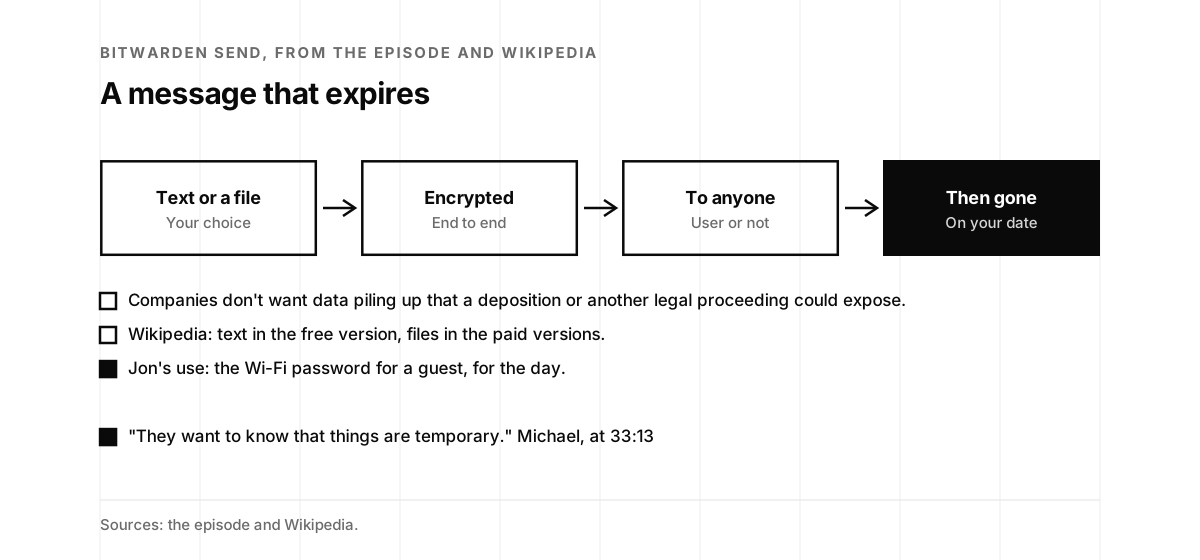
Then the adjacencies, such as Bitwarden Send. It sends a piece of text or a file, end-to-end encrypted, to anyone, whether they use Bitwarden or not, with the same zero-knowledge trust as the rest of the product. You can set an expiration date. Companies like that, because they don’t want data piling up that a deposition or another legal proceeding could expose.
“They want to know that things are temporary.”
Michael Crandell, at 33:13
Michael compared it to the tape recording that self-destructed in the Mission Impossible TV series: the message gets through, then goes away. Larger companies were asking for more of it. All of it sits under one aim: helping people stay safe online and do business faster, safely, starting with authentication that’s simple, secure and convenient.
Jon would use it to give a guest the Wi-Fi password for the day, so the password isn’t left on a phone that later gets lost.
Wikipedia describes Send the same way: end-to-end encrypted text in the free version, and files in the paid versions (Wikipedia). Bitwarden’s own video walks through a send, with options for an expiration date, access limits and a password.
Come have a look
“Please come have a look at Bitwarden. It’s free.”
Michael Crandell, at 34:35
Don’t get caught out by a password mishap, Michael said. Once you start, you get an aha moment, where security and ease of use come together, and you won’t go back.
What happened after the tape
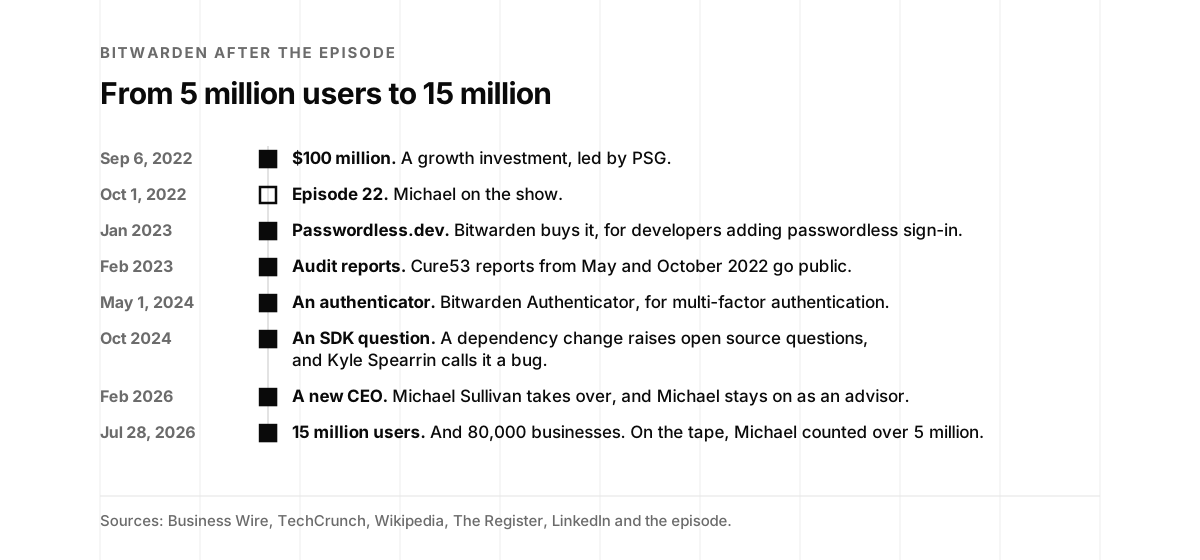
A $100 million round. On September 6, 2022, Bitwarden announced a $100 million growth investment led by PSG, with Battery Ventures taking part (Business Wire, Wikipedia). The episode came out on October 1.
Passwordless.dev joined Bitwarden. In January 2023, Bitwarden bought the Swedish startup, which gave developers an open-source way to add passwordless sign-in based on WebAuthn and FIDO2. Bitwarden also launched a beta that lets other developers add Touch ID, Face ID and Windows Hello sign-in to their apps (TechCrunch, Wikipedia). Both match what Michael named for the future: tools for developers, and passwordless.
Audit reports went public. In February 2023, Bitwarden released network security and security assessment reports by Cure53, from work done in May and October 2022 (Wikipedia).
An authenticator of its own. On May 1, 2024, Bitwarden launched Bitwarden Authenticator, a multi-factor authentication app (Wikipedia, Android Authority).
A bug that raised questions. In October 2024, a change to the desktop app’s dependencies added a restricted-use SDK that could stop some people from building the app from source, and some worried Bitwarden was moving away from open source. Kyle Spearrin called it “merely a bug” the company planned to resolve (The Register, Wikipedia).
Michael stepped down in February 2026. Michael Sullivan replaced Michael as CEO (Wikipedia), and Michael’s LinkedIn lists an advisor role at Bitwarden since then (LinkedIn).
From 5 million to 15 million. On July 28, 2026, Bitwarden said it had passed 15 million users and 80,000 businesses (Business Wire). On the tape, Michael counted over 5 million.
Did you catch it? A seven-question quiz
Seven questions from the episode. Each answer links the moment in the transcript or its section.
Quiz · seven questions
Did you catch it?
Pick an answer to see whether you caught it.
-
What two qualities does a secure password need, in Michael's words?
a. "We know that to be secure, a password needs to be unique and complex." Transcript, 2:12.
-
Where did Michael put the sweet spot for password length?
c. Long enough, and still easy with a password manager. See Unique and complex.
-
What was one of Michael's mantras on joining Bitwarden?
b. "One of my mantras when I joined Bitwarden was not to screw up anything that's already working." Transcript, 5:26.
-
Where does Bitwarden make its money, as Michael described it?
c. Free users bring Bitwarden to work. See Nobody is the product.
-
Why don't companies build Bitwarden from its open source code to save the license?
a. IT managers would rather license it. See Couldn't someone copy it?.
-
What did Bitwarden's four values spell?
b. "But together, they spell the word grit, which I think is really necessary." Transcript, 24:32.
-
How does Michael see passwords and passwordless?
a. "So we look at it really as an and, not an or." Transcript, 27:34.
How safe are your team’s passwords?
Eight questions on how your team makes, stores and shares passwords, built from the episode. Each tip links the section behind it.
Scorecard · eight questions
How safe are your team's passwords?
Answer for your team as it works today. If two answers fit, pick the lower one.
-
Does everyone on your team use a password manager?
- No
- Some of us
- Yes, everyone
A password manager makes passwords more secure and easier to use at once. See Unique and complex.
-
Is every account's password unique?
- No, many are reused
- Mostly
- Yes, every one
A unique password keeps one breach from opening other accounts. See Unique and complex.
-
Who makes new passwords?
- People, from memory
- People, following rules
- A generator, long and random
Michael put the sweet spot at about 14 characters. See Unique and complex.
-
Is your password manager tied to single sign-on and your directory?
- No
- Partly
- Yes
The largest companies ask for those integrations first. See What sets Bitwarden apart.
-
Do people sign in with biometrics or a security key where they can?
- No
- Some do
- Yes
Passwords and passwordless work together. See Passwords and passwordless.
-
How do people share a password or a sensitive file?
- In chat or email
- In a shared vault, with some chat
- Encrypted, with an expiration date
What expires can't pile up in inboxes. See Send, and what's next.
-
Would you know if your team's accounts turned up in a breach?
- No
- Only from the news
- Yes, we watch for it
Michael's worst day is a breach notice that repeats. See A worst day with a template.
-
Do your own password rules allow long passwords without character games?
- No, short limits and character rules
- Some of both
- Yes
Rules that cap length push people into games. See Password rules, and a comic.
Passwords live in people's heads and get reused. Start with a password manager for everyone, and unique passwords from a generator.
Most passwords are stored and unique. Tie the manager to single sign-on, and move sharing to links that expire.
Keep biometrics and security keys in the mix, and watch for breaches that name your accounts.
What does a slow security review cost?
Michael’s advice for selling to larger companies: lean in with their security team early, or fight a losing battle. This calculator puts a number on a review that drags.
Calculator
What does a slow security review cost?
Four numbers: deals a quarter that go through a buyer's security review, what a deal is worth, the weeks a review adds, and the share of those deals that stall out.
At 8 deals a quarter worth $60,000 each, $480,000 waits on security review every quarter. At 6 weeks each, that's 48 deal-weeks of delay. If 10% stall out, that's $48,000 a quarter, $192,000 a year.
The calculator counts a stalled deal as lost and four quarters to a year. The default numbers are placeholders, yours to change. Michael gave no figures for these on the tape.
From eFax to 15 million users
Michael’s path, Bitwarden’s history, the field around it, and this show. Filter by topic.
Timeline
From eFax to 15 million users
- MySQL
The first version of the open-source database appears (Wikipedia, on this page).
- eFax.com
Michael becomes executive vice president (LinkedIn).
- Celebros
Michael becomes CEO (LinkedIn).
- RightScale
Founded, with Michael among its three founders (Wikipedia).
- GDPR adopted
The European Union's information privacy regulation (Wikipedia).
- Bitwarden's first release
Apps for iOS and Android, extensions for Chrome and Opera, and a web vault (Wikipedia).
- Flexera buys RightScale
- GDPR takes effect
Two years after adoption (Wikipedia).
- CCPA signed
California's consumer privacy law (Wikipedia).
- A Cure53 audit
Security assessment, code audit and cryptographic analysis (Wikipedia).
- WebAuthn
Level 1 becomes a W3C Recommendation (Wikipedia, on this page).
- Michael joins Bitwarden
As CEO (LinkedIn).
- CCPA takes effect
California's consumer privacy law goes into force (Wikipedia).
- Episode 19
Aaron Painter of Nametag on why a password is not a passport (episode page).
- $100 million
A growth investment led by PSG (Business Wire).
- Episode 22
Michael on the show (Podbean, transcript).
- Passwordless.dev
Bitwarden buys the Swedish startup (TechCrunch).
- Cure53 reports
From assessments in May and October 2022 (Wikipedia).
- Episode 30
Dominik Schürmann of heylogin, a password manager with no master password (episode page).
- Bitwarden Authenticator
A multi-factor authentication app (Wikipedia).
- An SDK question
Kyle Spearrin calls the dependency change a bug (The Register).
- Episode 61
Taher Elgamal on how the password became the way everyone logs in (episode page).
- A new CEO
Michael Sullivan replaces Michael, who stays on as an advisor (Wikipedia, LinkedIn).
- Episode 92
Jasson Casey of Beyond Identity on identity as the security boundary (episode page).
- A video on Send
Bitwarden posts a walkthrough (YouTube, on this page).
- 15 million users
And 80,000 businesses (Business Wire).
What to do this week
Five things, in the order of the episode.
- Count the reused passwords. Find the accounts your team protects with the same password, as in Unique and complex.
- Give everyone a password manager. Tie it to single sign-on and your directory, as in What sets Bitwarden apart. The scorecard shows where else to look.
- Share secrets that expire. Move passwords and sensitive files out of chat and email, as in Send, and what’s next.
- Prepare for the buyer’s review. Line up the reports, the tests and a page that shows them before a buyer’s security team asks, as in From consumer to business, and run your numbers through the calculator.
- Get help with it. Our Sales Support team answers security questionnaires and joins buyer calls as your security team, and SOC 2 Type 2 gets you to an audit report in as little as five months. Penetration Testing gives you the tests buyers ask for, and vCISO Services gives you a security leader to set priorities. If you want to talk it through, book 15 minutes with us.