
Podcast Episode 25

Episode 025 56 min

David Gurle - Founder and Executive Chairman at Hive, on Empathy, Innovation, and Disruption

with David Gurle · Hive

0:00 / 56:00

Also on Spotify, Apple Podcasts, YouTube, Podbean, Player FM

Episode 25 of The Security Podcast of Silicon Valley, published November 16, 2022. Host Jon McLachlan talks with David Gurle, founder and executive chairman of Hive, a distributed peer-to-peer cloud built from the storage and compute of end users' computers. David once ran Skype for business, and Skype ran on everyone's computers with no data centers. That memory, and Symphony's Amazon and Google bills, gave David the idea for Hive in 2018. They cover a path from VocalTec and Microsoft to Thomson Reuters, Skype, Perzo and Symphony, empathy as a skill, the first Hive release the day before the recording, Apple's Gatekeeper warnings, sharing a terabyte to get a terabyte, a 5% fee on resold capacity, Uber as a model for a decentralized cloud, majority control over the big decisions, turning down a lead investor, a boss at Microsoft on being ready to walk away, a billion computers working for four hours, the CLOUD Act, a master key that nobody can recover, a new key for every chunk of data, hiring for self-awareness, and expense reports that file themselves.

Episode notes

In this heartfelt episode of a YSecurity.io production, we sit down with David Gurle, a visionary serial entrepreneur whose influence spans across some of the most transformative companies in secure communication and collaboration. From his early days at Thomson Reuters, Skype, Microsoft, Perzo, and Symphony Communications, and now as the Founder and Executive Chairman of Hive, David has consistently been at the forefront of driving positive change in how we connect and collaborate securely.

David's journey is deeply rooted in his formative years in Beirut, Lebanon, amid the backdrop of a civil war. He shares touching personal stories that highlight how these experiences instilled in him a profound understanding of the value of empathy and diversity. These principles have not only shaped his approach to technology and business but have also fueled his ambition to innovate and disrupt traditional paradigms.

At Hive, David is challenging the costly, error-prone, and insecure centralized compute and storage models by introducing a distributed cloud computing and storage platform. His insights into the genesis and mission of Hive offer a fascinating glimpse into the future of technology, where security, efficiency, and accessibility are paramount.

Throughout the episode, David reflects on the lessons learned throughout his career and the role of empathy in fostering innovation and driving change. His stories are a testament to the power of diverse experiences and perspectives in creating solutions that address some of today's most pressing challenges in communication and data security.

Join us on this YSecurity.io production for an inspiring conversation with David Gurle. Whether you're an entrepreneur, a tech enthusiast, or someone interested in the intersection of technology and human values, this episode offers a unique blend of personal narrative and professional insight that is sure to resonate. Discover the journey of a man who has made it his life's work to redefine the boundaries of secure collaboration and communication, driven by a commitment to empathy, diversity, and innovation.

Hosted by Jon McLachlan — co-founder of YSecurity.

The deep dive

A cloud on everyone's computers

David Gurle, founder and executive chairman of Hive: a career in real-time communication, a cloud built from the spare capacity of computers around the world, a first release the day before the recording, walking away from a lead investor, the lesson in being ready to walk away, keys that only the owner holds, and hiring for self-awareness.

Episode 25 of The Security Podcast of Silicon Valley came out on November 16, 2022, with Jon McLachlan hosting. The guest was David Gurle, founder and executive chairman of Hive, which builds a cloud from spare storage and compute on computers around the world (Podbean, Apple Podcasts, Spotify, LinkedIn, Hivenet). The episode is called “David Gurle - Founder and Executive Chairman at Hive, on Empathy, Innovation, and Disruption.”

Two threads run through the talk. One is Hive: a cloud that runs on computers people already own, where only the person who owns the data holds the keys. The other is what a long career in communications software teaches a founder about control, walking away and hiring.

This page follows the conversation in order: a section for each part of it, fifteen figures, ten clips from the tape, a LinkedIn post, the full transcript, and five tools: a quiz, a scorecard for who holds the keys to your data, a calculator for how many keys protect one file, a timeline, and a to-do list. Where the decodes of the tape disagree on a word, the transcript puts its best guess in brackets, and the page doesn’t quote or retell those words.

From Digital Equipment to Hive

Jon read out the path. David started as a software engineer at Digital Equipment Corporation, then worked as an R&D engineer at France Telecom and a technical officer at ETSI. Next came VocalTec, as VP of strategic alliances, and then Microsoft, as director of program management for real-time collaboration and communication, in 2002. David had a dry take on the timing: a knack for missing the rise of a stock. The arrival at Microsoft came at the height of Microsoft’s stock, which went down after David joined.

After Microsoft came Thomson Reuters, as global head of collaboration services and head of sales and trading in Asia, then Skype for business as general manager, then Avaya as VP of corporate strategy. Then David started Perzo, which Symphony Communications bought two years later, and David ran Symphony as founder and CEO.

LinkedIn fills in the dates: VocalTec from April 1997, Microsoft from November 1999 to March 2003, Thomson Reuters from April 2003 to January 2010, Skype from January 2010 to June 2011, Perzo from September 2012 to September 2014, and Symphony as founder and CEO from October 2014 to May 2021 (LinkedIn). Wikipedia credits David with founding Microsoft’s real-time communications unit, which built NetMeeting, Windows Messenger and Live Communications Server, and with co-authoring several IETF standards for presence and instant messaging over SIP (Wikipedia).
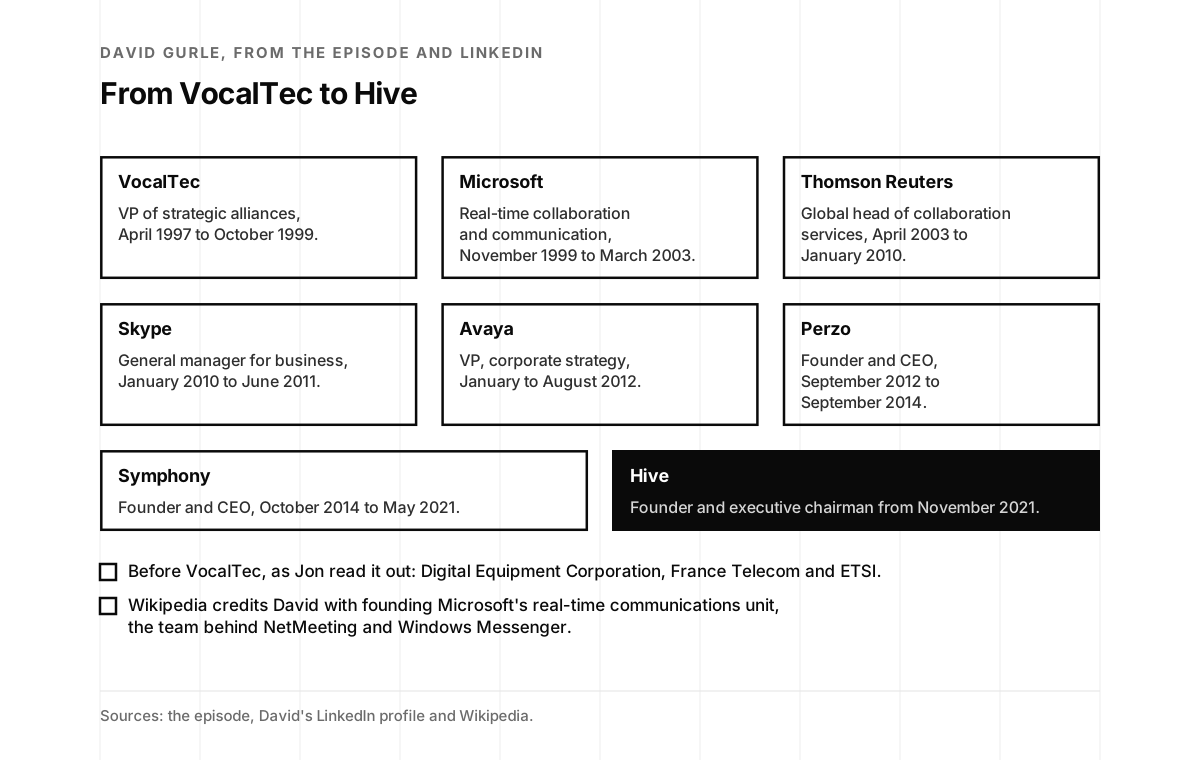
Eight cards in three rows. VocalTec: VP of strategic alliances, April 1997 to October 1999. Microsoft: real-time collaboration and communication, November 1999 to March 2003. Thomson Reuters: global head of collaboration services, April 2003 to January 2010. Skype: general manager for business, January 2010 to June 2011. Avaya: VP, corporate strategy, January to August 2012. Perzo: founder and CEO, September 2012 to September 2014. Symphony: founder and CEO, October 2014 to May 2021. Filled, Hive: founder and executive chairman from November 2021. Below: before VocalTec, as Jon read it out, Digital Equipment Corporation, France Telecom and ETSI. Wikipedia credits David with founding Microsoft's real-time communications unit, the team behind NetMeeting and Windows Messenger.
From VocalTec to Hive, as Jon read it out and LinkedIn lists it. Sources: the episode and David's LinkedIn profile.

Symphony, secure and strong

Symphony is where Jon and David met. Before Jon could go on, David stopped him with a thank-you for making Symphony secure and strong, along with Jon’s teammates.

“you managed to break through the impenetrable walls of Wall Street”

David Gurle, at 2:40

In David’s telling, Symphony became the standard there. Jon called it a team effort, built on the work that had gone into Perzo before Symphony. It was also Jon’s first chance to lead a team technically.

Symphony began inside Goldman Sachs as an internal messaging system. In October 2014, Goldman Sachs and 14 other financial institutions put in $66 million to set up Symphony Communication Services and buy Perzo, a messaging app known for end-to-end encryption. By 2020, Symphony said it had more than 400,000 users (Wikipedia). On episode 23, David M’Raihi, Jon’s mentor from those years, told the story of a best day at Symphony, in a room full of bankers.

Once an entrepreneur

After Symphony came board seats and advisory roles, and then Hive.

“Once an entrepreneur, always an entrepreneur.”

Jon McLachlan, at 4:20

Jon asked whether David would ever walk away from starting companies, or whether it’s too fun to stop. David agreed, and pointed to the word Jon had used: fun. Jon took it from there.

“You really have to have that passion, because things get gritty, things get difficult.”

Jon McLachlan, at 4:43

A founder also carries other people through the hard parts.

“but as a leader, you have to inspire everyone else around you to stick with it”

Jon McLachlan, at 4:54

Empathy is a skill

Jon’s first question was about the experiences that shaped David. That answer stays in the transcript. Jon took one idea from it.

“It’s a skill that you can develop, right?”

Jon McLachlan, at 13:47

“Oh, yeah, anybody can develop it.”

David Gurle, at 13:50

It takes a love of human nature, David said.

Jon shared the method he uses when a discussion turns into a disagreement. He starts from an assumption.

“I assume that everyone brings something to the table, that people are smart.”

Jon McLachlan, at 14:08

Then it’s his job as a listener to see that in the people at the table, to ask why the other view might be the right thing to do, and to find the values driving it.

“And to drop my set of values and really try to pick up another set of values”

Jon McLachlan, at 14:33

When the other set fits better, the disagreement stops being a disagreement.
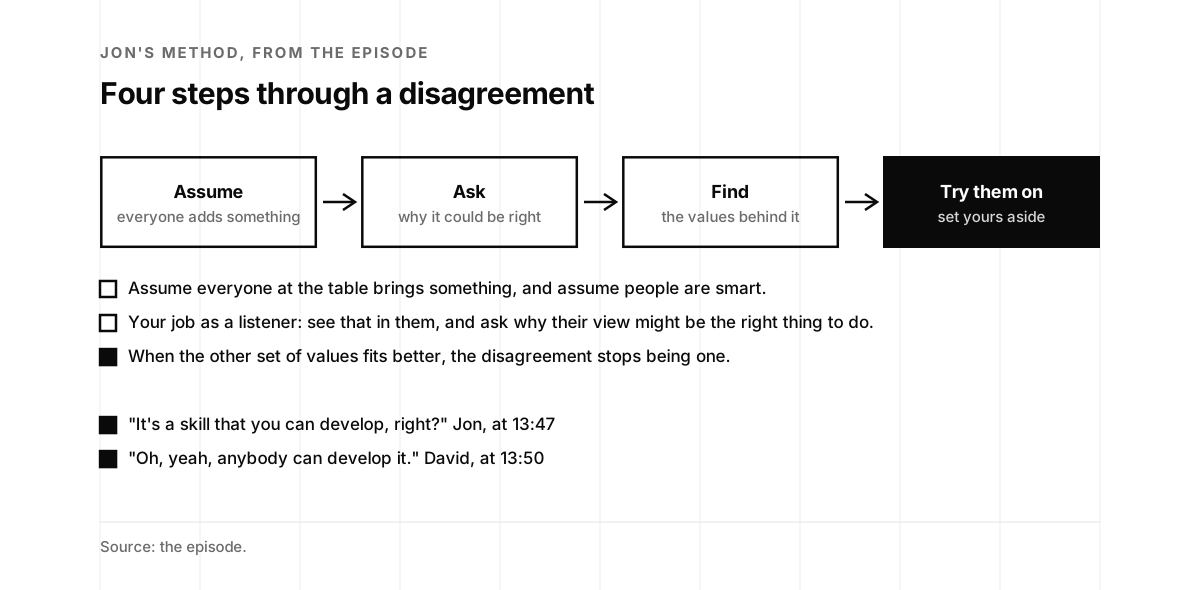
Four boxes joined by arrows: assume, everyone adds something. Ask, why it could be right. Find, the values behind it. Filled, try them on, set yours aside. Below: assume everyone at the table brings something, and assume people are smart. Your job as a listener: see that in them, and ask why their view might be the right thing to do. Filled: when the other set of values fits better, the disagreement stops being one. Then: "It's a skill that you can develop, right?" Jon, at 13:47. "Oh, yeah, anybody can develop it." David, at 13:50
Jon's four steps through a disagreement. Source: the episode.

Skype, without the data centers

Jon asked David to tell listeners about Hive.

“Well, Hive is a distributed peer-to-peer cloud solution.”

David Gurle, at 15:21

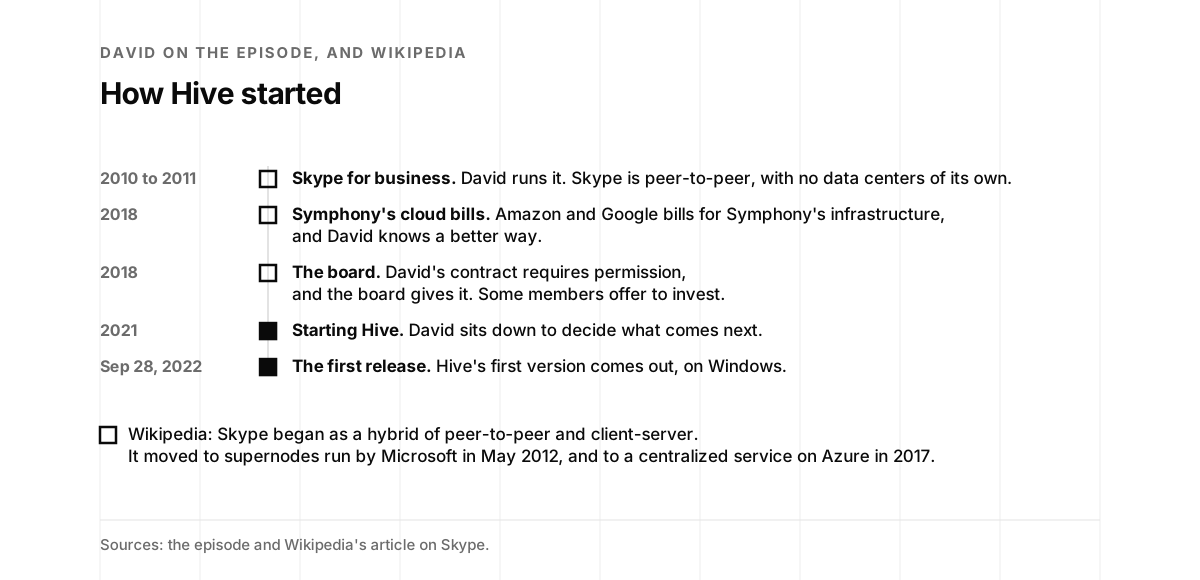
Hive takes the resources of end users’ computers around the world, puts them in a virtual operating system, and offers storage and compute services on top. The idea came in 2018, at Symphony, from the Amazon and Google bills for the infrastructure Symphony ran on. The bills were going up, but that wasn’t what bothered David. David had run Skype for business.

“and Skype was entirely peer-to-peer”

David Gurle, at 16:24

Skype ran with no infrastructure and no data centers of its own. It used everyone’s computers to do what servers do. David saw no technical reason the cloud couldn’t work the same way. So David went to Symphony’s board with the idea.

“because I had to ask permission. It was in my contract.”

David Gurle, at 17:04

The board said yes, and some board members offered to invest. Then David had no time for it, and the idea waited until 2021.

Skype began as a hybrid of peer-to-peer and client-server. Microsoft bought it for $8.5 billion in May 2011, ran it on Microsoft-operated supernodes from May 2012, and moved it to a centralized service on Azure in 2017. Skype was retired on May 5, 2025 (Wikipedia).
Listen · David Gurle on episode 25, from 15:21
About 35 seconds: David on what Hive is. The clip stops on its own. Read the full transcript.
Listen · David Gurle on episode 25, from 16:09
About 35 seconds: David on Symphony's cloud bills and Skype. The clip stops on its own. Read the full transcript.
A timeline. 2010 to 2011: Skype for business, David runs it, and Skype is peer-to-peer, with no data centers of its own. 2018: Symphony's cloud bills, Amazon and Google bills for Symphony's infrastructure, and David knows a better way. 2018: the board, David's contract requires permission, and the board gives it, and some members offer to invest. Filled, 2021: starting Hive, David sits down to decide what comes next. Filled, September 28, 2022: the first release, Hive's first version comes out, on Windows. Below: Wikipedia says Skype began as a hybrid of peer-to-peer and client-server, moved to supernodes run by Microsoft in May 2012, and to a centralized service on Azure in 2017.
How Hive started, in the order David told it. Sources: the episode and Wikipedia.

Released the day before

David had news.

“literally yesterday we released our first version”

David Gurle, at 18:00

Jon worked out the date: Wednesday, September 28. The first version ran on Windows. There was no public Mac version yet, and David offered to send Jon one. Apple hadn’t approved Hive’s signatures, so installing it brought up warnings. Jon explained what was going on for listeners. Apple’s Gatekeeper wants software signed with a private key tied to a root of trust that runs through Apple’s developer program. Software that isn’t signed that way meets error messages that work as a barrier to entry. David’s complaint was about the wording.

“the error message is actually incorrect”

David Gurle, at 19:54

The message said the program was broken and couldn’t work. An inexperienced user takes that at face value and doesn’t install it. David offered Jon a command line tool to get past the warnings.

Gatekeeper is a macOS security feature that enforces code signing and verifies downloaded apps before they run, which lowers the chance of running malware by accident (Wikipedia).
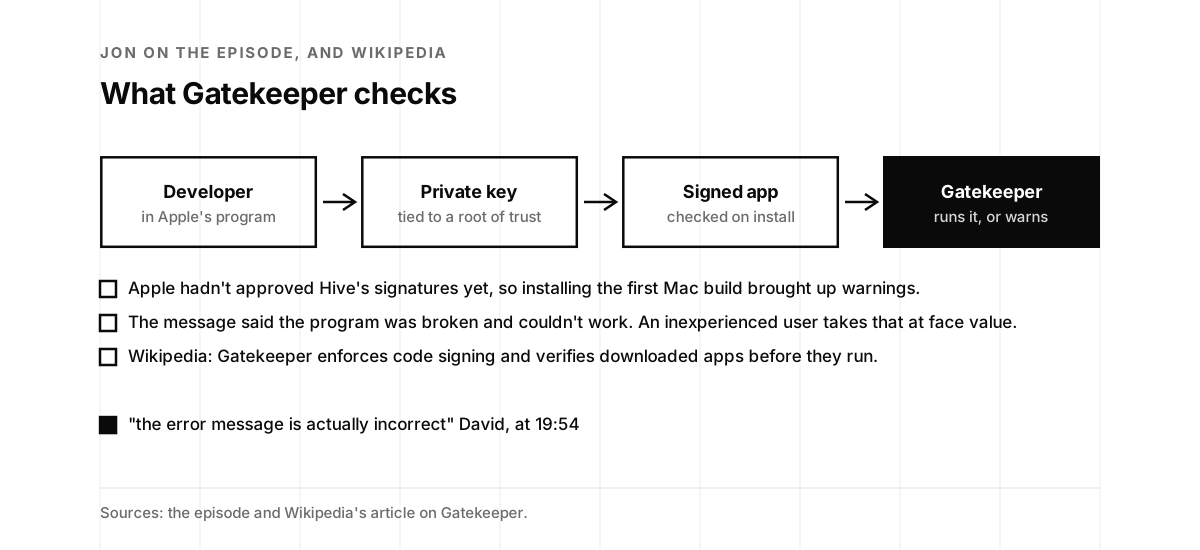
Four boxes joined by arrows: developer, in Apple's program. Private key, tied to a root of trust. Signed app, checked on install. Filled, Gatekeeper, runs it, or warns. Below: Apple hadn't approved Hive's signatures yet, so installing the first Mac build brought up warnings. The message said the program was broken and couldn't work, and an inexperienced user takes that at face value. Wikipedia: Gatekeeper enforces code signing and verifies downloaded apps before they run. Then: "the error message is actually incorrect" David, at 19:54
What Gatekeeper checks, as Jon explained it, and what the user sees. Sources: the episode and Wikipedia.

Share a terabyte, get a terabyte

Jon has plenty of spare compute, and four terabytes of storage on one machine that he doesn’t fully use. He asked what a contributor gets back.

“So if you share one terabyte, you’ll get one terabyte from the network, which you can use to back up your files.”

David Gurle, at 21:13

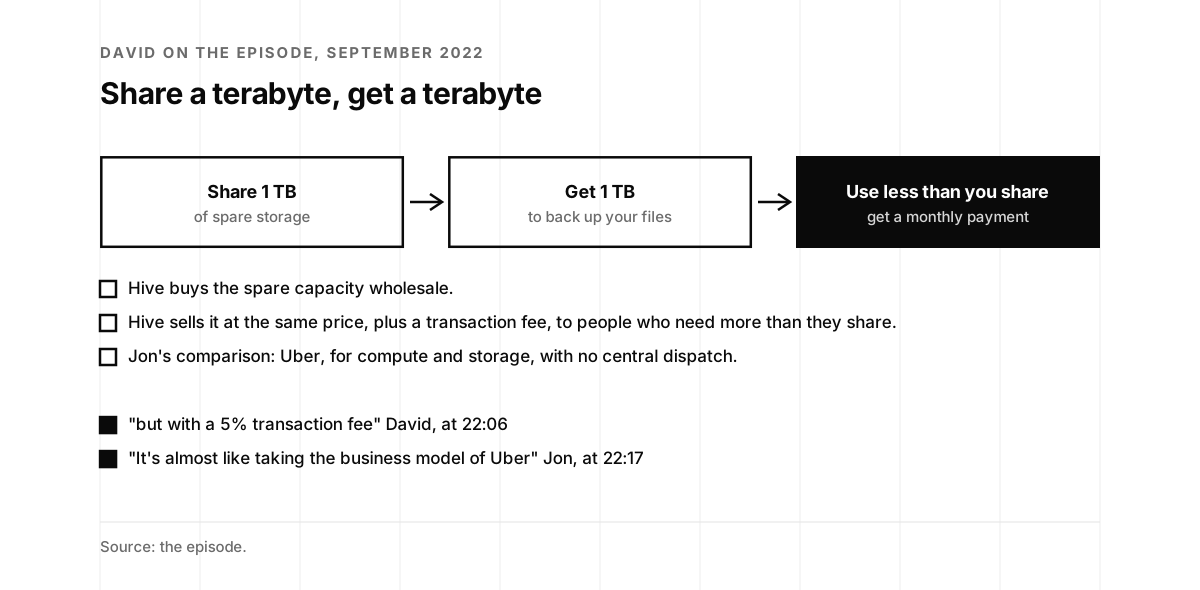
Hive didn’t plan to make money on that exchange. Contributors who use less than they share would get a monthly payment, because Hive would use their capacity for people who need more than they share. Hive would buy that capacity wholesale and sell it on at the same price, plus a transaction fee.

“but with a 5% transaction fee”

David Gurle, at 22:06

Jon heard a familiar model in it.

“It’s almost like taking the business model of Uber”

Jon McLachlan, at 22:17

In the centralized model that AWS and Google Cloud follow, a big company sits behind it all. You call one number, it goes to central dispatch, and the yellow cab shows up.

“this is the decentralized model of compute and storage.”

Jon McLachlan, at 22:51

David asked on the spot to use Jon’s comparison in the next Hive introduction video, and Jon said yes.
Listen · Jon McLachlan on episode 25, from 22:15
About 40 seconds: Jon on Uber and a decentralized cloud. The clip stops on its own. Read the full transcript.
Three boxes joined by arrows: share 1 TB of spare storage. Get 1 TB to back up your files. Filled, use less than you share, get a monthly payment. Below: Hive buys the spare capacity wholesale. Hive sells it at the same price, plus a transaction fee, to people who need more than they share. Jon's comparison: Uber, for compute and storage, with no central dispatch. Then: "but with a 5% transaction fee" David, at 22:06. "It's almost like taking the business model of Uber" Jon, at 22:17
Hive's model as David described it in September 2022. Source: the episode.

The best day

Jon asked for David’s best day with Hive so far. It was the day before, with the release of the first version.

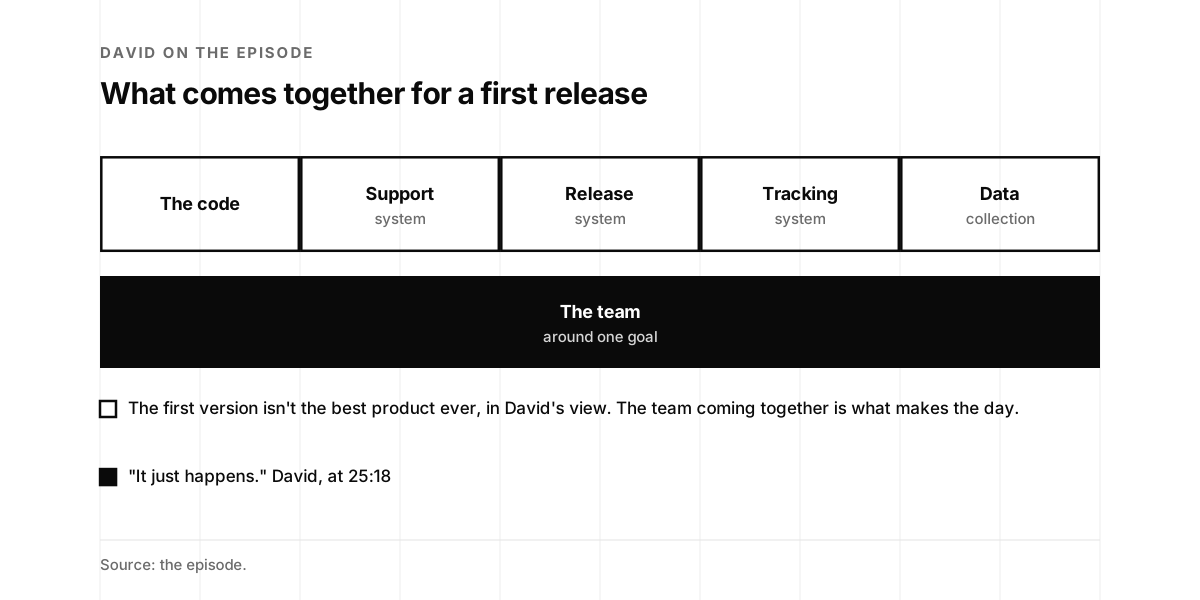
A first release means converging more than the code: the support system, the release system, the tracking system and the data collection. David doesn’t think the first version is the best product ever. What makes the day is the team. People merge with each other in a common goal, in ways no process or rule can describe.

“It just happens.”

David Gurle, at 25:18

Every time, David gets goosebumps, because it shows some of the best of humanity: the ability to come together for a common cause

“and to produce something that didn’t exist before”

David Gurle, at 25:35

David called it creation.

Jon remembered the day Symphony first released its public version, and the celebration out behind the offices.
Listen · David Gurle on episode 25, from 25:19
About 20 seconds: David on a team coming together for a first release. The clip stops on its own. Read the full transcript.
Five compartments in a row: the code, support system, release system, tracking system, data collection. Below them, a filled box: the team, around one goal. Then: the first version isn't the best product ever, in David's view, and the team coming together is what makes the day. Then: "It just happens." David, at 25:18
What has to come together for a first release, as David listed it. Source: the episode.

No money for Hive

The worst day came in October or November of the year before, while David was raising money for Hive. Symphony had taught some lessons. This time, no matter how much of the company David owned, David was

“going to have majority control over some key decisions”

David Gurle, at 26:55

“my shares will have more voting rights”

David Gurle, at 27:08

That meant more votes than the investors’ shares, which David hadn’t had at Symphony.

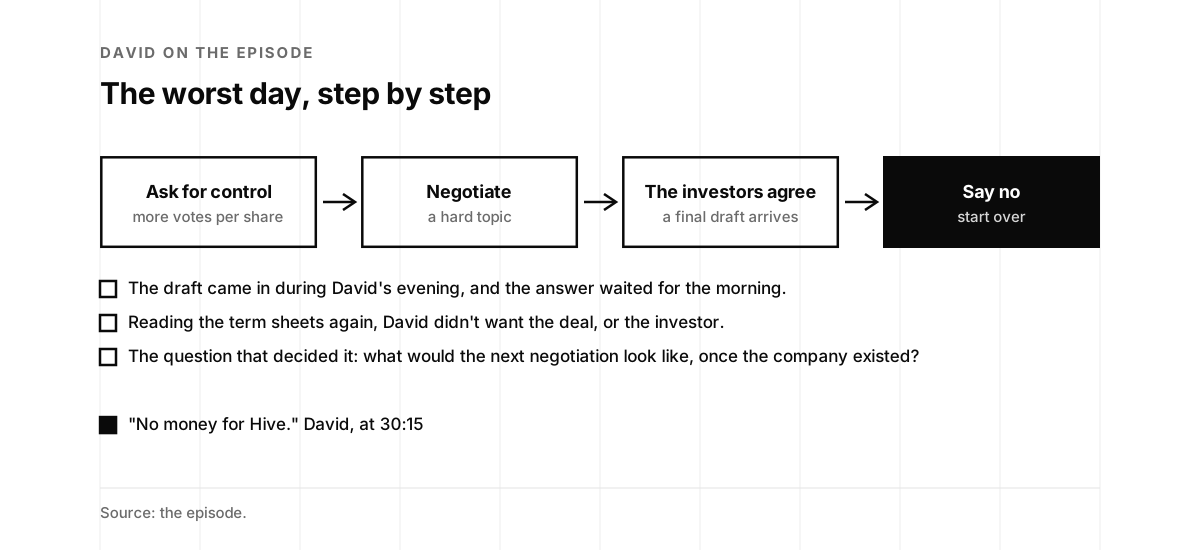
The negotiation with investors was hard, because nobody wants to lose control. David won that point anyway. The final draft came in during David’s evening. At 11 p.m., David put off the answer until morning. David went over the term sheets once more, and didn’t want the deal, or the investor. The fight had been too painful. David asked what the next negotiation with them would look like once the company existed, and whether this was the kind of investor David wanted. Without the lead investor, Jon pointed out, the other investors’ money would be at more risk, with a large share of the round missing.

“No money for Hive.”

David Gurle, at 30:15

Jon’s view: an investor should bring more than capital. It should bring its network and support, maybe a couple of customers, early traction, advertising, help with marketing, and even the security of the whole thing. David added judgment.

On episode 13, Jon and Paul Nguyen of Permiso talked about a clear no with customers: it’s information, and nobody’s time gets wasted.
Listen · David Gurle on episode 25, from 26:53
About 40 seconds: David on keeping control of the big decisions. The clip stops on its own. Read the full transcript.
Four boxes joined by arrows: ask for control, more votes per share. Negotiate, a hard topic. The investors agree, a final draft arrives. Filled, say no, start over. Below: the draft came in during David's evening, and the answer waited for the morning. Reading the term sheets again, David didn't want the deal, or the investor. The question that decided it: what would the next negotiation look like, once the company existed? Then: "No money for Hive." David, at 30:15
The worst day, step by step, as David told it. Source: the episode.

The deal you can leave

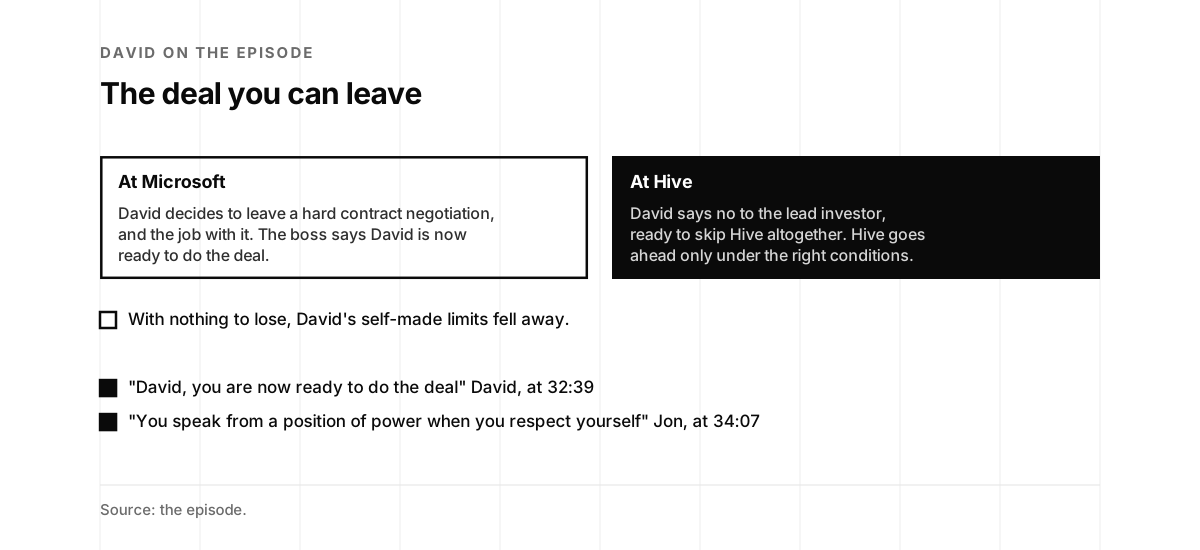
The lesson came from Microsoft. David was the business lead in a hard negotiation over breaking a massive contract, with top lawyers in the room. David decided to walk away, from the deal and from the job, and told the boss so. The answer:

“David, you are now ready to do the deal”

David Gurle, at 32:39

The reason the boss gave: David was ready to walk away. It took David a while to understand.

“it meant that I had nothing to lose anymore”

David Gurle, at 33:09

“all of the artificial constraints I put left and right in my decision process”

David Gurle, at 33:18

Those constraints were gone.

The same thing happened with Hive. Saying no to the deal, and being ready not to do Hive at all, gave David the courage to do it only under the right conditions. Jon put it in his own terms.

“You speak from a position of power when you respect yourself”

Jon McLachlan, at 34:07
Listen · David Gurle on episode 25, from 33:14
About 25 seconds: David on what being ready to walk away changes. The clip stops on its own. Read the full transcript.
Two cards. At Microsoft: David decides to leave a hard contract negotiation, and the job with it, and the boss says David is now ready to do the deal. Filled, at Hive: David says no to the lead investor, ready to skip Hive altogether, and Hive goes ahead only under the right conditions. Below: with nothing to lose, David's self-made limits fell away. Then: "David, you are now ready to do the deal" David, at 32:39. "You speak from a position of power when you respect yourself" Jon, at 34:07
Walking away, at Microsoft and at Hive. Source: the episode.

A billion computers for four hours

Jon asked David to look far ahead and describe a smashing success. David called it the moonshot. It’s in every device, gives people privacy and a sustainable way to use digital resources, and helps solve massive problems as science moves forward. The world has billions of computers and only 20 million servers in data centers, by David’s count. Picture a billion computers working together for four hours on a genome problem, or a math problem such as verifying the Riemann hypothesis. Jon, inspired, asked whether Hive was hiring security experts.
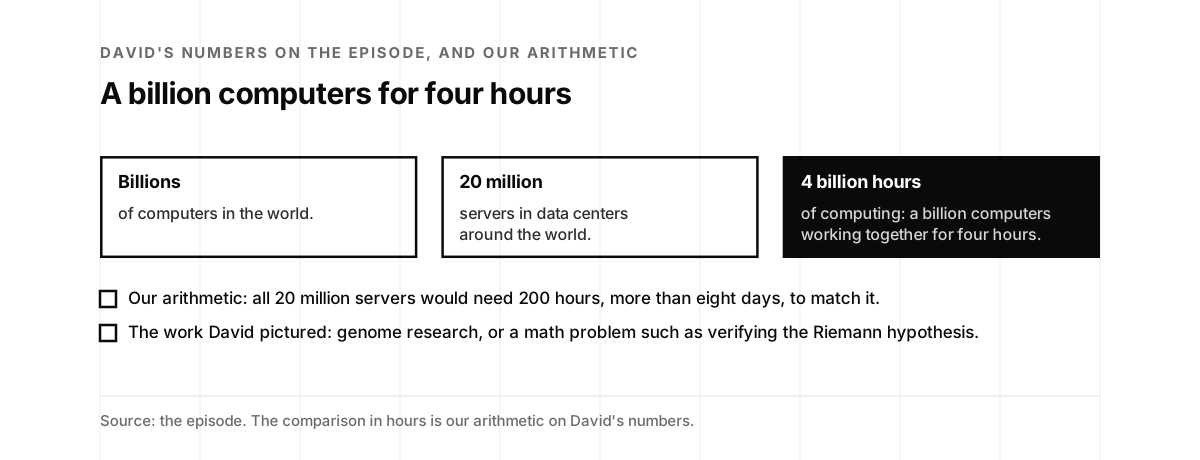
Three cards. Billions of computers in the world. 20 million servers in data centers around the world. Filled, 4 billion hours of computing: a billion computers working together for four hours. Below: our arithmetic, all 20 million servers would need 200 hours, more than eight days, to match it. The work David pictured: genome research, or a math problem such as verifying the Riemann hypothesis.
A billion computers for four hours, against the world's servers, in David's numbers. Source: the episode.

The cloud’s privacy problem

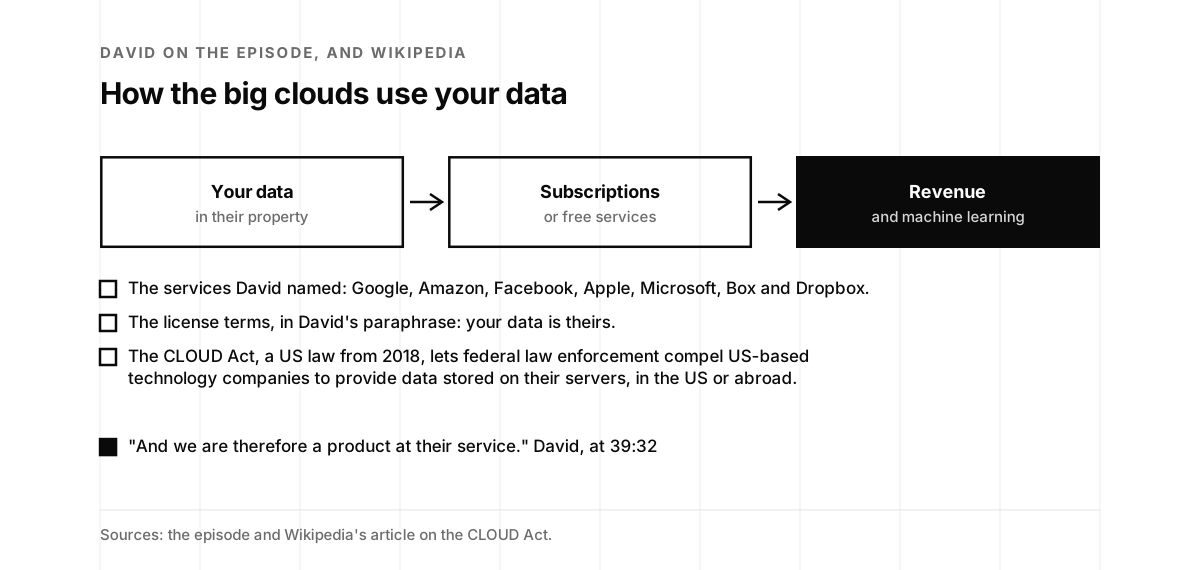
Jon came back to privacy, which David had mentioned. David called it an obsession. Jon thinks about privacy too, when putting data or running a sensitive program on someone else’s computer, and asked for the story. David started with how things stand. People keep their data with Google, Amazon, Facebook, Apple, Microsoft, Box and Dropbox, where it sits in those companies’ property and serves their commercial needs. They earn from subscriptions, or from free services meant to lead to a subscription. Whichever path you take, the data earns them revenue, and more and more it feeds machine learning.

“And we are therefore a product at their service.”

David Gurle, at 39:32

David also pointed to the US CLOUD Act, under which data on those companies’ infrastructure can be used in an investigation by US authorities without your knowledge. The end user license agreements say it plainly, in David’s paraphrase:

“your data is ours. We can do whatever we want with it.”

David Gurle, at 40:15

The CLOUD Act is a US law from 2018. It lets federal law enforcement compel US-based technology companies, by warrant or subpoena, to hand over data stored on their servers, in the US or abroad (Wikipedia).
Listen · David Gurle on episode 25, from 38:59
About 35 seconds: David on how the cloud uses your data. The clip stops on its own. Read the full transcript.
Three boxes joined by arrows: your data, in their property. Subscriptions, or free services. Filled, revenue, and machine learning. Below: the services David named, Google, Amazon, Facebook, Apple, Microsoft, Box and Dropbox. The license terms, in David's paraphrase: your data is theirs. The CLOUD Act, a US law from 2018, lets federal law enforcement compel US-based technology companies to provide data stored on their servers, in the US or abroad. Then: "And we are therefore a product at their service." David, at 39:32
How David described the cloud's business model and its reach. Sources: the episode and Wikipedia.

Keys only you hold

David called the privacy problem by far the first thing wrong with the cloud.

“So privacy is built into the DNA of the company.”

David Gurle, at 41:00

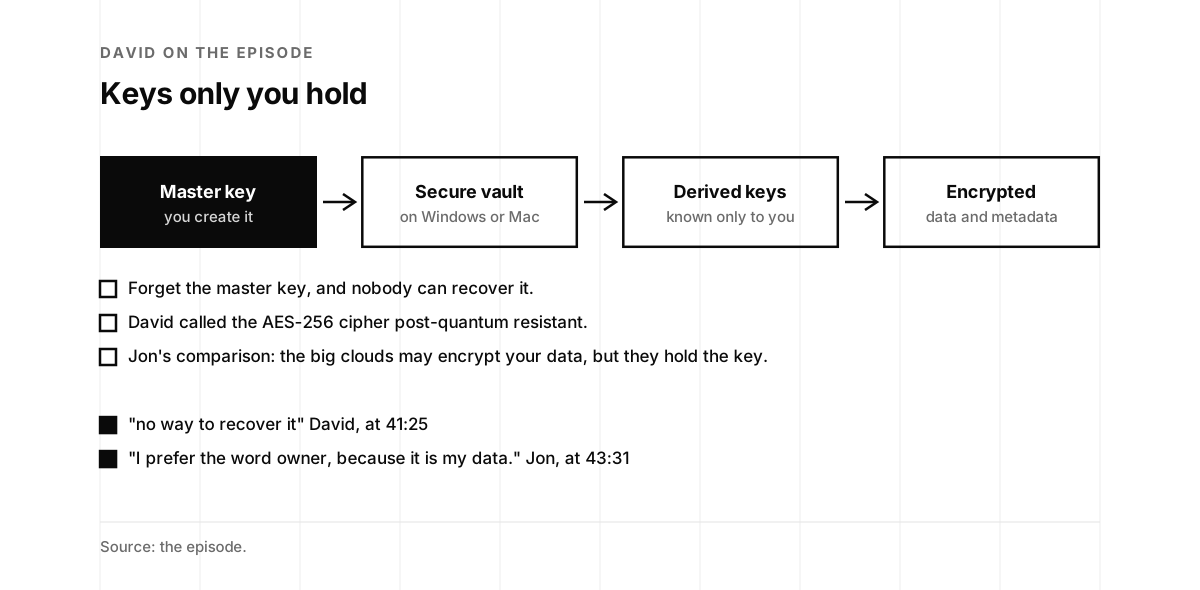
Hive uses full end-to-end encryption. You create a master key, and it lives in the secure vault on your Windows or Mac computer. If you forget it, there is

“no way to recover it”

David Gurle, at 41:25

Every other key derives from that root key, and only you know them. Hive encrypts metadata too.

“And then we encrypt data and metadata.”

David Gurle, at 41:40

The encryption is AES-256, which David called post-quantum resistant.

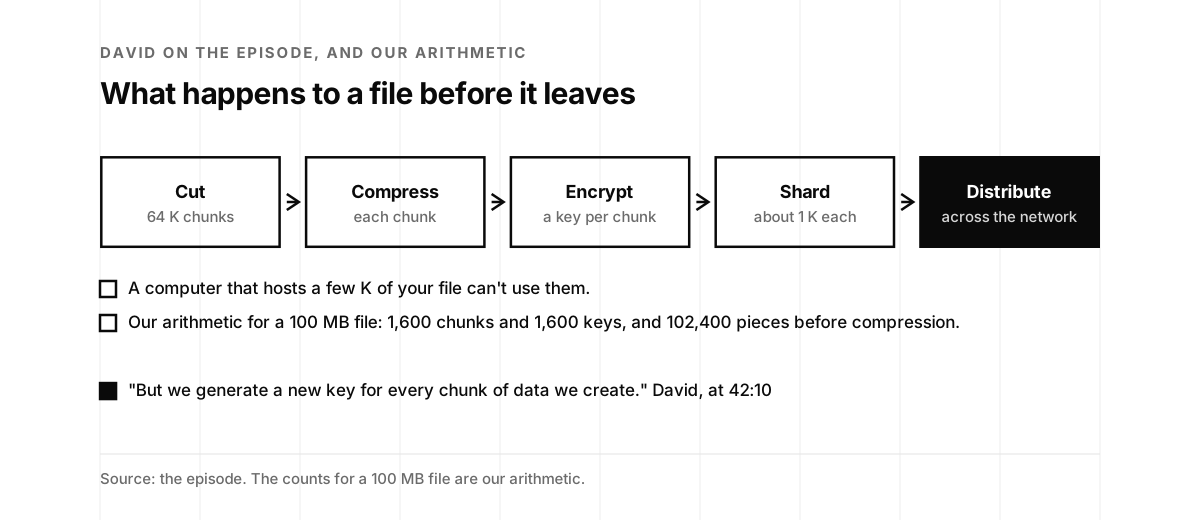
“But we generate a new key for every chunk of data we create.”

David Gurle, at 42:10

Hive cuts a file into chunks, compresses each one, encrypts it with its own key, splits it into smaller shards and spreads those across the network. Another computer might host 3K of your file.

“that 3K, even if you were to be able to access that, there’s just nothing you can do with it”

David Gurle, at 42:47

Jon summed up why that beats the big clouds, which may encrypt your data but hold the keys themselves.

“I prefer the word owner, because it is my data.”

Jon McLachlan, at 43:31

Wikipedia says AES-128, AES-192 and AES-256 are widely believed to be quantum resistant, because no known quantum attack does much better than classical attacks (Wikipedia). The quantum risk Kevin Kane of American Binary described on episode 96 sits in the key exchange, the step where two machines agree on a key.
Listen · David Gurle on episode 25, from 42:15
About 40 seconds: David on a key for every chunk. The clip stops on its own. Read the full transcript.
Four boxes joined by arrows: filled, master key, you create it. Secure vault, on Windows or Mac. Derived keys, known only to you. Encrypted, data and metadata. Below: forget the master key, and nobody can recover it. David called the AES-256 cipher post-quantum resistant. Jon's comparison: the big clouds may encrypt your data, but they hold the key. Then: "no way to recover it" David, at 41:25. "I prefer the word owner, because it is my data." Jon, at 43:31
From a master key on your computer to keys you alone know. Source: the episode.
Five boxes joined by arrows: cut, 64 K chunks. Compress, each chunk. Encrypt, a key per chunk. Shard, about 1 K each. Filled, distribute, across the network. Below: a computer that hosts a few K of your file can't use them. Our arithmetic for a 100 MB file: 1,600 chunks and 1,600 keys, and 102,400 pieces before compression. Then: "But we generate a new key for every chunk of data we create." David, at 42:10
What happens to a file before it leaves your computer, in David's numbers. Source: the episode.

Even if Google moved in

Jon pushed further. Suppose Google came to David the day after the release, ready to deploy all of its services, and data from Jon’s use of Google ended up inside Hive. Could it still be encrypted with Jon’s key, out of Google’s sight?

“We are not going to do it any other way.”

David Gurle, at 44:36

“No deviation around that.”

David Gurle, at 44:56

On episode 20, Benoit Chevallier-Mames of Zama described a further step: a server that computes on encrypted data and never learns what it’s working on.

Two interview questions

Jon remembered David’s interview of him as one of the best interviews he’d ever had, and asked for David’s favorite interview questions. The first is about a superpower. The second sends the candidate back in time with everything they know today, to an age of their choosing.

“now that you have all this knowledge, what are you going to do with it?”

David Gurle, at 46:18

David’s own answer stays in the transcript. Jon took a lesson from it about change, and David agreed. One of the essential elements of entrepreneurship, in David’s words:

“you are a change agent”

David Gurle, at 47:37

Hiring for self-awareness

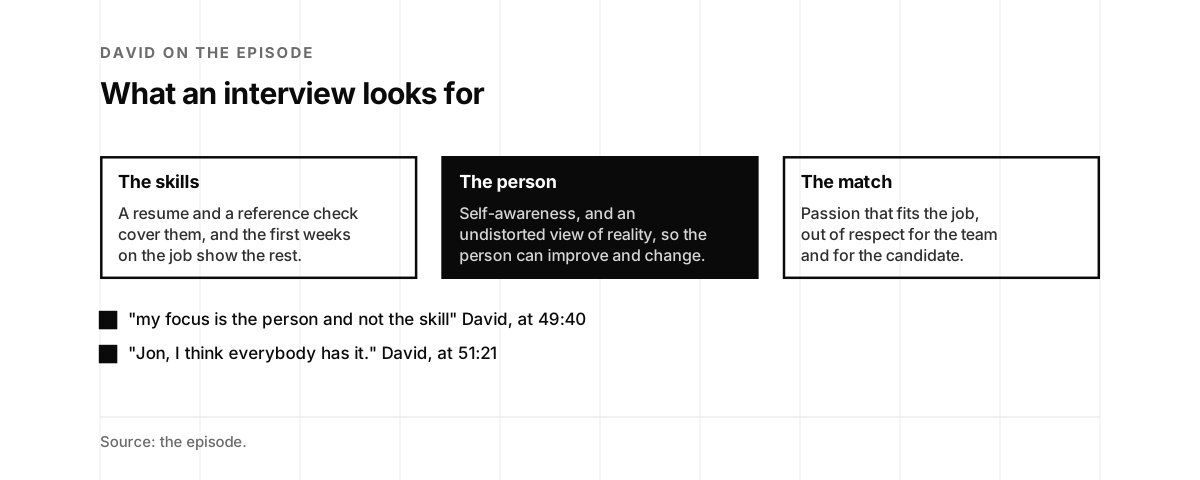
When David interviews someone, the skills aren’t the focus. A resume and a reference check cover them, and someone without the skills gets found out in the first weeks on the job. David has made many mistakes hiring the most skilled people, who hurt whole projects because of who they were.

“my focus is the person and not the skill”

David Gurle, at 49:40

An hour is too short to know a person, so the questions look for one thing: self-awareness, and an undistorted view of reality, so the person can improve and change.

Jon named it growth mindset, and David agreed. Jon added drive, a hunger you can’t teach. David had a different view.

“Jon, I think everybody has it.”

David Gurle, at 51:21

The question is whether the passion fits the job. Someone who doesn’t care about a company’s products won’t bring passion to selling them. So the hiring manager’s job, out of respect for the team and for the candidate, is the best match possible.

“Because if not, this person suffers and we suffer.”

David Gurle, at 52:37
Listen · David Gurle on episode 25, from 49:38
About 40 seconds: David on hiring for self-awareness. The clip stops on its own. Read the full transcript.
Three cards. The skills: a resume and a reference check cover them, and the first weeks on the job show the rest. Filled, the person: self-awareness, and an undistorted view of reality, so the person can improve and change. The match: passion that fits the job, out of respect for the team and for the candidate. Then: "my focus is the person and not the skill" David, at 49:40. "Jon, I think everybody has it." David, at 51:21
What David looks for in an interview. Source: the episode.

Expense reports that file themselves

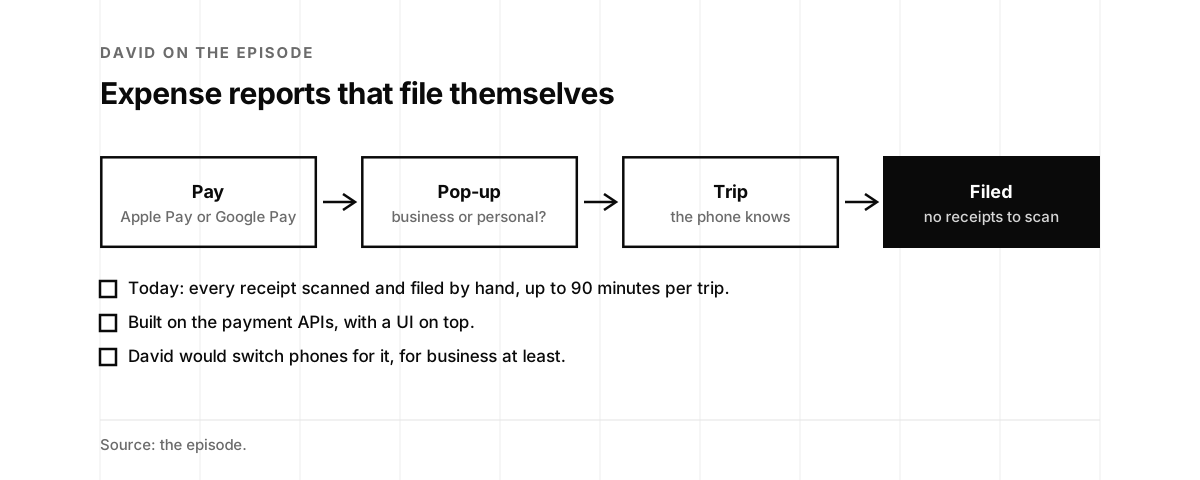
Jon asked for a tool David wishes someone would build. David held up a stack of receipts from a trip. Each one has to be filed for an expense claim.

“Such a waste of time.”

David Gurle, at 54:09

With Apple Pay and Google Pay around, David sees no reason for it. Pay, get a pop-up from the phone asking whether it’s a business or a personal expense, and the expense files itself because the phone knows you’re on a trip. David would switch phones for it, for business at least. Jon liked the idea. David’s answer: go build it.
Listen · David Gurle on episode 25, from 54:20
About 30 seconds: David on a tool for expense claims. The clip stops on its own. Read the full transcript.
Four boxes joined by arrows: pay, Apple Pay or Google Pay. Pop-up, business or personal? Trip, the phone knows. Filled, filed, no receipts to scan. Below: today, every receipt scanned and filed by hand, up to 90 minutes per trip. Built on the payment APIs, with a UI on top. David would switch phones for it, for business at least.
The expense tool David wants, from payment to filed claim. Source: the episode.

Don’t be afraid

Jon asked for advice for a younger self.

“I have only one. Don’t be afraid.”

David Gurle, at 56:07

What happened after the tape

Hive is now Hivenet. Wikipedia lists the company as Hivenet, formerly Hive (Wikipedia). Its site sells GPU and CPU compute for AI inference and high-performance computing, plus storage, and says it’s built on Antimatter and Policloud infrastructure (Hivenet). The storage product describes the design from the episode: files are “encrypted, split into fragments, and distributed” across Hivenet’s storage infrastructure (Hivenet). The page doesn’t say whether users’ own computers still hold the pieces.

PoliCloud and Antimatter. In March 2025, David launched PoliCloud, which Wikipedia describes as a distributed and decentralized modular micro-datacenter infrastructure. In 2026, Hivenet and PoliCloud merged with Data Factory to form Antimatter, with David as CEO (Wikipedia). LinkedIn dates the CEO role from April 2026 (LinkedIn).

On FRANCE 24. On May 21, 2026, FRANCE 24 English posted an interview with David from its People & Profit show, under the question “Powering the AI inference boom: Is it time to downsize the data centre?” (YouTube). Antimatter’s answer, in the post David shared: mini data centers that fit in a shipping container, with the energy and the software to run them (LinkedIn).

David on FRANCE 24's People & Profit, 13 minutes, posted on May 21, 2026. Watch on YouTube.

David called it Antimatter’s first TV appearance, with Antimatter introduced as an alternative to massive centralized data centers.

David on Antimatter's first TV appearance, at FRANCE 24.

David Gurle · May 25, 2026
David's post on the FRANCE 24 interview, with the link to it. View on LinkedIn.

The largest contract. On June 11, 2026, David announced Antimatter’s largest contract ever: 580 million euros for 29,000 GPUs, 2 million CPUs and 280 Policlouds, 35 megawatts in 18 months, in renewable power farms in five European countries. The post says Hivenet provides the distributed computing layer across the Policlouds (LinkedIn). That’s the distributed design from Skype, without the data centers, now spread across Antimatter’s own small data centers.

Symphony after David. Brad Levy became Symphony’s CEO in June 2021, and Ben Chrnelich in January 2026 (Wikipedia).
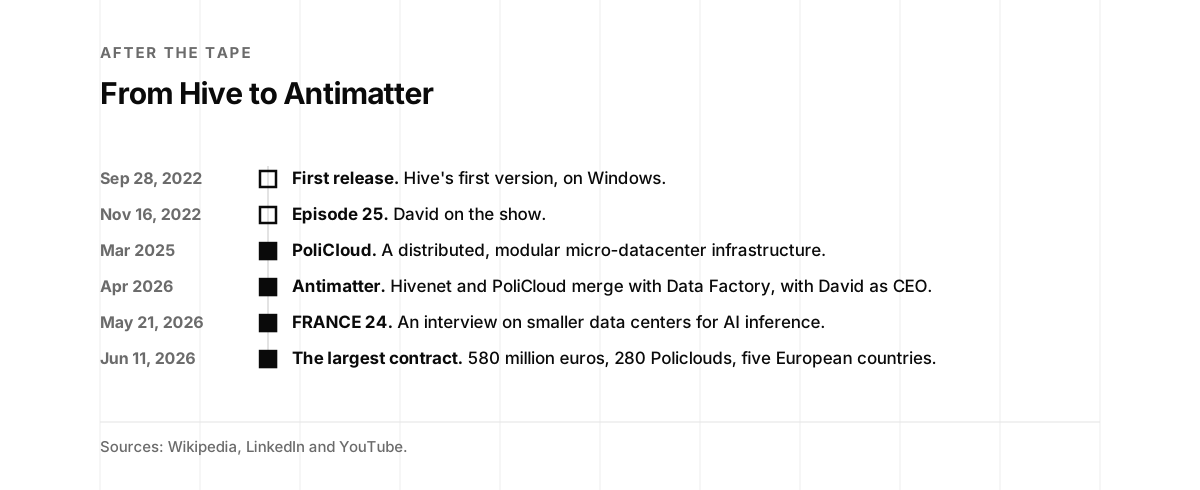
A timeline. September 28, 2022: first release, Hive's first version, on Windows. November 16, 2022: episode 25, David on the show. Filled, March 2025: PoliCloud, a distributed, modular micro-datacenter infrastructure. Filled, April 2026: Antimatter, Hivenet and PoliCloud merge with Data Factory, with David as CEO. Filled, May 21, 2026: FRANCE 24, an interview on smaller data centers for AI inference. Filled, June 11, 2026: the largest contract, 580 million euros, 280 Policlouds, five European countries.
After the tape: Hivenet, PoliCloud, Antimatter and a contract. Sources: Wikipedia, LinkedIn and YouTube.

Did you catch it? A seven-question quiz

Seven questions from the episode. Each answer links the moment in the transcript or its section.

Quiz · seven questions

Did you catch it?

Pick an answer to see whether you caught it.

  1. What gave David the idea for Hive?

    b. Skype used everyone's computers to do what servers do. See Skype, without the data centers.

  2. What did a contributor get for sharing one terabyte?

    c. "So if you share one terabyte, you'll get one terabyte from the network, which you can use to back up your files." Transcript, 21:13.

  3. What fee did Hive plan to take on the capacity it resold?

    a. "but with a 5% transaction fee" on capacity Hive resells at the same price. Transcript, 22:06.

  4. Why did David turn down the lead investor's final draft?

    c. Nothing was snuck into the terms. David asked what the next negotiation would look like. See No money for Hive.

  5. What did a boss at Microsoft tell David?

    a. "David, you are now ready to do the deal" because David was ready to walk away. Transcript, 32:39.

  6. How does Hive protect a file before it leaves your computer?

    b. "But we generate a new key for every chunk of data we create." Transcript, 42:10.

  7. What does David look for in an interview?

    c. The skills show up in a resume and a reference check. See Hiring for self-awareness.

Who holds the keys to your data?

Eight questions on who can read the data you keep in the cloud, built from the episode. Each tip links the section behind it.

Scorecard · eight questions

Who holds the keys to your data?

Answer for your most sensitive data. If two answers fit, pick the lower one.

  1. Who holds the keys to your most sensitive data in the cloud?

    • The provider, and we've never asked
    • The provider, in a key service we manage
    • We create and hold them, and the provider never sees them

    A big cloud may encrypt your data and still hold the key. See Keys only you hold.

  2. Is that data encrypted before it leaves your systems?

    • No, we rely on the provider's encryption
    • For some data sets
    • Yes, for everything sensitive

    Hive encrypts on your computer, before anything goes out. See Keys only you hold.

  3. Is the metadata encrypted too, such as file names and folders?

    • No
    • Some of it
    • Yes, along with the data

    Hive encrypts data and metadata. See Keys only you hold.

  4. Have you read what your providers' terms let them do with your data?

    • No
    • For our main provider
    • For every provider that holds customer data

    David's paraphrase of the license terms: your data is theirs. See The cloud's privacy problem.

  5. Do you know which governments can make your providers hand over data?

    • No
    • For our main provider
    • Yes, and our customers know too

    The CLOUD Act reaches data that US companies store abroad. See The cloud's privacy problem.

  6. What happens if you lose a master key?

    • We've never thought about it
    • The provider can recover it for us
    • We hold a tested backup, and nobody else can recover it

    In Hive, there is no way to recover a forgotten master key. See Keys only you hold.

  7. How much does one stolen key expose?

    • Everything
    • One customer's data
    • One piece of one file

    Hive generates a new key for every chunk of data. See the calculator.

  8. When a partner runs part of your service, do your keys stay yours?

    • No, the partner sees our data in the clear
    • It depends on the partner
    • Yes, whoever runs the service

    David's answer to Jon's question about Google: no other way. See Even if Google moved in.

The provider holds the keys

Your providers can read your data. Start with your most sensitive data set, and encrypt it before it leaves your systems.

Some keys are yours

Encrypt the metadata too, write down who can compel each provider, and rehearse losing a key.

You're the owner

Keep the key backups tested, and check each new partner's integration against them.

How many keys protect one file?

Hive cuts a file into chunks and encrypts each chunk with its own key, then splits each chunk into smaller shards. This calculator counts the keys and the pieces for a file of your size.

Calculator

How many keys protect one file?

Three numbers: the size of the file, the size of each chunk, and the size of each shard.

1,600keys, one per chunk
64shards per chunk
102,400pieces on the network

A 100 MB file in 64 KB chunks takes 1,600 keys, one per chunk. Split into 1 KB shards, that's 102,400 pieces on the network, 64 from each chunk. A computer that holds one piece holds 1 KB of one encrypted chunk, without the key.

The chunk and shard defaults come from the tape: 64 K chunks, and shards of about 1 K. The file size is a placeholder. The counts leave out compression, which shrinks each chunk before it's split, so the real number of pieces is lower. A megabyte here is 1,024 KB.

From VocalTec to Antimatter

David’s path, the field around it, and this show. Filter by topic.

Timeline

From VocalTec to Antimatter

  1. VocalTec

    Founded. Its founders patented the first voice over IP audio transceiver (Wikipedia).

  2. VocalTec

    David joins as VP of strategic alliances, until October 1999 (LinkedIn, on this page).

  3. Microsoft

    Product unit manager, then director of program management for real-time collaboration and communication, until March 2003. Wikipedia credits David with founding the unit behind NetMeeting and Windows Messenger (LinkedIn, Wikipedia).

  4. Thomson Reuters

    Global head of collaboration services, and from August 2007 also head of sales and trading in Asia, until January 2010 (LinkedIn).

  5. Skype

    First released, as a hybrid of peer-to-peer and client-server (Wikipedia).

  6. Skype for business

    David's role as general manager, until June 2011 (LinkedIn, on this page).

  7. Microsoft buys Skype

    For $8.5 billion (Wikipedia).

  8. Avaya

    VP of corporate strategy, until August 2012 (LinkedIn).

  9. Supernodes

    Skype starts running on supernodes that Microsoft operates (Wikipedia).

  10. Perzo

    David founds Perzo and runs it as CEO until September 2014 (LinkedIn).

  11. Symphony

    Goldman Sachs and 14 other financial institutions put in $66 million to set up Symphony and buy Perzo. David runs Symphony as founder and CEO until May 2021 (Wikipedia, on this page).

  12. Skype centralizes

    Skype moves from peer-to-peer to a centralized service on Azure (Wikipedia).

  13. The CLOUD Act

    A US law that lets federal law enforcement compel US-based technology companies to provide data stored on their servers, at home or abroad (Wikipedia, on this page).

  14. The idea

    Symphony's cloud bills, and the memory of Skype, give David the idea for Hive. Symphony's board gives permission (on this page).

  15. Symphony's next CEO

    Brad Levy takes over (Wikipedia).

  16. Hive

    David's role as founder and executive chairman starts. In October or November, David turns down the lead investor's final draft (LinkedIn, on this page).

  17. The first release

    Hive's first version comes out, on Windows (on this page).

  18. This episode

    David on the show (Podbean).

  19. PoliCloud

    David launches a distributed, modular micro-datacenter infrastructure (Wikipedia).

  20. Skype retires

    Skype is retired (Wikipedia).

  21. Symphony's next CEO

    Ben Chrnelich takes over (Wikipedia).

  22. Antimatter

    Hivenet and PoliCloud merge with Data Factory to form Antimatter, with David as CEO (Wikipedia, LinkedIn).

  23. FRANCE 24

    An interview on smaller data centers for the AI inference boom (YouTube, on this page).

  24. The largest contract

    580 million euros for GPUs, CPUs and 280 Policlouds across five European countries (LinkedIn).

What to do this week

Five things, in the order of the episode.

  1. Read the terms you agreed to. For each provider that holds customer data, check what its terms let it do with that data, and which governments can make it hand data over, as in The cloud’s privacy problem.
  2. Write down who holds each key. For every place your sensitive data lives, list who creates the encryption keys and who could use them, as in Keys only you hold. The scorecard shows where to start.
  3. Encrypt before upload, metadata too. Encrypt on your own systems, file names included, and use a key per piece where you can. The calculator shows what one key per chunk adds up to.
  4. Interview for self-awareness. Add one question that shows whether a candidate can see their own mistakes and change, as in Hiring for self-awareness.
  5. Get help with it. Our Product Security team ships customer-managed keys and end-to-end encryption in your product, Penetration Testing shows what an attacker can reach, and a vCISO can own the program. If you want to talk it through, book 15 minutes with us.

Key takeaways

  1. A cloud from computers people already own

    Hive pools the storage and compute of end users' computers in a virtual operating system. The idea came from Skype, which ran peer-to-peer with no data centers of its own.

  2. Share a terabyte, get a terabyte

    At launch, contributors got back as much storage as they shared, to back up their files. Those who use less than they share get a monthly payment, and Hive planned a 5% fee on what it resells.

  3. Keep control of the big decisions

    After Symphony, David wanted founder shares with more votes than investor shares. The lead investors agreed, and David still turned the deal down.

  4. Be willing to leave

    A boss at Microsoft told David the deal could be done once David was ready to walk away. With nothing to lose, the artificial constraints were gone.

  5. An investor brings more than money

    Jon looks for a network, support, a few customers, early traction, marketing help and even security. David added judgment.

  6. Privacy belongs in the design

    The big clouds keep your data in their property, use it to make money and fall under the CLOUD Act. Hive built privacy into the company from the start.

  7. Keys only the owner holds

    A master key stays in your computer's secure vault, and nobody can recover it. Hive encrypts data and metadata, with a new key for every chunk.

  8. Hire for self-awareness

    Skills show up in a resume and a reference check. The interview looks for self-awareness and an undistorted view of reality, so the person can improve and change.

  9. Match the passion to the job

    Everybody has drive, in David's view. The hiring manager's job is the best match, out of respect for the team and for the candidate.

Chapters

Tap a chapter to play from there.

Pull quotes

“Well, Hive is a distributed peer-to-peer cloud solution.”

David Gurle ·

“and Skype was entirely peer-to-peer”

David Gurle ·

“because I had to ask permission. It was in my contract.”

David Gurle ·

“literally yesterday we released our first version”

David Gurle ·

“the error message is actually incorrect”

David Gurle ·

“So if you share one terabyte, you'll get one terabyte from the network, which you can use to back up your files.”

David Gurle ·

“It's almost like taking the business model of Uber”

Jon McLachlan ·

“It just happens.”

David Gurle ·

“my shares will have more voting rights”

David Gurle ·

“No money for Hive.”

David Gurle ·

“David, you are now ready to do the deal”

David Gurle ·

“You speak from a position of power when you respect yourself”

Jon McLachlan ·

“And we are therefore a product at their service.”

David Gurle ·

“So privacy is built into the DNA of the company.”

David Gurle ·

“But we generate a new key for every chunk of data we create.”

David Gurle ·

“I prefer the word owner, because it is my data.”

Jon McLachlan ·

“We are not going to do it any other way.”

David Gurle ·

“my focus is the person and not the skill”

David Gurle ·

“Jon, I think everybody has it.”

David Gurle ·

“I have only one. Don't be afraid.”

David Gurle ·

About the guest

David Gurle, Founder and Executive Chairman, Hive

David Gurle is founder and CEO of Antimatter, formed in 2026 when Hivenet, formerly Hive, and PoliCloud merged with Data Factory. When this episode was recorded, David was founder and executive chairman of Hive. Before Hive, David founded Perzo and ran Symphony as founder and CEO from October 2014 to May 2021, after roles at VocalTec, Microsoft, Thomson Reuters, Skype and Avaya. Wikipedia credits David with founding Microsoft's real-time communications unit, the team behind NetMeeting and Windows Messenger, and with co-authoring IETF standards for presence and instant messaging over SIP.

About the host

Jon McLachlan is co-founder of YSecurity, the on-demand cybersecurity team for startups, and of Cyberbase.ai. The Security Podcast of Silicon Valley is hosted by Jon McLachlan and Sasha Sinkevich. Jon McLachlan on LinkedIn ↗

Context and sources

  • Episode 25 on Podbean: David Gurle, Founder and Executive Chairman at Hive, on Empathy, Innovation, and Disruption. Source ↗
  • David Gurle on LinkedIn: founder and CEO of Antimatter since April 2026, Hive from November 2021, PoliCloud from February 2025, Symphony founder and CEO from October 2014 to May 2021, Perzo, Avaya, Skype, Thomson Reuters, Microsoft and VocalTec. Source ↗
  • Wikipedia, David Gurle: founder of Microsoft's real-time communications unit, Symphony's founder and CEO, Hivenet, formerly Hive, PoliCloud in March 2025, and Antimatter in 2026. Source ↗
  • Wikipedia, Symphony Communication: $66 million from Goldman Sachs and 14 other financial institutions in October 2014 to set up Symphony and buy Perzo, more than 400,000 users by 2020, and later CEOs. Source ↗
  • Wikipedia, Skype: a hybrid of peer-to-peer and client-server, bought by Microsoft for $8.5 billion in May 2011, moved to Azure in 2017 and retired on May 5, 2025. Source ↗
  • Wikipedia, VocalTec: founded in 1985 by founders who patented the first voice over IP audio transceiver. Source ↗
  • Wikipedia, CLOUD Act: a US law from 2018 that lets federal law enforcement compel US-based technology companies to provide data stored on their servers, in the US or abroad. Source ↗
  • Wikipedia, Gatekeeper (macOS): enforces code signing and verifies downloaded apps before they run. Source ↗
  • Wikipedia, Advanced Encryption Standard: AES-128, AES-192 and AES-256 are widely believed to be quantum resistant. Source ↗
  • Hivenet: GPU and CPU compute for AI inference and high-performance computing, plus storage, built on Antimatter and Policloud infrastructure. Source ↗
  • Hivenet Store: files are encrypted, split into fragments and distributed across Hivenet's storage infrastructure. Source ↗
  • FRANCE 24 English on YouTube, May 21, 2026: Powering the AI inference boom: Is it time to downsize the data centre? Source ↗
  • David Gurle on LinkedIn, May 25, 2026: Antimatter's first TV appearance, at FRANCE 24. Source ↗
  • David Gurle on LinkedIn, June 11, 2026: Antimatter's largest contract, 580 million euros for GPUs, CPUs and 280 Policlouds in five European countries. Source ↗

Transcript

Automatic transcription. Jon McLachlan hosts this episode with David Gurle, founder and executive chairman of Hive. There is no diarization on the tape, so speaker labels were assigned from the content and checked against reference recordings of each voice from this episode, and a few short lines may sit with the wrong speaker. Names and terms were normalized where the recognizer misheard them (Jon McLachlan, David Gurle, Hive, Perzo, Symphony, Thomson Reuters, VocalTec, Cosmian, Chekk, Rothschild, F24, Skype, Gatekeeper, CLOUD Act, AES-256). Words in [brackets] are best guesses where the audio is unclear, and [...] marks words no decode made out. Speech is transcribed as spoken, though many repeated words and false starts are left out, and so are short backchannels such as "yeah" where they overlap the other speaker.

Read the full transcript 7,709 words

Jon McLachlan

Hey, welcome everyone to another episode of the Security Podcast in Silicon Valley. I'm here today with a very special guest, David Gurle. David, welcome to the show.

David Gurle

Thank you, Jon. And the way you pronounce my first and last name is perfect.

Jon McLachlan

I am so happy about that. I'm really good at butchering names. David brings to the table so much experience. You started your career, it looks like, at Digital Equipment Corporation in France. You were a software engineer there. Then you moved to France Telecom. You were an R&D engineer, and then ETSI, you were a technical officer there, VocalTec, the VP of strategic alliances, and then you moved into Microsoft. And at Microsoft, you are actually director of program management of real-time collaboration and communication. And that was back in 2002. So, right as soon as the, right after the dot-com bust, I suppose, and we're getting serious about communications.

David Gurle

Well, the thing is, I'm very good at missing the rise of the stock and arriving at the end of the [ride]. So, I arrived at Microsoft at the height of Microsoft stock. And after I joined, it just went down and [never] recovered.

Jon McLachlan

So I'm so sorry to hear that. Oh. Okay. And then after that, you were at Thomson Reuters. You were the global head of collaboration services and head of sales and trading Asia. Awesome. And then you were the general manager at Skype for business. This is now in Palo Alto. And at this point, I think your career really started to take off. You were with Avaya, VP of corporate strategy, and then you started your own company. You started Perzo Inc. Yeah, you were the founder and CEO of Perzo. That chugged along for two years and was bought by Symphony Communications. You were the founder and CEO of Symphony Communications, which has a very special place in my heart, because I joined Symphony Communications. This is where we met.

David Gurle

Yep. I have to interrupt you right now, just for a minute, because I was thinking about this podcast and I said, what am I going to do to Jon to embarrass him a little bit? And I just want to say that I am so grateful for everything that you've done for Symphony. You made Symphony secure. You made Symphony strong. And thanks to the great work that you've done, along with your teammates, you managed to break through the impenetrable walls of Wall Street and became the standard there. So thank you, Jon.

Jon McLachlan

David, you're very kind. It was a solid team effort. And we wouldn't have had that opportunity if it wasn't for all the hard work everyone had put into Perzo and then followed through with Symphony. And a lot of, you know, Symphony Communication was where I had the first opportunity to really lead a team technically. And it was an amazing experience. And I have all of the gratitude and humility in the world for having had those opportunities and made those connections, and a spectacular adventure that we shared together, I would say, David.

David Gurle

Yep.

Jon McLachlan

So thank you. But the gratitude is a two-way street. And after Symphony, you're a founder and board member of Symphony Communications. You got involved with a lot of advising, [One] Creation Corporation, Cosmian.

David Gurle

Cosmian, yep.

Jon McLachlan

Chekk, you're advisor and board member there. Quest Partners, founder and executive chairman at Quest. Rothschild and Co., a senior advisor with [Rothschild], [and the] investment banking.

David Gurle

Yep.

Jon McLachlan

And F24 AG, you're chairman of the board there. You took a role with the government of France. You're an ambassador to France 2030.

David Gurle

Yep.

Jon McLachlan

Amazing. And now you've done it again. Once an entrepreneur, always an entrepreneur. You're the founder and executive chairman at Hive.

David Gurle

Yeah, one more time. One more time.

Jon McLachlan

I mean, is it something that you're really going to walk away from ever? Is it just, it's just too fun to keep doing these things, right?

David Gurle

Exactly. And I think that you mentioned the keyword, the fun.

Jon McLachlan

You really have to have that passion, because things get gritty, things get difficult. You have to reach down deep and find that drive, and not just plow forward for your own sake, but as a leader, you have to inspire everyone else around you to stick with it, stick through it, right? Yeah. So was there any part of your childhood that, you know, getting into our first question, was there any part of your childhood that really makes you you, or that was like very influential? Maybe a unique experience that gave you some of that grit or some of that drive?

David Gurle

Yeah, I believe so. I'm not sure if it's only one thing, Jon, but I grew up in the Middle East. I was born there. Parents were diplomats. And I grew up in the streets of Lebanon, Syria and Turkey, and played with the kids of my age from those countries. And, you know, growing up playing football, soccer, and all types of games that we used to play, I always was this kid who wouldn't do things like the other kids would. Kind of the [odd ball]. But I never felt wrong doing it. You know, I always felt that I was doing what I wanted to do, and if it was against what the group was doing, it was okay for me, and vice versa. So people will always call me, like, you're special, or you don't listen, and you are [hard-headed], and all of those things. And I got Teflonized into the Teflon, this thing that never sticks.

Jon McLachlan

Yeah, it never sticks to you, huh?

David Gurle

Nothing, nothing ever sticks.

Jon McLachlan

Just like [Teflon], really.

David Gurle

Yeah, exactly. Just like, very early on in my life. And I have one memory that I can relate to. I was 13 years old. We were in Turkey, and there was a military coup in Turkey in 1980. And it was curfew. But you know, who would respect a curfew when you're a 13-year-old and there's nothing to do home? And so I just got out and managed to convince a few of my friends to get out as well, by just yelling at them. And then we started playing outside. I don't know what we were playing, but eventually a military truck came by and saw us and stopped us. So [...] curfew, we can't go out. So they just aligned us like that. And I was the youngest.

Jon McLachlan

Oh, you're the youngest. Wow.

David Gurle

I was the youngest. And they started hitting us from the oldest all the way to me. And it was my turn. I was the youngest. I thought I might escape it because I was the youngest and I was the last one. It just didn't matter. And I just got a big hit on my face and a big hit in my stomach. And I just looked around and I said, okay, are you done? And so I guess this rebellious attitude that I have, the fact that I make my own rules, was probably in me. And the environment in which I grew up helped me to further sharpen that edge that I had, and it never left me. And I think it's one of my qualities.

Jon McLachlan

One of your secret strengths.

David Gurle

Yeah, maybe. Yeah.

Jon McLachlan

No, it's amazing. And I'm sorry that you went through that. I believe firmly that it's the experiences that we go through that sort of shape who we are and give us the opportunity to rise to the occasion. And it sounds like you really took it upon yourself to be yourself, even in the face of great adversity.

David Gurle

Yeah, because it was the only way. You know, I was a foreigner, right? You know, if you think about it, I was a foreigner trying to integrate. And so I faced racism all my youth. You know, I was a minority. I was the only white kid playing in those places, only white and only non-Muslim. So, you know, you had no choice but to deal with it.

Jon McLachlan

Right. And you had to deal with it at a very [formative] time in your childhood. And it sounds like you made the most of it. And it really shaped you to be able to handle, like, tough situations.

David Gurle

Yeah, but also learn respect, you know. The thing you need to understand when you are in a situation like that is the fact that where you were born affects a lot your future and affects who you are a lot. And so, rather than judging people for who they were, I was trying to understand the differences and respect those differences, right? And so, you know, even though I was this [odd] kid, because I always respected their differences and tried to understand their differences and tried to [love] their differences, eventually I was welcomed. So it was a good learning for me.

Jon McLachlan

That's really heartwarming, actually. To be different, to be perceived as different, and then to be welcomed into the group, right?

David Gurle

Yeah, it does.

Jon McLachlan

I have to admit that it sounds very similar to experiences that I had, coming out [...] in Minnesota, in a very conservative environment. You're forced to deal with differences and things that you can perceive as adversity, but they do shape you into who you become, right?

David Gurle

Yeah, of course. No, no, no. Adversity is a very good trainer. You know, if you have the right support.

Jon McLachlan

If you do.

David Gurle

Yes. Yeah. I mean, you know, being alone is not easy. I mean, some exceptional people can do it all by themselves. But if you have the right support from family, friends, you know, that helps a lot.

Jon McLachlan

That is absolutely critical.

David Gurle

I'll come back to these differences through an experience I want to share with you.

Jon McLachlan

[Oh], please.

David Gurle

We were in Beirut, the capital of Lebanon. And I was much younger then, you know, maybe eight, nine years old, but enough to remember. And it was the civil war of Beirut. And the buildings were destroyed, the roads were destroyed, and we were walking with my dad on the street going somewhere. I don't remember where. As we walk by, across the street, there is this kid, older than me, but a kid. He's got an AK-47 on his shoulders, you know, this Kalashnikov thing. And, you know, we being young just got scared, and I hid myself behind my dad. And my dad said, what's going on? And I said, well, you know, you look at this kid, you know, he's a bad person and he might kill us. And he said, well, how do you know he's a bad person? Well, I said, because, you know, he's got a gun. Right. And yes, but imagine you were born in his shoes and you were defending your home. What would you do? And that for me was the, somehow, defining experience in tolerance and in understanding diversity and not judging, you know, not judging the book by its cover. You know, it's trying to read it and understand it and give time. And so I think that would be the right answer to your question.

Jon McLachlan

Yeah, I appreciate that. Yeah, I can feel the empathy. It's a skill that you can develop, right?

David Gurle

Oh, yeah, anybody can develop it. You just need to love the human nature.

Jon McLachlan

Not be too surprised by the unexpected. But, you know, one of the tricks that I've always used was, you know, when there's a disagreement, I assume two things. I assume that everyone brings something to the table, that people are smart. And it's my job as a listener to see that in other people that are at the table. And it's also my job to play with a sense of perspective and empathy to answer the question, okay, why is this the right thing to do? Like, what set of values are driving the discussion so that this is the right thing to do? And to drop my set of values and really try to pick up another set of values that might actually be a better, a better set, where the problem or the disagreement is not a problem or a disagreement anymore. You know, it sounds like you were put in a situation where you were doing exactly the same thing, except it was someone with a gun, a kid with a gun who was just defending his country, perhaps, or his family or his loved ones, right?

David Gurle

Exactly.

Jon McLachlan

I'm sorry that you have to go through those things, but it sounds like it really helps shape who you are today. And I think that's a pretty spectacular person.

David Gurle

I think so too.

Jon McLachlan

So would you like to share our listeners a little bit about Hive?

David Gurle

Yeah. Well, Hive is a distributed peer-to-peer cloud solution. It is unique in its approach to build an alternative cloud to the ones that, you know, we use every day. It has the ability to take the end-use resources of computers around the world and put them in a virtual operating system, from which we can offer, and we offer, storage and compute services. So that's really the nature of that. And I had the idea actually when we were at Symphony, 2018. The bills of Amazon and Google, on which we were building and running our infrastructure, I was going mad. And the reason I was going mad, not because the bills were going up, obviously they were going up, but because I knew that there was a better way of doing it, because I used to run Skype for business, you mentioned it earlier, and Skype was entirely peer-to-peer. So no infrastructure and no data centers. So we were using everyone's computers, you know, to do what servers do. And so I said to myself, there's really no technical reason that we couldn't do the same thing with the cloud. So I went to the board and I said, okay, guys, I know I'm running Symphony, but I have another idea, and that's really what I want to do. And so I want to have the right to start doing it, because I had to ask permission. It was in my contract. And so they gave the permission to me. And some of them even said, okay, we're going to invest in it, we liked the idea. But life happened. I didn't have time. [Symphony] just absorbed me so much that I couldn't put a minute on this new initiative, which wasn't called Hive in my mind back then. And then it's only when I decided to sit down in 2021 that I said, okay, what am I going to do next? And that became the beginning of the journey for Hive, for me. So we can obviously talk more about how, but that's kind of how it started and it's kind of what we do. And as a matter of fact, you are catching me at a very opportune moment, because literally yesterday we released our first version.

Jon McLachlan

Wow, congratulations. That's huge. That is amazing. So that was Wednesday, September 28th. And so when you say the first version is released, can I try it out? Can I download it? I can participate in?

David Gurle

You can if you have a Windows machine. We don't have a Mac version yet. I'll send you the Mac version. I'm running Mac myself. Sure. The thing is that we haven't gotten, you know this better than anyone else, all the signatures from Apple approved, you know, all the developers. So when you install Hive, you get all these warnings. And so you need to mute those warnings to install cleanly. So since you know all of this better than I do.

Jon McLachlan

Security, something like that. Yeah, yeah. No, I guess to loop in our listeners, like, what's going on with Apple. Apple is pretty famous for being a closed ecosystem, meaning they do try to control what goes into it. But on your desktop computer, it's been pretty open, but they're slowly introducing this feature called Gatekeeper, and a developer program. And so all software that runs on [a Mac] is supposed to be signed with a private key that [chains] back up to a root of trust that goes through their developer program, so that they can detect things that were not developed by a person that has an official relationship with Apple through the developer program. And it sounds like they're making great strides. I don't follow their program very closely, but it sounds like they're starting to get to the point where error messages become, like, almost like barriers to entry.

David Gurle

It is, because the error message is actually incorrect. You know, it says the program is broken, it cannot work. I mean, you know, but what you see when you try to make such an install, if you are an inexperienced end user, you're going to say, okay, I'm not going to install something that doesn't work.

Jon McLachlan

Of course, of course. But when you send me the Mac version, I'm just going to click through all of those [warnings]. I'll be like, yeah, I know what I'm doing. Don't worry.

David Gurle

There's a special command line interface, which I'll send you, which will mute all of those things. Don't worry about that.

Jon McLachlan

Okay. I'll be happy to run that. And I have plenty of spare compute. So I'll be interested to see if maybe the next big SaaS service can be deployed on top of Hive, and part of it can run on my local machine here in San Francisco, and maybe even use some of the storage, because I have four terabytes of storage on this machine. I don't use all of it by any stretch of the imagination. So, do you monetize? So as a contributor to the network, is there any sort of reward that I get for participating?

David Gurle

Exactly. You get a reward. At this time, the reward is what you share, you get in exchange. So if you share one terabyte, you'll get one terabyte from the network, which you can use to back up your files. And we don't plan to make money out of what I call this [pure] exchange. Having said that, if you want to consume less than what we share, we ought to pay you. So we're going to actually pay you a monthly fee, because we're going to use the end-use capacity that you have for people who want to consume more than what they share. And so our goal will be to kind of, in a wholesale fashion, buy all these compute and storage capacity, and then sell it at the same price, but with a 5% transaction fee, back to the users who want to consume more than the exchange.

Jon McLachlan

I think that's awesome. It's almost like taking the business model of Uber and distributing it across folks that just have spare resources and spare time, help connect people looking for rides with folks able and willing to give rides, except we're doing it in the compute space. And instead of centralizing all of the stuff, like AWS has done, like, you know, Google GCP has done, where there's a big company behind it, and the yellow taxi cab shows up, and you have to call one specific phone number, it goes to central dispatch, like, this is the decentralized model of compute and storage.

David Gurle

Exactly.

Jon McLachlan

Very nice. Very nice.

David Gurle

I'd like to ask your permission to use what you just described in my next Hive introduction video, because it is so well said and so well, you know, metaphor. I hope you'll give me that.

Jon McLachlan

Oh, please. Yeah, of course. Of course. I'm just rephrasing what you've shared. And so all of the content is yours, 100%. Please do. I'd be very flattered. Thank you. So what's been your best day along your journey so far with Hive?

David Gurle

28th of September, 2022. The release of the first version.

Jon McLachlan

Yesterday was your best day. Amazing. You're still floating on the clouds.

David Gurle

I am. I am still. But distributed cloud, you know.

Jon McLachlan

Let's not [underplay] that. Not a centralized cloud, the distributed cloud that we're floating on.

David Gurle

Exactly. Yeah. I mean, the reason it's a best day, you are a software engineer, you know, by training, and you know how hard it is to converge the first release. You have to not only converge the code, but the engineering, you know, back office things behind it together, the support system, the release system, the tracking system, the data collections. I mean, everything that needs to come together is still a lot of effort. And so what's really beautiful about this, and why I'm so happy, is not that it's the best product ever. I honestly think it's not. The first version of Hive is something we look at as, oh, why did we release this thing, a few releases from now. It is actually how everything comes together, and the team comes together. And suddenly, you know, the humans just merge with each other in this common goal, in ways in which no words, no process, no rule can describe. It just happens. And I've seen this many, many times. I mean, many, many times. And every time, I have goosebumps from it, because I think it represents some of the best of humanity, and this ability to come together for a common cause and to produce something that didn't exist before. It's creation.

Jon McLachlan

Yeah. Yeah, I understand that entirely. I remember when we first released the public version of Symphony, and there were cigars [involved]. And at the end of the day, there, in the back, out back behind the offices, it was a celebration of the greatest type. And I'm sure that there at Hive, you're broadcasting from New York, right?

David Gurle

Yes.

Jon McLachlan

I'm sure there's celebrations happening there too. Okay. So how about the worst day that you've had on your journey so far at Hive?

David Gurle

So there was a moment in October, November last year. So you have to put things in perspective, right? I did Symphony. Now I am raising for Hive. And there are things that I absolutely want to do differently than I have done in Symphony, because I have learned a few lessons. And one of the things that I absolutely wanted to do was that I am going to have majority control over some key decisions, no matter how much I own in the company. And so that basically means that my shares will have more voting rights than investor shares, which I did not have at Symphony. And so I'm negotiating with investors around that, and it's a very, very difficult topic, like you cannot imagine, because nobody wants to lose control. But somehow, you know, through [grit], through empathy, through negotiation, I managed to get the lead investors to agree to this. So I'm pretty happy with it. And I'm saying, okay, [we're there]. So I received the final draft, and I was in Hong Kong at that time. So it gave me an excuse to [sleep] over, because it was my evening, it was their afternoon, they were European VC firm. And so I said, okay, you know, I got it. You know, it's now 11 p.m. for me. I'll get back tomorrow morning. So I also had six hours in the morning when I woke up to think about it.

Jon McLachlan

It's a good thing.

David Gurle

Yeah, it's good. It's, 24 hours was very important. And so I go once more, you know, over the term sheets and kind of all the process, and I realize that I don't want this deal. I don't want it. And I don't want this investor. But I have no other investor. I mean, they're the lead investor.

Jon McLachlan

Right. Okay.

David Gurle

I have other investors, but if I basically don't deal with this investment, I don't know what's going to happen to others.

Jon McLachlan

Right. It's a very precarious situation, because the other investors are not prepared to put more in, but if they lose the lead investor, then their investment becomes much riskier, because now there's a huge chunk of capital that's not being injected, that needs to get injected in order for them to feel comfortable again, right?

David Gurle

Absolutely. So here you go, right? You know, we are almost there. All I need is to sign that thing, because it's something that I negotiated so hard that they agreed to, but I decided not to do it.

Jon McLachlan

Did they try to sneak something else into the terms?

David Gurle

No, it was just too painful. [...] And I said to myself, what if I'm in a different situation, now that the company exists, and I'm going to have to negotiate again with them? And is this really the culture, the type of investor I want in the [cap] table or not? And I realized that I didn't want that. And so suddenly, back to square one. No money for Hive. And despite the fact that I had all the money I wanted. And so, you know, the call when they woke up was not an easy call to make, to explain it. And then I have to figure out what I'm going to do next, because I have to start from scratch. So yeah, that was a low point.

Jon McLachlan

Yeah, those can be very difficult decisions that we have to make as founders. But keeping that long-term vision in mind. And I 100% empathize with wanting to retain control of the company, because if you retain control of the company, you retain control of your, you can execute against your vision, right? But if it's an arm and a leg and twisting, and is it really the optimal partner? Because when you pull in an investor, it's not just capital that they bring, right? It's supposed to be the network and the support, and maybe a couple customers, and initial traction, and advertising, and help with the marketing, or even like the security of the whole thing.

David Gurle

And on top of that, the judging.

Jon McLachlan

And the judging. Yeah. Yep.

David Gurle

And so, you know, one day I was at Microsoft, and we were in a very tough negotiation with an organization, a very, very tough negotiation. I mean, I was the one instigating the break of a massive contract, which I felt was against Microsoft. And so we are going in this negotiation with the top lawyers and everywhere, but I am the business lead. And so we arrive to this point in which, for me, I'm just not going to continue. I'm not going to do this deal. I'm saying that I'm just too tired. I'm not doing this deal. It doesn't go the way it should go. And so I go to my boss. I say, you know, Bob, his name is Bob, said, Bob, you know, I'm sorry, but I'm going to walk away. I'm not doing this deal. And he looks at me, and he says, David, you are now ready to do the deal, because you are ready to walk away.

Jon McLachlan

You mean walk away from your role with Microsoft?

David Gurle

Yes. To be totally clear about this, yes. And he said, now you are ready to do the deal. And I didn't understand what he said. But it took me, I don't know how long, but it meant that I had nothing to lose anymore.

Jon McLachlan

Right.

David Gurle

You see, at that point, suddenly, you know, all of the artificial constraints I put left and right in my decision process were gone. And I just could do whatever [I] wanted to do. And it's exactly the same thing that happened with Hive. So when that situation happened, I said, okay, what? I'm not going to do Hive. I don't care. You know, not doing it. If it's not going to happen the way I want, I'm not going to do [Hive]. And so that gave me somehow the courage to say no and to say, okay, I'll do it only in the right condition. At least I gave myself, you know, this out.

Jon McLachlan

Right. And I think that was critical. You speak from a position of power when you respect yourself, you know, and you acknowledge that, like, these are small, I mean, maybe they're not small problems to face, but you put it into context, you know, and you remind yourself, like, what really matters at the end of the day.

David Gurle

Yeah. Yeah.

Jon McLachlan

That can be very empowering. 100%. David and I, we both ride motorcycles. It's a very dangerous endeavor. I've had some very close calls, and so I count all of this as icing on the cake. Sometimes I use that experiences just as a similar reminder.

David Gurle

Yes. And I have obviously one regret, we haven't [ridden] many times together.

Jon McLachlan

That's right.

David Gurle

We will fix this.

Jon McLachlan

Yeah, we have to. We have to. Absolutely. I look forward to that too. We'll do some spectacular, perhaps longer rides through Europe.

David Gurle

Have you [ridden] any time in Europe? I mean, there are some beautiful passes and areas of Europe. I want to go from [Cannes], where I am, in summertimes, all the way to the northern tip of Norway.

Jon McLachlan

There we go. So if we step back and we look at this bigger picture, and through this lens of the bigger picture, you fast forward into the future, and I'll let you decide how much we would like to fast forward into the future for this, but you look at that future and we see a smashing success for [Hive]. Can you help us see what that is for you?

David Gurle

The moonshot.

Jon McLachlan

The moonshot. Yeah, your [North Star].

David Gurle

Well, [Hive] becomes the fabric of our digital lives. You know, it's in every device. It takes care of giving us privacy. It takes care of giving us means to have a sustainable use of digital resources that we love to use or we have to use. It facilitates the solving of massive, concrete problems that humanity faces, as we need to progress science, because we have billions of computers and only 20 million of servers in data centers around the world. So imagine you could put a billion computers together to work just for four hours, to solve a particular genome problem or a particular math problem, like Riemann hypothesis verification. And we could make maybe leaps forward in the way humanity survives, in the way humanity thrives, and offers new doors. So that will be for me the biggest reward.

Jon McLachlan

No, I love it. Very inspirational. Makes me want to go off and look to see if you have any job openings, as always. Do you have job openings for security experts? Okay, well. And you did mention privacy.

David Gurle

Yes. Oh, I'm obsessed about privacy.

Jon McLachlan

You're obsessed about privacy. I mean, when I put my data on someone else's computer, or when I run a very sensitive program or some compute on someone else's computer, I am thinking about privacy. How do you see, let's double-click on that just for a second. What's that story? What's that piece of the story look like?

David Gurle

Before we go on the mechanics of that, I think we need to think about, we need to understand what's the current situation, right?

Jon McLachlan

The atrocious current situation.

David Gurle

Yeah, the current situation is [as] anti-private as you can imagine it could be. So this is where we use services from Google, Amazon, Facebook, Apple, Microsoft, and a few others, like Box and Dropbox, in which our personal data gets stored in the property of these companies, and we subject that data to their commercial needs. And so they make money in two ways. They make money in one way, which is they sell subscription services to individuals or corporates, or they sell free services in the hope that you can upgrade to a subscription service. And regardless of which path you take, on a commercial basis, that data is used to generate revenue for these companies, and increasingly for machine learning. And we are therefore a product at their service. And so, furthermore, they are subject to US CLOUD Act. And any data that is part of their infrastructure, without your knowledge, can be used against you, or any investigation by any US authority. And so we literally have no privacy. Like, it just does not exist. And if you were to read their end user license agreements, the EULAs, it's pretty explicit. They're not lying to you. They're just saying, you know, bluntly, your data is ours. We can do whatever we want with it. Don't put your data in our system if you care about privacy. Don't put your data in our system if you think that your data needs protection, because we don't guarantee it. So that's the lay of the ground. I think that's not okay. For me, there are a number of things which are great with the cloud, and there are a number of things which are wrong with the cloud, and this is, I would say, by far the first one. And so for me, building [Hive] isn't only trying to take advantage of this end-use capacity of computers and using good technologies, but it's mostly building a cloud that's better for us as individuals and corporate. So privacy is built into the DNA of the company. And so it's entirely zero trust system. Now, if you want to double-click into this, you know, it's full end-to-end encryption. There is a master key that you create, and that gets stored into your local secure vault of Windows and Mac. And you forget it, you know, screwed. There is no way to recover it. And from there, we derive from the root key, from there we derive a subset of keys. And those keys are only known to you, and only you can never, ever, ever access to it. And then we encrypt data and metadata. So anything that goes into the infrastructure, anything that goes into the internet, anything that is stored in your computer, or of someone else's data, is impenetrable, not only by the virtue of this encryption. We use AES-256, which is the post-quantum resistant certified algorithm today. But we generate a new key for every chunk of data we create. So we take a data, we cut it in size of 64 K, and then we compress it, and then that compressed file is then encrypted with a different key each time. And so it's sharded in 1 K sizes, and then it's distributed across the network. And so the data that you might host for me, maybe 3K of my [1 gig] file, that 3K, even if you were to be able to access that, there's just nothing you can do with it.

Jon McLachlan

Right. No, I love it. So it means that the places that my data ends up will never, never, never be able to access that data directly, because I'm the one controlling the key, and all of those [derived] keys from that one key. It's encrypting. So this is better than the Googles and the AWS's of the world today, because that key is actually controlled by them in their cloud. And of course, I'm sure they do some encryption, but they're also controlling the key. And this puts me as the user, the owner of the [data]. I prefer the word owner, because it is my data. The owner of my data is encrypted on my local machine before it's sent up and out and distributed across the Hive network, and maybe even used for compute operations too. So, perfect. That's great. I love that. Let me ask a follow-up question, if you don't mind, like one more double-click. So if there's a smashing success, and Google comes to you, David, tomorrow and says, oh, we saw yesterday you released this thing. It's going to fit perfectly with our vision of how we want to move forward with how we run all of the services in Google. We're going to deploy all of our services [on top of Hive]. The data that ends up inside Hive through Google, through my use of Google, could that still be encrypted using my key, so that Google doesn't have visibility?

David Gurle

[That's] the only way to do it. We are not going to do it any other way. It's just not designed nor desired to do it in any other way.

Jon McLachlan

Okay, I like the future.

David Gurle

Yeah, this is the immutable features of Hive. And this is, I would say, absolute one. No deviation around that.

Jon McLachlan

I love this vision of the future. Thank you so much for sharing, not just sharing your vision of the future, but making it, bringing it to fruition too. Let's go back to your job board for a [second]. I remember when you interviewed me, it was actually one of the best interviews that I've ever had. It was very unexpected, very unexpected, but most delightful. And so that leads into this question, which is, do you have a favorite interview question, or questions?

David Gurle

Yeah, I have questions. Can I get more than one shot?

Jon McLachlan

Sure. Okay. Of course.

David Gurle

Well, the first one I always ask, you know, after getting to know the person, is, if you [had a] superpower, what would that be?

Jon McLachlan

I really like that.

David Gurle

The second question is, I send you back in time, with all the knowledge that you have. You will not forget, you know, whatever you know. You have the right to go back in time. Pick, first of all, pick the age that you want to go back in. So that's the first question. And the second question is, now that you have all this knowledge, what are you going to do with it?

Jon McLachlan

What, I'm super curious, what time period would you go back to? I'm sure you've thought about this.

David Gurle

Of course. Every day. For me, that will be when I was 13, 14 years old. We left the Middle East when my dad retired, and we moved to Cannes. And, you know, I wish I knew what I know today, and go back and correct a few things that needed correction back then.

Jon McLachlan

No, that's spectacular. That's awesome. So you'd be part of the change that you want to see in the [world]. I feel like that's just part of the journey that we're all on, as is yours, right?

David Gurle

I think we like change. I think that's one of the essential elements of entrepreneurship, is that you are a change agent. You embrace, promote change. Always. So [fundamentally], that's really what we are after.

Jon McLachlan

Right. And having that playful sense of empathy to help answer that question, like, what does it mean to have a better future?

David Gurle

Yes.

Jon McLachlan

Right. Do you have any other interview questions that you enjoy?

David Gurle

Well, I got plenty. I'm not going to go through [...]. I tell you, I tell you, actually, for me, when I interview someone, I honestly don't care about the skills [in an interview]. The reason I don't, it's not like I don't care, is because I assume that I have a resume here, somebody who is coming with some experience, and I can always do [a] reference check, that it's very hard to lie and survive first week or two in your job. If you are not skilled, you are going to get ejected very, very fast. And so no need to bother on that kind of stuff. Now, in the engineering universe, there are a bunch of coding tests and et cetera that people make. It is what it is. For me, that is not actually what defines a good hire. It's not the skill, because I have made so many mistakes of hiring the best skilled people, that I could be jealous of because they were so good, right? But they screwed the entire project because of the problem of who they were, not the problem of what they did. And so, therefore, my focus is the person and not the skill. And my questions are always around understanding the person. And most importantly, and I can't, in an hour, get an idea of a person, it's too short of a time, whether they have self-awareness and a reality which is not distorted, so that they can improve and they can change.

Jon McLachlan

Growth mindset.

David Gurle

Growth mindset. So that's what I'm after when I interview someone. Does this person have this capacity or not? And if they do, no matter who they are, they will become better.

Jon McLachlan

It's true. You can learn new things. You can, I mean, technology is always changing anyway. You better be able to learn new things, right?

David Gurle

Exactly. I mean, I'm not done learning.

Jon McLachlan

There's so many things out there. So I'm optimistic that I think most people share that mentality.

David Gurle

Most people do. There are a few who don't, and you need to find ways to filter them out from the company you are building.

Jon McLachlan

Yep. It's that passion. It's the drive. It's the one thing that I don't know how to teach somebody, and I don't know. Like, it has to come from inside you. You have to want it. It's like a hunger almost.

David Gurle

Jon, I think everybody has it. Everyone. I think it's just not necessarily applied to the job that they're interviewing for, right?

Jon McLachlan

Oh, I see what you mean. Yeah.

David Gurle

I mean, imagine, I don't drink alcohol or smoke cigarettes. Now, if you were to hire me for one of those companies, right, you know, who are doing manufacturing and selling those goods, honestly, you will not find me passionate about it. I'm going to come flat and uninteresting, okay? Because I just don't have a passion for that. Some people do, and that's perfect, as long as that passion and skill matches that domain in which they want to work. And I think, as an interviewer or as a hiring manager, our job is to make sure that, for the respect of the people who we live with in this adventure, and for the respect of this individual who wants to join us, we make the best match possible. Because if not, this person suffers and we suffer.

Jon McLachlan

That's right. But when it's a good match, like, both benefit.

David Gurle

And this is why the two are together. Fly together.

Jon McLachlan

I like that. Yeah. Very nice. No, thank you for sharing. If you think about your experience, maybe with Hive, maybe with Symphony, and you fast forward a little bit into the future, is there one tool or service that you're just dying to have show up in the marketplace, that you've never, I don't know, maybe never had the interest to build, but have always needed, or never had the time to build, but has always needed? This is a little bit of a leading question for entrepreneurs who listen to this and are playing around with.

David Gurle

I'll show you something. These are my bills of my trip into New York. Like, there's all of these. Oh, yes. Okay, so I have to go through each one, one by one, and file it so that, you know, the expense claims is done. I want to get rid of this.

Jon McLachlan

You want to get rid of [this]?

David Gurle

[I want to get rid of this]. There's really no reason, right, in a world in which I have Google, Apple Pay, that you have to make expenses. This doesn't automatically go into my expense. Why will I have to get those things print, you know, not print, you know, I have to go and scan it and [attach] it and all this stuff? Such a waste of time. I'm going to spend probably an hour, an hour and a half, just to do that at the end of this trip. [But as long as] somebody has access to Apple Pay APIs and Google Pay APIs.

Jon McLachlan

Yeah.

David Gurle

And you can build a UI on top of that. Like, imagine a scenario in which I make a payment, it goes through, and then [poof], I have a pop-up that comes from the native experience. Is it business or personal account? Is it a business of a personal expense? It's expense. And this thing knows I'm in a trip, and voila, we're done. I mean, you know, that will be such a lifesaver.

Jon McLachlan

Would you switch carriers if it only showed up on, like, switch from Google to Apple?

David Gurle

Yeah, I would. Yeah. I mean, as long as I do business, because, obviously, you know, you travel and you have these expenses.

Jon McLachlan

Yep.

David Gurle

In a personal life, I'm not sure if that would be a good reason to switch, but maybe there would be utility, maybe it's for tax benefits. I don't know.

Jon McLachlan

Maybe. Yep. All those. That's a very good idea. I love that idea, actually. So, David, it's been.

David Gurle

Please do it. Don't hesitate.

Jon McLachlan

David, it's been an absolute pleasure. Thank you so much for joining on the show of the Security Podcast in Silicon Valley, and sharing just a little bit about your great experience and your adventure along the way, and some very personal stories.

David Gurle

Thank you, Jon. Fun, engaging. I enjoyed the questions and enjoyed the interactions. It's a great opportunity. I'm looking forward to riding with you one of these days, in Europe or elsewhere around the world.

Jon McLachlan

We definitely will ride together. Would you like to leave our listeners with any final pearls of wisdom, or perhaps advice that you could give to your younger self?

David Gurle

I have only one. Don't be afraid. Just go for it.

Jon McLachlan

All right. Well, thank you everyone for tuning in, and don't forget to catch the next episode as well.

David Gurle

Thanks.

FAQ

Questions this episode answers

What is Hive?
Hive, now Hivenet, is a distributed peer-to-peer cloud. On the episode, David Gurle described it as taking the resources of end users' computers around the world, putting them in a virtual operating system, and offering storage and compute services on top.
Where did the idea for Hive come from?
From Symphony's Amazon and Google bills in 2018, and from Skype, which David had run for business. Skype was peer-to-peer, with no infrastructure and no data centers.
What did contributors get for sharing storage?
As much as they shared: share one terabyte, and get one terabyte from the network to back up files. Contributors who use less than they share get a monthly payment, and Hive planned a 5% fee on the capacity it resells.
How does Hive encrypt data?
End to end. You create a master key that stays in your computer's secure vault, and Hive derives other keys from it. It encrypts data and metadata with AES-256, with a new key for every chunk. Chunks of 64 K are compressed, encrypted and sharded into pieces of about 1 K across the network.
Can a lost master key be recovered?
No. If you forget the master key, nobody can recover it, and only you know the keys derived from it.
What is the CLOUD Act?
A US law from 2018 that lets federal law enforcement compel US-based technology companies to provide data stored on their servers, in the US or abroad. David pointed to it as one reason the big clouds offer no privacy.
Why did David turn down a lead investor?
The final draft gave David the control asked for, but the negotiation had been too painful, and David asked what the next one would look like. Saying no meant starting over, with no money for Hive.
What happened to Hive after the episode?
It became Hivenet. In 2026, Hivenet and PoliCloud merged with Data Factory to form Antimatter, with David as CEO.
New episodes every other Tuesday

Got a story like this one?

We're always looking for practitioners who've been in the room when it mattered.